





Sonic Knock Deep Dive
What the Community Thinks About Sonic Knock
Reviewers describe Sonic Knock as a chaotic, tactile flicking game with genuine mass-market appeal, particularly for fans of the Sonic franchise who are newer to modern board games. The game's reception splits along experience lines: players chasing accessibility and nostalgia consistently praise its vibrant components and fun factor, while veteran board gamers acknowledge solid fundamentals but wish for deeper strategic gameplay. Across Bower's Game Corner, Tantrum House, and Grant Lyon's coverage, the consensus emerges that Sonic Knock succeeds best as a casual experience for 2-4 players and struggles meaningfully at higher player counts, where blocking mechanics and game length create friction.
Core Mechanics That Define Sonic Knock
Puck Flicking for Target Completion
The core action of Sonic Knock centers on flicking your character puck across a 3D board to hit specific targets revealed on your cards. Each turn, you attempt to strike a location occupied by another player, a famous Sonic character like Knuckles or the alligator guy, or a designated spot on the board. Successfully hitting your target completes the card, drawing you closer to victory while triggering immediate rewards. The unpredictability inherent in flicking mechanics means your puck doesn't always go where intended; reviewers note that pucks bounce off obstacles and opponents in surprising ways, creating moments of delightful chaos. Completing cards also grants you bonus flicks on future turns, accelerating your progress once you build momentum.
Exact Coin Management as Endgame Condition
Once you complete your entire deck of objective cards, Sonic Knock pivots to an unusual endgame: you must collect exactly two coins of every color and flick your way up and off the exit ramp. This requires meticulous coin gathering and intentional loss; reviewers describe landing on spikes to lose coins you've accidentally collected, then repositioning to grab the right colored coins from collection zones. The exactness creates tension and player interaction, forcing you to navigate the board with surgical precision after the energetic card-completion phase. This endgame proved controversial in reviews, with one commentator calling it a "weird ending" and another noting it extends playtime in ways that feel glacially paced at eight players.
The Sonic Knock Experience
Chaotic Dexterity Fun
Reviewers consistently describe Sonic Knock as a delightfully chaotic experience. Grant Lyon emphasizes that the game is not real-time; players take turns, but your flick's outcome remains uncertain. Once your puck leaves your fingers, it bounces off board features, collides with opponent pucks, and ricochets in directions you didn't anticipate. Bower's Game Corner notes that this unpredictability means you try your best but the puck "goes wild." The chaotic energy peaks when multiple players intentionally flick the Dr. Robotnik token to steal opponents' coins, creating memorable moments of interaction. One reviewer compares the kingmaking potential and player blocking to Munchkin, highlighting how the chaos intensifies as more players crowd the board.
Toy-Like Tactile Appeal and Sonic Nostalgia
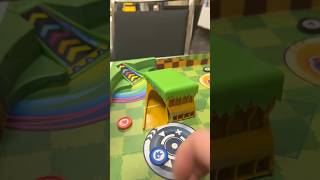
The physical quality and Sonic-themed aesthetic anchor Sonic Knock's charm. Bower's Game Corner celebrates the plastic components and custom assembly pieces that hold the 3D board together, describing them as "really stinking well" engineered. The board itself impresses visually; one reviewer grew markedly more excited upon seeing photographs of the arena, plastic pucks, and architectural features, noting the cool plastic pieces and overall presentation. For Sonic franchise fans, the nostalgia of flicking iconic characters like Sonic himself, Knuckles, and the Eggman robot across a themed board taps into childhood memory while delivering tactile satisfaction. The game functions as much as a toy to manipulate and play with as it does a traditional board game, particularly for younger audiences and casual enthusiasts.
What Makes Sonic Knock Stand Out
Impressive 3D Board Design and Plastic Components
Sonic Knock's most distinctive asset is its physical production. The foldable 3D board assembles using plastic connectors that reviewers describe as effective and elegant; the board features a spinnable Sonic loop-de-loop, spike zones, ring collection corners, and an exit ramp that players must navigate strategically. The plastic pucks and tokens feel high-quality in hand, and the overall package conveys the care invested in making this a tactile, interactive experience. This tangible quality differentiates Sonic Knock from card-driven or tile-based games and explains much of its appeal to families and casual players who value games as objects to enjoy.
Dr. Robotnik Interaction Mechanic and Power-Up Cards
The Dr. Robotnik (Eggman) token provides a clever thematic interrupt: when you hit it, you flick it at an opponent, potentially stealing a coin of your choosing from their collection. This creates memorable moments of targeted player interaction and thematic fun. Complementing this, power-up cards reward skillful flicking by granting abilities that ease your objectives or disrupt opponents. Reviewers highlight the good variety of these power-up cards and objective variations, noting that the card deck provides enough novelty to keep turns from feeling repetitive, even though the core flicking action remains consistent.
Potential Drawbacks
Weak Strategic Depth Beyond Flicking and Luck
Experienced board gamers consistently voice the same concern: Sonic Knock lacks meaningful strategic gameplay once you understand the flicking targets and coin mechanics. Bower's Game Corner explicitly states the "amount of gameplay is weak," and reviewers contrast the game's depth unfavorably against other modern dexterity titles. The card objectives are straightforward hits; the coin endgame, while unusual, boils down to moving methodically between collection zones. For players accustomed to games with branching decision trees, resource optimization, or tactical positioning, Sonic Knock can feel thin. One reviewer emphasized this is not a drawback for Sonic fans or younger players new to board gaming, but for hobbyists with extensive game libraries, the experience may feel limited.
Seven-to-Eight Player Count Becomes Miserable
The most damning criticism concerns scaling. At eight players, Sonic Knock devolves into frustration; reviewers describe it as "freaking miserable" and explicitly compare it to the notorious Munchkin experience of king-making and blocking. With seven people between your turn and the next opportunity to act, opponents can deliberately place ramps or trap you in coin-loss zones, leaving you unable to progress. The exact-coin endgame exacerbates this, extending turn order dramatically. One reviewer initially praised the eight-player capacity as a feature ("fantastic, I think you could easily play this at a 10-to-15-year-old's birthday party") but then recanted after gameplay, warning that the game "outstays its welcome" at higher counts and recommending play at three to four players for the best experience. The reviewer's own playtime assessment shifted downward once they factored in the eight-player math.
Confusing Rules Wording and Unusual Mechanics
Bower's Game Corner notes that the rulebook feels "obnoxiously large" for such a simple game, with a square fold-out design that makes finding specific rules frustrating. Some mechanics are worded in ways that invite table confusion; reviewers reported needing to puzzle out whether hitting the coin zones while knocked by another player triggers the coin loss or gain. The exit ramp mechanic itself was described as counterintuitive, with reviewers initially expecting to slide down into the ramp rather than place it flat and flick into it. While these issues resolve once explained, they create friction at first play and suggest the rulebook could benefit from clearer prose and simpler layout.
If You Enjoy Sonic Knock
Reviewers highlight Munchkin as a comparable experience, though Sonic Knock foregrounds physical dexterity over card-play chaos. Both games shine at casual tables where player interaction and moments of levity outweigh optimization. If Sonic Knock clicks for you, you likely value tactile fun, franchise nostalgia, and forgiving rules over crushing your opponents through calculated precision. The game rewards good flicking feel and lucky bounces as much as strategic insight, making it ideal for mixed-skill groups.
What Reviewers Are Saying
"If you're coming at this as a Sonic fan who doesn't play a lot of board games, I think you're going to think this is just hunky-freaking-dory and you're going to have a fun old time."
— Bower's Game Corner
"It's a bit of a chaotic dexterity game. It's not in real time, so it's not like everybody's going to be flicking at the same time, but you know, you flick and you don't always know where it's going to go and how it's going to bounce off of things."
— Grant Lyon
"The first player to successfully make it through their entire deck of cards and exit the arena will win the game in Sonic Knock."
— Tantrum House