





Harmonies: Pulse Deep Dive
What the Community Thinks About Harmonies: Pulse
Reviewers treat Harmonies: Pulse as a modest, carefully scoped addition to the abstract tile-placement puzzle Harmonies. The shared view is that this is a small expansion that layers in a new decision without reworking the base game. Game Night Picks - Pair Of Dice Paradise is the most enthusiastic voice, predicting strong demand because the expansion adds pressure in exactly the right places while leaving the original design intact. Grant Lyon describes Harmonies as a really great abstract, pretty puzzly game and calls Pulse a mini expansion that adds new cards to a system Grant Lyon already admires.
The Board Game Garden pairs a reintroduction of the base game with a look at Pulse, and focuses on the way the new cards change placement planning. BoardGameCo lists Pulse among the expansions worth watching this season, describing it as a small card pack built around a new color system and noting that a second Harmonies expansion, Crescendo, is also on the way. The agreement is strong on what Pulse is. The emphasis differs mainly on how much it matters, with Game Night Picks treating it as a likely hit and the other channels framing it as a worthwhile addition for players who already enjoy the base game.
Core Mechanics That Define Harmonies: Pulse
Pulse does not introduce a new system. It extends the two mechanics that reviewers describe as the heart of Harmonies: drafting tile groupings onto a personal board, and completing animal habitats through pattern matching. Libellud's Harmonies runs on both, and Pulse changes only the second.
Three-Color Animal Pattern Matching
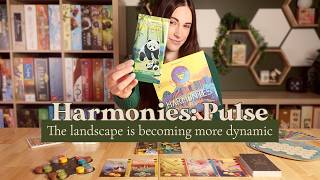
Each animal card asks a player to build a specific terrain pattern on their board. Once that pattern exists, the bottommost cube on the card moves onto the token shown there, and those cubes score at the end of the game. Pulse keeps that loop and raises the requirements. Jenna of The Board Game Garden explains that the 10 new animal cards each show three terrain types instead of two. Jenna's examples include an axolotl that needs mountain, grass, and water, and a mountain buffalo that needs water, mountain, and fields. Grant Lyon makes the same distinction, noting that the base cards carry two colors while the new cards carry three, which demands more forward planning and more pattern matching. The expansion also includes a reference card for visualizing the flipped versions of each pattern, which pairs with the mirror option that Game Night Picks highlights.
Drafting Tile Groupings onto a Personal Board
On a turn, a player drafts one of five available groupings of tokens from the central board and places them anywhere on their personal board, including stacked on existing tokens, as long as the stacking rules are followed. Those tiles form landscapes of trees, mountains, buildings, water, and fields, and players score at the end for how those landscapes are built. Jenna notes that the expansion does not change this step at all. Its effect comes indirectly, because the drafting choice now has to serve a landscape and a three-color pattern at the same time. Reviewers describe this as the central planning decision of the game.
The Harmonies: Pulse Experience
Reviewers describe Pulse as a quiet, beautiful puzzle that asks one more question on every turn. The emphasis is on absorption and anticipation rather than direct confrontation.
Calm, Absorbing Puzzle Focus
Grant Lyon praises Harmonies as abstract and puzzly yet very gorgeous, and suggests that the new cards keep that character intact. The rhythm of play is unhurried. Each turn asks the player to look at a shared market of tokens, read the patterns on their own board, and decide where the next piece belongs. The rhythm reads as contemplative rather than confrontational, with the satisfaction coming from solving a visual problem one placement at a time.
Anticipation and Forward Planning
The tension in Pulse comes from looking ahead. Jenna says the expansion "adds in a little bit more planning and anticipation of placement," which turns each draft into a question about what the board will need several turns later. Game Night Picks frames the same tightening in its own words, describing the expansion as adding pressure in exactly the right places. The constraints make a familiar game feel sharper without overwhelming it, and the payoff arrives in the moment a three-color pattern finally completes and a cube drops onto its token.
What Makes Harmonies: Pulse Stand Out
A Small Expansion That Adds Constraints Instead of Rewriting Rules
The most consistent praise is for restraint. Game Night Picks observes that Pulse "doesn't try to rewrite Harmonies" and instead "just adds a few new constraints," calling this the sweet spot for a small expansion. Jenna reaches the same conclusion from the rulebook side, explaining that the expansion leaves the base gameplay unchanged. For players who already know the original, that means a fresh puzzle layered onto rules they already understand.
Visual Presentation and Optional Mirror Patterns
Harmonies is widely described as beautiful, and reviewers extend that praise to Pulse. Grant Lyon calls the artwork very gorgeous, and Jenna highlights the visual character of the new animal cards. Game Night Picks also points to the new symmetry option that uses mirror patterns, which gives experienced players a second way to approach the same cards and keeps the expansion from feeling like a simple copy of the base set.
Potential Drawbacks
Limited Scope for Players Who Want More
Several reviewers are clear that Pulse is small. Game Night Picks calls it a small expansion, Grant Lyon describes it as a mini expansion that adds new cards, and Jenna confirms that the core gameplay does not change. Players who want a new mode or a larger shift in how Harmonies plays will find Pulse modest. BoardGameCo points those players toward Crescendo, which adds landscapes that accommodate multiple animals, new game boards, and whisper creatures.
Availability at Launch
Game Night Picks reports that at the time of recording, Pulse was available in several countries but had not yet appeared in US locations, and invites viewers to report local availability in the comments. For American players who want the expansion quickly, that means checking local retailers and online stores before assuming it is on the shelf. Reviewers do not identify any issues with the expansion's rules or components, so the concern is one of access rather than quality.
If You Enjoy Harmonies: Pulse
Players who enjoy Pulse's three-color patterns will find the most satisfaction in the base Harmonies game, which is where the landscape scoring and animal habitat cubes that Pulse builds on come from. Reviewers describe the base game as a gorgeous abstract puzzle, so it remains the natural starting point for anyone new to the line. Players who value the planning tension of matching terrain to animal cards will recognize the same satisfaction in the original, just without the added constraint of three colors per card.
Players looking for a bigger step after Pulse should watch for Crescendo, which both BoardGameCo and The Board Game Garden mention as the next Harmonies expansion. BoardGameCo describes it as adding new landscapes, new game boards, and new creatures, which makes it a more substantial follow-up than the card-only Pulse.
What Reviewers Are Saying
"Pulse is a small expansion, but if Harmonies is any indicator, people are going to be gobbling this up because this expansion adds pressure in exactly the right places by introducing 10 new animal cards using three color patterns. And Pulse doesn't try to rewrite Harmonies. It just adds a few new constraints, which can often be the sweet spot for small expansion."
— Chaz Marler, Game Night Picks - Pair Of Dice Paradise
"Well, all of the animal cards in the base game just have two terrain types on them, two colors on them. These cards all have three colors on them. So it takes a little bit more forward planning, takes a little bit more pattern matching."
— Grant Lyon
"The expansion doesn't change the gameplay of the base game at all, but does add in a little bit more planning and anticipation of placement and requires players to think a little bit more when it comes to placing out those different tokens, providing a new tactical boost to the base game of Harmonies."
— Jenna, The Board Game Garden