


Marvel Champions: The Card Game – Fear No Evil Expansion Deep Dive
What the Community Thinks About Marvel Champions: The Card Game – Fear No Evil Expansion
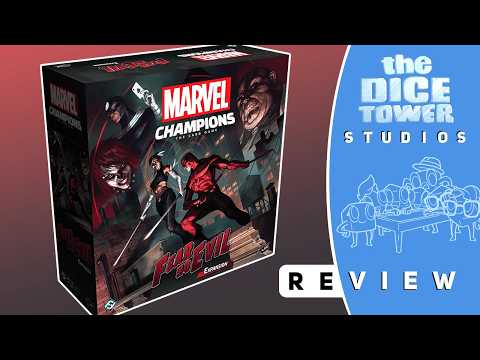
Reviewers largely agree that Fear No Evil is a strong addition to Marvel Champions. The main point of debate is how consistent the difficulty feels. Z Garcia of The Dice Tower called the expansion a tremendous box, praised the heroes, villains, and schemes as thematically on target, and gave it a 9.5 out of 10. The Dice Tower's weekly roundup in Week in Review reached a similar verdict, describing the box as worth returning to the game for if you have been away.
The reviewers who disagree do so on specifics rather than on the overall quality. The Dice Tower questioned how evenly the campaign plays out, while the hype segment on Board Stupid framed the expansion as a new starting point for players who have never tried the game, and as a soft reset for the series. slickerdrips approached the release from a different angle, focusing on the tokens, dials, and trackers designed to accompany the expansion rather than on a playthrough. That video also discloses an affiliate relationship with the token maker, By the Same Token.
Core Mechanics That Define Marvel Champions: The Card Game – Fear No Evil Expansion
Modular Scenario and Campaign Structure
Fear No Evil is built around modularity. Each scenario pairs an underling with a story, and players can combine any underling with any scheme. Z Garcia explained that you can mix any two of these things together and it will give you a story, which means the same villain can face several different plots. The underlings each play differently. Bullseye floods the table with extra boost symbols, Purple Man controls influenced minions that gain guard, Typhoid Mary flips between her two sides as players work to clear her counters, Electro discards electric charges to flip boost cards, and Hammerhead stuns anything he hits. The schemes include an art museum heist, a protection racket that shifts between locations, a getaway chase that tracks speed counters, and a Raft breakout.
The campaign layer ties these together. Several threats advance at once, and players mark ticks on the campaign tracker as they draw cards. Three ticks means a scheme has failed and leaves a lasting penalty for the rest of the campaign, while completing one grants a boon. Z Garcia noted that the campaign cards total six, describing it as one of the cleanest, least overhead campaigns Fantasy Flight Games has produced for Marvel Champions, and tied the design to the modularity introduced in the Marvel Champions: The Card Game – Civil War box, calling Fear No Evil an evolution of that system with more ideas packed into it.
Daredevil's Sense Deck
Daredevil brings a side deck of five Sense cards, one for each sense, which are set aside face up and played as though they were in hand. Each costs one and attaches to a villain, minion, or scheme. Some sense cards deal damage after the attached enemy is attacked, some reduce attacks or redirect targeting, and others reduce the cost of the next card or remove additional threat once a scheme is thwarted. Every discard sends a card to the bottom of the Sense deck, so the deck cycles through over a game. Daredevil also thwarts effectively while in his Matt Murdock alter ego, using actions tied to personas such as Foggy Nelson and Karen. Elektra's ability adds a thematic link to him: when she would take consequential damage, Daredevil takes it instead, as a force interrupt.
The Marvel Champions: The Card Game – Fear No Evil Expansion Experience
Pressure From Every Side
The campaign is designed to feel like a city under siege. Reviewers describe a steady stream of simultaneous crises, such as the heist, the prison breakout, and the newspaper takeover, that demand triage. Z Garcia described the feeling as trying to put out separate fires around the city, and noted that waiting too long on one threat hands you a permanent penalty. Most campaigns end with players completing four of the five scenarios before facing Kingpin in the finale, which Z Garcia praised for doing interesting things with the signature nemesis.
Street-Level Thematic Immersion
The expansion's strongest emotional hook is its tone. Z Garcia said the box feels like street-level heroes doing street-level things, from cops and social workers caught under Purple Man's influence to tracksuit mafia enforcers and small-scale crimes that players must stop. The Sense deck reinforces the sense of Daredevil as a blind hero who perceives the world through his other senses. For many reviewers, the theme is not decoration but the reason the scenarios feel worth winning.
What Makes Marvel Champions: The Card Game – Fear No Evil Expansion Stand Out
Daredevil's Versatility
Z Garcia described Daredevil as incredibly fun and one of the most versatile heroes in the line. Even a weak opening hand can be salvaged, because the Sense deck gives the hero a steady supply of cheap, flexible plays that can be placed on whichever enemy or scheme needs attention. Z Garcia also highlighted Daredevil's alter ego side as a strong asset, placing him alongside Gambit in terms of what he can accomplish while in that form. Many reviewers pointed to Daredevil as the hero who makes the expansion approachable for players who are not yet comfortable with more complex builds.
The Ronin Lone Wolf Concept
Elektra introduces a new archetype that rewards players for having no allies in play. Z Garcia said that the idea of going it alone and being rewarded with discounts and extra benefits is a concept greatly enjoyed, hoping Fantasy Flight Games will expand on it in future releases. Elektra's core loop, which tucks events under her and replays them with a discount, also gives the hero a distinctive identity within the Defenders lineup.
Potential Drawbacks
Difficulty That Varies Between Matchups
The most consistent criticism is that difficulty can swing wildly depending on which underling and scheme are drawn. Z Garcia reported that Purple Man paired with the Raft breakout felt near impossible on one attempt and then easy on a retry, describing the campaign beats as going up and down unpredictably. Because the campaign does not guarantee a steady ramp, the experience can feel uncontrollable at times. Players who prefer a gradual climb may find this variance frustrating, even though the modular structure is what makes the box interesting.
Solo Fragility and Elektra's Learning Curve
Each main scheme is a single card, which Z Garcia said makes solo games especially vulnerable to a sudden loss. A player can advance quickly and lose before feeling ready, and the mulligan is noted as essential for some matchups because the early round demands specific cards. Elektra adds to this concern: Z Garcia described Elektra as feeling like an expert hero from the start, with a higher skill ceiling than Daredevil, and with results that depend heavily on how well the deck is built, producing wilder swings, with some games going well and others ending in flat defeat.
If You Enjoy Marvel Champions: The Card Game – Fear No Evil Expansion
Players who enjoy the expansion's modular campaign should consider the earlier Marvel Champions: The Card Game – Civil War box, which introduced the same basic idea of mixing scenario components, and the base Marvel Champions: The Card Game, which provides the hero and villain framework that Fear No Evil builds on. Reviewers who appreciate the scenario-driven feel of Fear No Evil often also recommend Arkham Horror: The Card Game, where linked scenarios and a campaign structure are central to the experience.
What Reviewers Are Saying
"This feels like street level heroes doing street level things and stopping that kind of stuff. And I think they from a thematic point of view knocked it out of the park."
— Z Garcia, The Dice Tower
"The magnetism gives you like some nice resistance when you turn in the numbers. It's really clever."
— slickerdrips
"It is an incredible box that is is worthy of coming jumping back into the game for if you've been away."
— Z Garcia, The Dice Tower