



Looney Tunes: Hunting Wabbits Deep Dive
What the Community Thinks About Looney Tunes: Hunting Wabbits
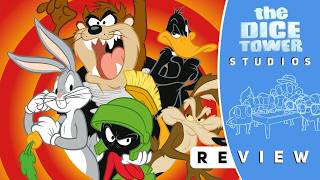
Reactions to Looney Tunes: Hunting Wabbits are sharply negative in the most detailed review available, published by The Dice Tower. The reviewers describe a card game with a straightforward rulebook and attractive components that never turns those strengths into satisfying play. Their verdict is blunt: they say the game is broken by design, and one of the hosts calls it the worst game they played that year. The two hosts differ mainly in how harsh they are, not in what they think is wrong. Both agree that the theme and production are the best parts, and both agree that the card powers leave players with very little room to make meaningful choices.
Earlier impressions from The Dice Tower were more cautious. In a Gen Con preview, The Dice Tower described the game as a competitive card game that looked light and fun, with a family weight feel, and the hosts admitted they had not researched it before the show. That early curiosity did not survive a full playthrough.
Core Mechanics That Define Looney Tunes: Hunting Wabbits
Simultaneous Card Reveals and Ordered Abilities
Each player starts with an identical deck of 12 Looney Tunes character cards, numbered one through twelve, plus a reference card that explains what each character does. Players draw three cards as their starting hand and then play one card face down at the same time. Once every card is on the table, the played cards are flipped in the order printed on the reference card, starting with Lola Bunny and ending with Bugs Bunny. The reviewers stress that this reveal order decides which abilities resolve first. Lola Bunny is revealed at the start of the round and cancels all other abilities, while Yosemite Sam removes every played card from the game so each player selects a new one. Because abilities fire in a fixed sequence, a card can have its effect wiped out before it ever resolves.
Bugs Bunny Captures and Wabbit Tokens
The scoring system runs on captures. Bugs Bunny is the highest-value card and has no ability of its own, but a player who captures the Bugs Bunny card from another player receives a Wabbit token. At the end of the game, each Wabbit token is worth two points and each card in a player's scoring pile is worth one point. The game ends when one player is down to two cards and cannot draw back up to three, and the rules include simple tiebreakers for close finishes. The reviewers questioned the token count, noting that with up to five players there is only one Bugs Bunny card in each deck, so many tokens seemed unnecessary when the points could have been printed directly on the card.
The Looney Tunes: Hunting Wabbits Experience
Chaotic Swings Where Little Sticks
Playing the game feels like a cartoon scramble. The reviewers describe nearly every round as one where cards get cancelled, shuffled away, or adjusted by something else on the table. Two players who play the same card cancel each other out, and the hosts point out that four or more players can cancel one another at once. The result is a game that the hosts say is clearly courting chaos. The tension comes from wondering which card will survive the reveal rather than from planning ahead, and the reviewers observe that a player can finish a round with almost nothing to show for their turn.
Nostalgic Looney Tunes Playfulness
The other prominent feeling is a warm, playful nostalgia. The reviewers grew up with Looney Tunes and believe the characters hold up well today. The card asks players to say each character's catchphrase when it is revealed, and the hosts laugh at the printed line that players who skip it are lame. They describe that instruction as such a 90s thing to say. That affection keeps the reviewers engaged with the table ritual and the cartoon rhythm of the reveals, even while they dislike how the cards actually play.
What Makes Looney Tunes: Hunting Wabbits Stand Out
Production Quality and Card Artwork
The most consistent praise concerns how the game looks and feels. The reviewers say the artwork is what fans would expect from Looney Tunes and that the card quality is good. The cards are large, which lets the art shine, and the hosts single out the Wabbit tokens and the magnetic closure on the box. For a game the hosts ultimately dismiss, they still acknowledge that the production is excellent and that a player would at least have attractive cards and artwork to look at during a game.
A Looney Tunes Theme With Real Appeal
The theme is the reason many people are drawn to the game, and the reviewers say it was their own reason for trying it. They describe Looney Tunes as a great intellectual property that is still fun to revisit. The hosts also believe the theme could have supported a far better design. In their view, a family weight Looney Tunes card game could have kept the same basic structure while making the character powers more interesting and giving players a greater sense of agency.
Potential Drawbacks
Almost No Meaningful Decisions
The central criticism is that players have very little agency. Because what you play is likely to be cancelled or changed by another card, choosing among three cards matters far less than the rulebook suggests. One host argues that a player could simply take the top card of their deck, play it face up, and still have a real chance to win, and the other host agrees that this is exactly what the game feels like. The reviewers say chaos is not inherently bad in a light card game, but a game that promises more than chaos still needs to give players a meaningful sense of control.
A Missed Opportunity Against Simpler Rivals
The second concern is that the game does not deliver on its promise. The reviewers acknowledge that the rule set is straightforward, but they argue it does not produce a fun experience, and one host predicts that players will leave the table with no points. They compare it unfavorably with Exploding Kittens, Uno, and Flip 7, which they describe as games without especially complex rules that still have clear, satisfying outcomes. The reviewers felt the production and basic structure could have supported a decent family weight Looney Tunes card game, which is why they see the card powers as the source of the disappointment.
If You Enjoy Looney Tunes: Hunting Wabbits
Players who want a light card game built on chaotic card effects and a clear rule set will find the closest spirit in Exploding Kittens, which the reviewers rank above this game for exactly that reason. Players who enjoy the idea of a card that disrupts other people will recognize the appeal of Citadels, where the Assassin can pick another character to stop, a mechanic the reviewers use as an example of player interaction that can sometimes frustrate people but still works as a design. Players who want the satisfaction of a simple highest card wins finish will find more meaningful choices in Flip 7, which the reviewers say is better than this game. Players who prefer quick hand management with well understood rules should try Uno, which the reviewers describe as a stronger option for the same kind of light, approachable play.
What Reviewers Are Saying
"It's not broken mechanically. It's broken by design because it's just poorly designed."
— The Dice Tower
"This is a game that clearly is courting chaos. It's not shying away from chaos. And chaos, especially in a little family weight card game, isn't necessarily bad, but you have to feel like you have some sense of agency."
— The Dice Tower
"The Looney Tune ones is like a competitive card game kind of thing. Looks kind of fun, light, family weight."
— The Dice Tower