



Pasteles Deep Dive
What the Community Thinks About Pasteles
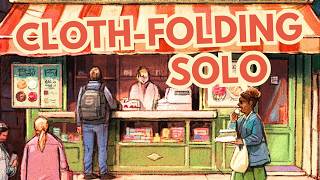
Pasteles is a solo-only game from Salt & Pepper Games about reopening a family's corner pastry shop. The channels that have covered it so far approached it from two angles: Dice Tower introduced it on its Crowd Surfing show as a Gamefound project, paired with the Conservas: Exotic Tides expansion, while Totally Tabled played a prototype copy in full. Both describe the same core hook, a cloth board that is folded before play and then covered with polyomino tiles. Reviewers were drawn to the concept even when they were unsure how the finished game would feel.
Core Mechanics That Define Pasteles
Pasteles from Salt & Pepper Games builds its play around two systems that feed each other. Covering customer requests is the first, and the money and tiles those requests produce make up the second. Totally Tabled described the design as a puzzle with two layers: the physical folding, and the economic decisions that follow from it.
Fulfilling Customer Orders With Covered Symbols
Each customer card shows the flavors they want, represented by icons such as sweet hoops, tart swirls, savory lines, and spicy and salty symbols. Those icons sit on the folded cloth rather than on the tiles, so players cover the matching symbols with polyomino pieces to serve a customer. Totally Tabled noted that a single piece can carry several of the same icon, so one placement can satisfy more than one order. Covered symbols that go unused are lost when you move to the next pastry or draw another customer, which makes every placement a commitment.
Resource Management Through Money, Tiles, and Wages
Each served customer pays out either money or tiles for your storage, and that choice sits at the center of the economy. The market token sets how many customer cards are drawn, and wages come due at the end of each day. Equipment cards add a separate risk: drawing two of the same card breaks that piece of equipment, though Totally Tabled showed that you can pay the listed cost to discard the card before the penalty resolves. Employees bring special abilities, such as letting leftover tiles be stored, or forgiving the first customer you fail to serve.
The Pasteles Experience
Cozy Pastry Shop Satisfaction
Reviewers kept returning to how well the theme holds together. Dice Tower summed up the premise as balancing customer demands, limited money, aging equipment, and an evolving recipe book, adapting your strategy with each pastry you bake. Totally Tabled framed the opening as learning on the job, with customers already lining up outside the window while the early recipes stay simple. That setup gives the game a warm, workaday feel where each completed order feels like a small win for the shop.
Tactile Puzzle Tension
The folding gives Pasteles its physical tension. Early recipes ask you to fold a cloth into a 2 by 2 or 2 by 3 square, and the rulebook sets a 30-second timer that Totally Tabled described as optional but thematic, since the orders are waiting. Later recipes layer on more steps, such as folding only a middle 3 by 3 grid and then folding two opposite sides over to produce a 3 by 5 board. Totally Tabled's own first fold went wrong, and the moment became a source of laughter as much as stress.
What Makes Pasteles Stand Out
A Folding Mechanic That Becomes the Board
The most praised element is that the cloth itself is the board. Dice Tower noted that the mat is folded like dough according to the recipe, and then the pieces go on top. Totally Tabled called the folding system "really quite clever," and pointed to the variety of fold instructions, from simple squares to a 1 by 5 strip, as a way to bring out the theme of pastry making. Dice Tower also compared the gimmick to Fold It, a speed puzzle built on a similar cloth-folding idea, while noting that Pasteles uses it for a different purpose.
Theme Integration Through Dough
Reviewers consistently tied the mechanics back to baking. Dice Tower put it plainly: the gimmick is a pastry shop, and the cloth is dough that you knead and fold. Totally Tabled said the pieces read as the ingredients you are working with, which keeps the tile placement grounded in the kitchen fiction. The game also does not judge how neat your folds look, which keeps attention on the puzzle and the orders rather than on craft.
Potential Drawbacks
Folding Takes Practice, and the Trade-Offs Are Tough
Totally Tabled called the puzzle very tricky, and the fold itself can be hard to get right under the timer. The reviewer also found the strategic choices demanding: it is hard to know how many customers to bring in each day, and hard to know when to take money and when to take tiles. Because unused covered symbols are lost, a tile that looks useful can be wasted if the next order does not match. Players who want a quick, low-stakes puzzle should expect a steep learning curve.
A Familiar Theme and Mechanic Pairing
Dice Tower was candid that the combination is not new territory. Their reaction to the reveal, "Oh, another polyomino game. Oh, another pastries," captured a sense of familiarity with both the polyomino tile puzzle and the pastry shop setting. The folding is what the reviewers singled out as distinctive, so the appeal depends on whether that gimmick feels fresh enough to offset a crowded theme.
If You Enjoy Pasteles
Conservas is the most direct link. Totally Tabled described Pasteles as a sequel to Conservas, at least story-wise, and Dice Tower's preview of Conservas: Exotic Tides describes the same solo, scenario-based structure with new seas, flavors, and locations. Players who already enjoy Conservas will recognize the solo approach and the shop management tension. Dice Tower also suggested that the expansion is aimed at players who have already played the base game a lot, so it is worth considering that audience before jumping in.
Fold It is the closest mechanical relative. Dice Tower described it as a speed puzzle that uses the same gimmick of folding a cloth to show printed symbols, and called the two very similar. Fans of quick folding puzzles will likely find the handling familiar, but Dice Tower argued that the bakery setting is what gives the folding a purpose in Pasteles.
What Reviewers Are Saying
"It's really quite clever, and I find the puzzle here very tricky. There's kind of two layers to the puzzle, because you've got to figure out this, and then you also have to figure out how to best use your tiles. It's hard to know when to take the money and when to take the tiles."
— Totally Tabled
"If you are playing a solo-based, scenario-driven game in which you have polyomino tiles and you have to run your own bakery, I am all here for [Pasteles]. No guarantee I'll like it. You never really know which games land, which ones don't, but I am very intrigued by it."
— BoardGameCo
"But if the gimmick here is it's a pastry shop and this is dough, which you are kneading and then folding."
— The Dice Tower