



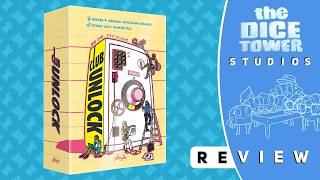
Club Unlock Deep Dive
What the Community Thinks About Club Unlock
Reviewers at The Dice Tower land on a cautiously positive verdict for Club Unlock, a safe-cracking card game designed by Jürgen Grunau and Wolfgang Kramer. The design dates to 1990, when it was released as Cash, and the Korean publisher Plate Games has brought it back in a newer edition. The hosts who review it on camera score it 7 out of 10, and the same score appears in a later roundup of short reviews, where the host calls it a solid little game that feels fresher than expected for such an old design. Nobody treats it as a standout. The consensus is that it is a light filler that is more engaging than its rules suggest, and that its limited depth keeps it from being more. One reviewer's summary captures the mood well: it is a clever enough game, it is fun, and it can be recommended, though it may not be the deepest game in the world.
Core Mechanics That Define Club Unlock
Set Collection
The foundation of Club Unlock is set collection. On a turn, a player either takes one key card into their hand or cracks one or more safes. Each safe displays colored icons on its left edge that name the key cards required to open it. Cracking a safe means returning the matching cards to their decks and keeping the safe, which scores its printed points at game end. Reviewers stress that there is no hand limit and that each color has a finite supply of 15 cards, so players must decide which colors to chase. The reviewers describe the activity as collecting colored cards and turning them in for safes, a simple loop that they say is the game's whole engine.
Push Your Luck
The second mechanic that reviewers discuss in depth is push your luck. Cracking more than one safe in a single turn earns a 10-point bonus for each safe beyond the first, which rewards players who build up a large hand before spending it. Taking the last card of a color lets a player place a bonus token on a matching safe, and claiming the final safe on the table also pays a bonus. The reviewers frame the tension directly: a player can finish a safe immediately or hold cards back for another one. The risk is that rivals may claim the safes being chased, so a player who hoards cards can end up with a hand that no longer matches any open safe. Some players respond by collecting colors that do not appear on any open safe, anticipating the moment the safes are replaced.
The Club Unlock Experience
Light, Breezy Filler
Reviewers describe Club Unlock as quick, approachable, and well suited to larger groups. The game plays fast and works well as a filler between heavier games. The box lists three to six players, and the reviewers say the game shines at higher player counts, with five and six players working especially well. Several reviewers note that the rules are easy enough to teach to almost anyone, which makes it a practical choice for mixed groups. The overall feeling is relaxed and low-stakes, closer to a pick-up game than a strategic session.
Tense Jockeying Over What to Take
Beneath the easygoing pace, reviewers describe a steady tension over what other players are doing. Because the table can see the safes being cracked and the cards being collected, a player is constantly comparing their progress against rivals. One reviewer describes sitting at the table asking whether an opponent is one card ahead, then changing course to avoid handing a safe to a competitor. The reviewers advise watching what you take, since a hand built for one safe may become useless when the table shifts. The result is a light game that rewards watching the table as much as building your own hand.
What Makes Club Unlock Stand Out
A Bonus Structure That Adds Real Choices
Reviewers single out the bonus system as the element that gives a simple game its personality. Although the rules offer little to think about at first glance, the multi-safe bonus and the last-safe bonus create real decisions on every turn. Mike Delisio draws a comparison to Ticket to Ride, noting that the bonus encourages players to gather large handfuls of cards, much as the route-building game encourages drawing and collecting. This bonus structure is the main reason reviewers rate the game above what its rules would predict.
Production Quality and Replay Value
Reviewers praise the production of this edition. The card quality is described as good, and the wooden bonus tokens are called very nice even though they are not strictly necessary. One reviewer who played the earlier Cash edition describes the new version as a clear improvement. Delisio welcomes the return of the game to circulation, arguing that it still has a place, particularly for groups that want an accessible card game with some interesting moments. For a design from 1990, that combination of updated components and a quick, teachable core is a notable strength.
Potential Drawbacks
A Thin Theme and Rules That Sound Unexciting
The most common criticism is that the rules alone do not sell the game. One reviewer recalls reading them and wondering whether there was a game at all, and admits that the first impression was that the game was not very good. Reviewers also argue that the core activity feels like familiar contract fulfillment, a pattern they say has been seen many times before. Several reviewers acknowledge that the game grows on players after a few turns, but the early experience depends on a group willing to look past a rulebook that does not sound exciting.
Limited Depth, Uno-Level Complexity, and Card Wear
Reviewers consistently describe Club Unlock as shallow compared with heavier games. One reviewer says the game does not go much beyond Uno in terms of complexity, and Delisio says it may not be the deepest game around. Players who want strategic weight will likely find it thin after a few plays. Production has a practical downside as well: reviewers say the card quality is good but recommend card sleeves, because players go through the number cards constantly during play.
If You Enjoy Club Unlock
Reviewers draw two comparisons. The first is to Ticket to Ride. One reviewer calls the game Ticket to Ride for Dummies, since players collect resource cards with no hand limit and are encouraged to keep drawing. Delisio says the game almost feels like the card version of Ticket to Ride, with the difference being the bonus for claiming multiple safes in one turn. If you enjoy drawing and collecting cards toward a set of goals, Ticket to Ride is the closest reviewer-recommended match. The second comparison is to Uno. Reviewers say the game's complexity does not go much beyond Uno, which makes it an easy choice for families or casual groups that want to move on quickly. Fans of either game are likely to find the basic loop familiar, while the safe-cracking bonuses give it a distinct personality.
What Reviewers Are Saying
"There are games where I read the rules and I go, Is there a game? And that's how I felt about this one for sure."
— The Dice Tower
"The little thing that's different here is that oftentimes you're incentivized to collect big handfuls of these colored cards, because if you can break more than one safe on a turn, it's going to get you bonus points. And the risk of doing that is that other people might come and snake the ones you've been trying to get before."
— The Dice Tower
"I went through the rules and they don't sound good. Let's try it anyway. We started playing I was like, This is not a very good game. But as it went by I was very amused by it."
— The Dice Tower