
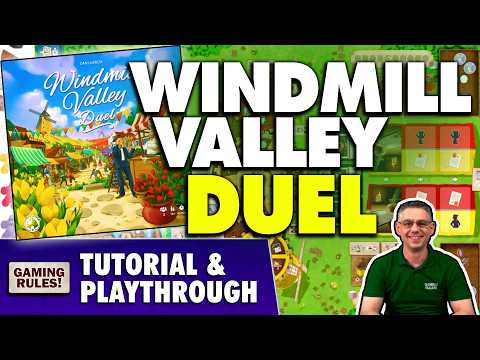







Windmill Valley: Duel Deep Dive
What the Community Thinks About Windmill Valley: Duel
Windmill Valley: Duel is a standalone two-player version of Windmill Valley, the design by Danny Garcia published by Board and Dice. Reviewers treat it as a deliberate reshaping of the original rather than a straight port, and most of the discussion focuses on how the head-to-head format changes action choice, interaction, and scoring.
The most detailed account comes from Gaming Rules!, whose host played a full game with a co-host. The channel describes the design as adding considerably more player interaction than the original, where each player was largely doing their own thing. It is positive about that change, yet it is also candid that the economy is tight and that the scoring can lead to mistakes, so its enthusiasm comes with practical warnings.
Tantrum House included the game among the honorable mentions in its Essen Spiel 2026 preview. The hosts said they rarely play two-player only games, but they wanted to try this one because they love the theme and gameplay of the original. Their interest centers on the linked dials, which appear to connect each player's wheel to the middle dial so that spinning your own affects your opponent.
Rahdo Runs Through also previewed the game without playing it. Its host described it as a head-to-head version of a design they hold in high regard and said they were curious whether the format would work. The tone is largely anticipatory: the reviewers who have played the game praise its interaction while warning about its economy, and those who have only read about it are watching to see whether the format holds together.
Core Mechanics That Define Windmill Valley: Duel
Interlocking Wheels and Opponent-Chosen Actions
Each player controls a personal wheel, and both wheels mesh with a central wheel in the middle of the board. On a turn, the active player rotates their own wheel one or two spaces, which determines the actions on offer. They then choose either the action on their own wheel or the one on the central wheel, and can spend tools to rotate further or to take both actions. The non-active player always receives the action the central wheel is showing at that moment. The calendar marker advances on triggers such as an emptied stack, a player reaching 40 points, or a fifth windmill, and once it reaches its final spot the round is completed and the game ends.
Gaming Rules! highlights the consequence of this structure: the active player is also deciding what the opponent gets to do. A market visit on the central wheel may be strong for you while also handing your rival a useful action. Reviewers say this is where the interaction comes from, because each turn asks you to read both your options and your opponent's.
Helper and Contract Farm Enhancements
Each farm enhancement card carries a helper ability on one side and a contract on the other. Playing a card onto your own side makes it a helper that gives you a bonus for the rest of the game, and the contract on its reverse scores for your opponent. Playing it onto your opponent's side reverses this, giving you the contract and handing them the helper. Gaming Rules! treats this as the design's central tension, since every helper you take is a contract your rival may cash in.
Contracts slide along a track toward the end of the play area. When one falls off the end, the other player may pay one gilder to score it; otherwise it is discarded. Example contracts in the video include two points for each patch holding at least one black tulip and one tulip of a different color, and points for each windmill next to a patch with a yellow tulip. Helper abilities trigger only on the active player's turn, a rule the hosts forgot mid-game and had to confirm.
The Windmill Valley: Duel Experience
A Contest Over Shared Tulip Patches
Both players plant into the same patches, which turns each planting action into a small negotiation. The first tulip placed in a patch can be any color, but the tulips that follow must match it, and a player can enter a patch from either edge. Gaming Rules! describes a moment where one player must fill a patch with black tulips to deny the other's contract, while the other player works to land a violet tulip beside a different color. The feeling is of two gardeners working the same field and each watching what the other is trying to grow.
Tight Money and Chained Actions
Money is the constraint that shapes most decisions. Gaming Rules! returns repeatedly to how quickly gilders run out, since buying from the market and building windmills both cost money, and many choices compete for the same coins. Once players start upgrading their wheels through market visits, actions begin to chain together. One turn can trigger several calendar movements, and then the game rushes toward its end. The channel said its filmed game ran far longer than a normal session because of this chaining, and contrasted it with a slower practice game played earlier the same afternoon. The result is a tight engine that can suddenly accelerate.
What Makes Windmill Valley: Duel Stand Out
Windmills That Score on Their Own
Gaming Rules! identifies a clear departure from the original. In Windmill Valley, violet tulips needed both of their windmills built before they scored, but in this game a single windmill is enough for the violet tulips beside it to score. Each windmill is also worth points according to what surrounds it, which gives the final scoring a layered feel. The channel's end-game walk-through ran through windmill after windmill, producing totals large enough that the printed scoring track had to be lapped.
Interaction Built Into Every Card
The second feature reviewers keep returning to is how many choices carry an effect for both players. Gaming Rules! says the design increased player interaction relative to the original. Rahdo Runs Through suggests that a game where each action also benefits the opponent is likely to appeal to players who dislike taking things away from their rival, which is a distinct appeal of the design. The helper and contract system is the clearest example, since every card you use for yourself is a card you have quietly given your opponent.
Potential Drawbacks
A Tight Economy and Complex Scoring
The economy is the most common warning. Gaming Rules! says money is always quite tight, and that the scoring can be complicated enough to produce mistakes. Planting, shipping, and building all compete for gilders, and the free market options are sometimes the only way to keep an engine running. The hosts also found that their scoring walk-through went well past the printed 80 point track, so players should expect large totals and track them carefully.
Long Sessions When Actions Chain
Length is the second concern. Gaming Rules! describes the game as normally running about an hour, but its filmed match took around an hour and a half because of the chain of upgrades and market visits. The hosts did not frame this as a flaw, but it is a caveat for anyone planning an evening around a typical session. Some rules, such as the restriction that helpers only work on your own turn, were also easy to overlook during play.
If You Enjoy Windmill Valley: Duel
Players who want to compare the two side by side should start with Windmill Valley, the original game that this duel is built from. Gaming Rules! describes the original as offering less direct interaction, so the duel is the better choice for players who want the theme and planting loop with a sharper edge. Players who enjoy Windmill Valley: Duel's interlocking wheels will find similar satisfaction in the other Danny Garcia design that Rahdo Runs Through names among its favorites, Barcelona, which the channel mentions alongside the original Windmill Valley.
What Reviewers Are Saying
"Now, this is a change from Windmill Valley. In Windmill Valley, I believe, and somebody will correct me if I'm wrong, you had to have built both of them for your violet tulips to score. But not in this game. In this game, if I've just built one of them, all of my violet tulips are going to be one point."
— Gaming Rules!
"So, I don't know. We haven't played it yet, but this seems intriguing."
— Tantrum House
"Windmill Valley's Duel, it it really focuses on when you do an action, your partner gets something. So every time you do something, your partner's also getting something."
— Rahdo Runs Through