




Deckers: Duplicity Deep Dive
What the Community Thinks About Deckers: Duplicity
Reviewers approach Deckers: Duplicity as an expansion that changes how the base game feels rather than as a separate product. The common view is that it adds a small number of new ideas, most of them centered on a double-sided Sentinel Mission Card and a wall that switches sides during play. Solo and two-player sessions both come across as demanding, with players who enjoy the base game finding the additions a natural next step while newcomers sometimes need several games before the new triggers stop getting lost in the turn structure.
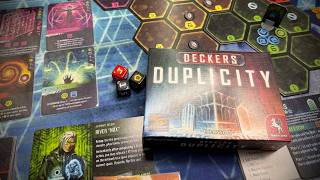
Gaming Rules! covered the expansion twice and called it a mini expansion whose small box of contents still fits inside the main Deckers box, framing it as an easy addition for anyone who already owns the base game. Box of Delights took a slower, hands-on approach, walking through a full solo session with the new Sentinel Mission Card in play. Across both channels, the tone is consistently positive, with the enthusiasm aimed squarely at fans of the existing game rather than at newcomers looking for a first introduction to Deckers.
Core Mechanics That Define Deckers: Duplicity
The Double-Sided Sentinel Mission Card
The first mechanic reviewers highlight is the way the Sentinel Mission Card, or SMC, works in this expansion. The setup choice determines which side of the card is in play, and the other side becomes the one that governs the game's special rules after setup finishes. Box of Delights walked through this using the Yanos card, explaining that the card is double-sided, with one name on each side, and that whichever side a player chooses during setup is the side that stays active in game. The key idea is that the side in play controls the threat, and that threat drives most of the decisions a player must make on each turn.
The Flipping Wall
The second mechanic is the wall, which reviewers describe as the expansion's most distinctive addition. The wall divides the network and changes the way sparks move across it. Players must plan around it because a breach has to be timed carefully, and a wall that stays up can trap programs on the wrong side. Reviewers noted that the wall is not static. It can be brought down on a turn and returns at the end of the turn when sparks remain on its spaces, so each turn has to account for the state the wall will be in at the next checkpoint. Several commentators also pointed out that the wall shares space with the existing rules for sparks and guardians, which is why the sequence of phases matters so much.
The Deckers: Duplicity Experience
Tense Planning Under Pressure
Much of the enjoyment that reviewers describe comes from a sense of pressure. Every action has a cost, sparks spread and threaten to turn into guardians, and a single missed trigger can change the outcome of the entire round. Players who enjoy careful planning find the constant trade-offs satisfying, because each decision has a visible consequence on the board. The pressure is not abstract. It shows up as a board that gets harder to manage over time, which keeps the final rounds of a session tense.
A Lot to Track
The second vibe is a feeling of being overloaded. Reviewers agree that the expansion adds enough new steps that players will forget something in the first few sessions. Gaming Rules! relied on the small tokens included with the expansion to remind the table of pending effects, and found that these reminders made a noticeable difference once the group had a few games under its belt.
What Makes Deckers: Duplicity Stand Out
The Wall Works Well
Reviewers consistently call out the flipping wall as the best part of the expansion. The mechanic is compact, it changes the geography of the network in a meaningful way, and it gives the game a fresh tactical problem without replacing the core loop. Commentators who played through a full mission described the wall as clever, and the way it flips on and off gave the session its turning points. For many players, that single rule is the reason the expansion is worth owning.
Missions and Modularity
The expansion also gives players more ways to customize the game. Gaming Rules! mentioned the two new missions, a range of other components that can be mixed with the base content, and a Blitz mode variant that drops the silver objectives to make the game quicker. That variant makes the game shorter, which many players see as a practical benefit for a title that can otherwise run long. The result is an expansion that broadens the game without forcing every group to use the full package at once.
Potential Drawbacks
A Steep Learning Curve
The most common criticism is that the expansion makes a demanding game more demanding at the start. Reviewers acknowledged that the new triggers and the double-sided setup take time to absorb, and that a first session can feel more confusing than rewarding. Players who expect a quick teach should plan for a slower introduction, even though the rules become much easier once a group already knows the core game well.
Movement and Resource Pressure
Some reviewers found that resources could run thin in the middle of a session. Because many actions depend on having the right programs and sparks in the right places, a poor sequence early in the game can make later turns feel constrained. Reviewers accepted that this is part of the intended challenge, but they also noted that it can frustrate players who are still learning the rhythm of the game.
If You Enjoy Deckers: Duplicity
Players who enjoy hacking-themed puzzle games with careful resource management and a board that changes under their feet are the audience most likely to appreciate this expansion. Anyone who already plays the base Deckers game will find the new Sentinel Mission Card and wall rules a natural extension, while players who like planning several steps ahead and recovering from setbacks will likely find the experience rewarding once the rules are familiar. Groups that enjoy games with tight trade-offs and a steady rise in pressure should also find it worth exploring.
What Reviewers Are Saying
"Yanos is a double-sided SMC. Whichever side has Yana on one side, Yanos on the other."
— Box of Delights
"It's more of a mini expansion. It's a small box, and the contents of it will fit in your main box, but it's a no-brainer for anybody who's a fan of Deckers cuz it just gives you a few extra uh more things about it."
— Gaming Rules!
"And I think it's a no-brainer for anybody who likes Deckers. It's a no-brainer because it just adds more stuff to it."
— Gaming Rules!