


Nakasendo Deep Dive
What the Community Thinks About Nakasendo
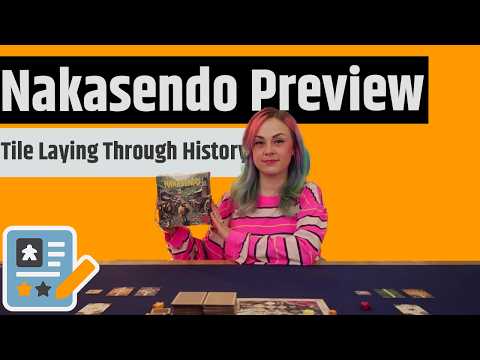
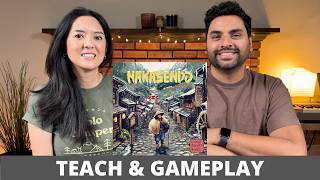
Reviewers present Nakasendo as a compact tile placement game with more long-term planning than its runtime suggests. Published by Little Rocket Games, it asks players to extend a personal route along the historic path between present-day Tokyo and Kyoto, building on a 4x4 grid and scoring as they go. The two channels that covered it were both sponsored previews. Before You Play ran a complete two-player session from setup to final scoring, while BoardGameCo walked through the rules using a prototype copy and warned that components and rules could still change.
The shared view is that the rules are quick to learn and the difficulty comes from planning. Reviewers agree that the game rewards players who keep an eye on the endgame route while still chasing points in the mid-game scoring rounds. Where they differ is in how much of the game feels like puzzle-solving and how much depends on the tiles that happen to appear. BoardGameCo's presenter found the planning rewarding, while the Before You Play hosts were more openly frustrated by how quickly a route could be blocked.
Core Mechanics That Define Nakasendo
Longest-Path Endgame Scoring
The central scoring rule is that only part of the board matters at the end. Once the final round is complete, each player traces the longest connected route through their tiles that has exactly one entrance and one exit. Only tiles on that route score discovery bonuses, terrain points, and penalties. BoardGameCo explained that a tile placed mid-game can score during the intermediate phases and still contribute nothing at the end if it falls off the route. Before You Play noted the reverse benefit: tiles outside the true route also carry no snow or bear penalties, so a dead-end tile can serve as a dumping ground. Tiles must be placed orthogonally adjacent to the existing route, and they can be rotated only so that they sit vertically in the grid, which keeps the layout tight and makes every orientation choice matter.
Reservations and Supply Denial
Each turn grants two actions, which players can spend on tiles from their own supply, on tiles taken from another player's supply, or on discovery tokens. Taking from an opponent's supply hands them an extra action token, which can be spent later for another action or held for two points at the end. Players can also reserve a tile or token from the market or an opponent's supply by placing their hiker meeple on it at the end of their turn. If the reserving player's opponent later places that reserved piece, the reserving player retrieves the meeple and scores two points. Before You Play's hosts repeatedly described this as the game's main tactical tension, because a reservation can force an opponent to either give up the piece they need or hand over two points.
The Nakasendo Experience
A Tight, Slightly Anxious Planning Puzzle
Playing Nakasendo feels like working inside a narrow corridor. Before You Play described the grid as a place where free building can quickly turn into trouble, and one host said the layout required a clear vision for the route even though the tiles arrive at random. The 4x4 limit means a poorly placed tile can close off the only remaining exit, and BoardGameCo observed that as the grid fills, players start trading away extra action tokens because they need a specific curve or direction. The result is a steady sense of pressure that builds through the middle of the game.
Playful Rivalry Over Shared Tiles
The taking and reserving rules also produce a lively back-and-forth at the table. Before You Play's players frequently teased each other about reservations, joked about being "mean" with their path choices, and openly debated whether to give the other player two points. Those exchanges make the game feel social even though every decision is a calculated one. When a tile arrives exactly where a player needs it, or an opponent's reservation finally pays off, the moment lands as a clear satisfaction, and the teasing that follows makes the tension feel friendly rather than hostile.
What Makes Nakasendo Stand Out
Discovery Tokens That Answer the Event Penalties
Reviewers praised how the discovery tokens interact with the event penalties. Temples protect the tile they sit on from bear and snowflake penalties, bells cancel bear penalties on their tile and orthogonally adjacent tiles, and wheels score a point for each snowflake on their tile and neighboring tiles. BoardGameCo pointed out that a wheel placed next to a temple lets a player collect snowflake points while avoiding the penalty. Before You Play showed the same idea in action when one player placed both snowflakes on a single temple tile and later used a second wheel to bank points from the surrounding snow. Because the event penalties can be turned into scoring opportunities, the snow stops feeling like pure punishment.
Foresight Built Into the Event Deck
The event system gives players information in advance. Each event is revealed one round ahead of when it resolves, so players always know what challenge is coming. BoardGameCo explained that snow requirements grow from one token to four across the game, while bear events always add a single bear. Mid-game scoring tokens are also visible from the start, and the round tracker shows when they will score. Reviewers saw this as a way to plan toward known deadlines instead of reacting to surprises, and that foresight makes the decision to reserve or deny a tile feel meaningful.
Potential Drawbacks
Tile Scarcity and Dead Ends
The most consistent complaint from Before You Play was that the planned route often fails to materialize. The hosts found certain path shapes rare, so a route they had visualized early in the game was blocked by the time the right tile appeared. One host described the game as tough when the needed path tiles do not show up, and the other said they had to roll with the punches. BoardGameCo's presenter also noted that a free-building approach can leave a player stuck with dead spots, which is why the game requires some foresight to avoid a dead-end route.
Limited Visibility of Standing Mid-Game
The second concern is that the scoring picture is hard to read until the end. Before You Play's players said they could not easily tell where they stood during the game and felt unsure whether they were ahead until the scoring rounds revealed the totals. That uncertainty is amplified by the endgame route rule, because a large body of tiles can look productive in the middle of the game and still score nothing at the end. Reviewers who value clear feedback may find this hard to track, although the intermediate scoring rounds give some checkpoints.
If You Enjoy Nakasendo
Neither review drew a direct comparison between Nakasendo and another named title, so the following suggestions come from the design itself rather than from the reviewers. Players who enjoy Nakasendo's longest-path endgame should look at Tsuro, where a connected path likewise determines who survives to the end rather than how many tiles a player has placed. Those who enjoy the reservation system, where claiming a piece an opponent needs can cost them two points, will find a similar denial dynamic in Through the Desert, where grabbing a camel another player wants changes the shape of the whole board. Players who value the protective discovery tokens, which turn a looming penalty into a scoring chance, may be drawn to Castles of Burgundy, where matching the right tile to the right space is what turns a liability into points.
What Reviewers Are Saying
"In Nakasendo, players are going to be primarily focused on the path that they are creating because that endgame scoring is going to be crucial. And when you have these different discovery tiles out, you're able to optimize them in a way that you're able to get a bunch of endgame scoring for yourself."
— Professor Mag, BoardGameCo
"Because that's the thing. I think for the longest time I was really trying to just take discovery tokens that were going to match the terrain type. But I think at the end, even if it doesn't match, as long as it's scoring you, you know what I mean?"
— Before You Play
"I couldn't tell where I stood like in the game. I was like, I think I'm doing okay."
— Before You Play