
Game Info
Year
1909
Players
2
Age
12+
Playtime
20 min
Publisher
H.P. Gibson and Sons
Collection
Ratings
Creator Score
Mechanic profile
Waiting on more creator content
Vibe profile
Waiting on more creator content
Description
A classic hidden-rank wargame in which two armies of ranked pieces try to capture the opposing flag and the direct ancestor of Stratego
Featured Videos

Ask a Rules Question
All mentions
Browse transcript mentions, sentiments, pros/cons, mechanics, topics, quotes, and references.
Total mentions: 1
This page: 1
Sentiment:
pos 1 ·
mix 0 ·
neu 0 ·
neg 0
Showing 1–1 of 1
Video ax6MwN6GnNU
BoardGameBollocks Review at 0:19 sentiment: positive
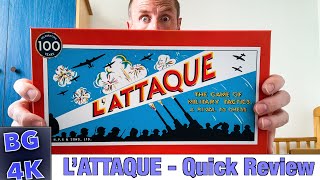
Click to watch at 0:19 · YouTube ↗
Overall sentiment (raw)
positive
Pros
- Still in print after 100 years, morphing into Stratego but preferred for its simpler, bare-bones approach and historical theme.
- The hidden information element creates suspense and strategic depth, with information gradually revealed.
- Exciting to see powerful units decimate weaker ones, leading to satisfying moments of overwhelming an opponent.
- The setup is a critical 'game within a game' that profoundly impacts strategy and requires anticipating the opponent.
- A good alternative for those who enjoy classic games like Chess and Draughts.
Cons
- Losing your Sappers makes it very difficult, if not impossible, to win if the opponent has mined their flag, as there's no clear rule for this scenario.
- Towards the end of the game, turns can become monotonous with simple forward movements as the board empties, reducing fun.
- The board's appearance is described as uninspired, lacking terrain or artwork, and looking like a photocopy.
- There's a risk of accidentally knocking over pieces when moving them, which can reveal information and ruin the game.
Thematic elements
- First World War army theme
Comparison games
Mechanics (from transcript analysis)
- Area Movement — Units move on a grid of squares. Scouts can move any number of orthogonal spaces, while most other units move one space orthogonally. No diagonal movement is allowed.
- Hidden Movement — Each player sets up their army with unit ranks facing away from the opponent, concealing their identity and position.
- Minefield — Mines are placed on the board and cannot be moved. Only Sappers can destroy mines; other units are destroyed if they move onto a mine.
- Objective Capture — The primary goal is to capture the opponent's flag.
- Rock paper scissors combat — When units engage, the piece with the higher rank (number) destroys the enemy piece, which is then removed from the board. This is described as a 'little bit of basically rock paper scissors'.
- Special unit abilities — Sappers are the only units that can destroy mines. Spies are the only units that can capture the Commander-in-Chief.
Video topics + discussion points
No key topics recorded for this video.
Quotes (from this video)
- We're going to be talking about L'Attaque and this is a game where you will be assuming the role of like an army commander you'll be sending their troops and bow you'll be doing a little bit of basically rock paper scissors in order to capture the enemy flag and eventually win the game.
- The setup is fundamental to the success or failure of your strategy and the more you play this game you'll find that this is a game within a game.
- It's dated but that's the point this is a museum piece and we do still love it dearly after nearly 40 years.
References (from this video)
No references stored for this video.
Transcript Navigation
Showing 1–1 of 1