


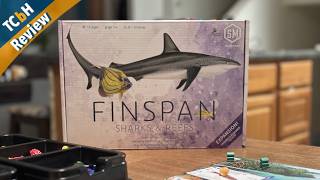













Finspan: Sharks & Reefs Deep Dive
What the Community Thinks About Finspan: Sharks & Reefs
Finspan: Sharks & Reefs arrives as a confident expansion that reviewers consistently praise for adding meaningful depth without reinventing the base game. The Hungry Gamer and other community channels emphasize that the expansion strikes an ideal balance: it introduces engaging new mechanics through coral reef building while maintaining the accessibility that makes Finspan the easiest entry point among the Span family of games. Across reviews, a strong consensus emerges that this is a must-have addition for Finspan players, though reviewers also note it will appeal most strongly to those who already enjoy the core game's design philosophy. Where reviewers do diverge is on teaching strategy with newcomers, with Tabletoptiktok suggesting the expansion might be best reserved for a second play with casual gamers, while other channels recommend including it from the start for experienced hobby players. The overarching sentiment, however, is unified: Sharks & Reefs is an excellent expansion that enhances rather than complicates.
Core Mechanics That Define Finspan: Sharks & Reefs
Coral Reef Building
The heart of this expansion is a new resource: coral tokens in three distinct colors (blue, green, and purple) that players place on reef overlay tiles as their diver descends through the ocean zones. When a diver reaches the reef section during a dive, players may pay various costs (an egg, a young fish, or a discarded card from hand) to place a coral token on their designated reef. The genius of this system, as Stonemaier Games designer Jamie explains, is that each coral token is worth one point at the end of the game, but completing an entire reef section (six tokens matching in color) awards bonus points, encouraging long-term planning. Reviewers highlight that coral tokens feel like natural extension of Finspan's existing resource economy, neither overwhelming beginners nor boring experienced players. The coral mechanic transforms early-game turns that might otherwise feel slow into opportunities for meaningful progression toward end-game scoring, addressing a historical critique of the base game.
Sharks as Mechanical Disruptors
Shark cards introduce a fresh thematic twist on the feeding mechanic. Rather than simply consuming smaller fish for straightforward advantage, sharks scatter schools in dramatic fashion. When a shark's ability triggers, the player discards a school token but places four individual young fish across different slots on their player mat. The counterintuitive payoff: trading one school (worth six points) for four young fish sounds risky until players realize those young fish may immediately form new schools based on placement, or fuel future strategy. Grant Lyon notes that sharks "can scare away schools of young fish and leave behind food scraps that any fish in the ocean can consume," capturing the thematic elegance. Reviewers, particularly the Hungry Gamer's Original Don, found this mechanic genuinely clever, describing how the shark abilities rewarded experimental deck-building even when the strategic math wasn't obvious at first glance. The sharks exemplify how the expansion layers thematic storytelling onto mechanical innovation.
The Finspan: Sharks & Reefs Experience
A Modular Feel Without the Complexity
Across reviews, a consistent phrase emerges: this expansion feels like a module you add to your game, not a reinvention. The Hungry Gamer articulates this precisely, noting that "it doesn't feel like you're suddenly playing a different game" and that the added layers bring "a little more nuance without dramatically changing the game." Tabletoptiktok echoes the sentiment, saying it feels like you already know Finspan and now "get to do a little bit more." Players report that teaching the expansion to experienced hobby gamers requires only a brief explanation of coral placement and the new fish abilities. The component quality from Stonemaier Games is evident throughout the unboxing reviews from The Mill, where everything slots neatly into the base game box, creating a seamless integrated experience.
Growing Your Mat While You Play
A subtle but consistent source of satisfaction reviewers mention is the visual and tactile joy of building your coral reef as the game progresses. Jamie from Stonemaier Games describes feeling "good to complete those core reefs" and notes that the expansion "makes the mat even more colorful because you're kind of growing your mat with these reef tokens while you're playing." This real-time visible progress transforms the player mat into a dynamic canvas rather than a static scoring track. The three distinct colors of coral, which The Mill reviewers note are color-coded and thematically distinct (the purple tokens resemble brain coral), create an aesthetically satisfying arc as reefs grow and diversify across a game.
What Makes Finspan: Sharks & Reefs Stand Out
Thematic Coherence in Mechanical Design
The expansion demonstrates exceptional restraint in how it weaves theme into mechanics. Rather than bolting on flavor text, every system serves thematic purpose. Coral-dwelling fish genuinely require coral presence to play. Sharks behave like predators that disrupt schools. Reef overlays slot into the ocean's bathic zones where coral naturally grows. Tabletoptiktok praises this explicitly, calling it "an excellent expansion to the game in my opinion because it adds something that's really interesting to the game with the coral edition and with some new abilities, but it doesn't change the game in such a fundamental way that you feel like you have to relearn it." This restraint is the expansion's greatest strength: it respects the base game's elegant design while genuinely expanding player agency.
Substantial Content Without Bloat
Grant Lyon highlights that "this one is really one of those expansions that's just adding a lot more content to the game." The expansion includes approximately 75 new fish cards, five new starter fish, three double-sided goal tiles, new achievement objectives, updated solo cards for Automa play, and the entire coral token system. Yet none of this feels gratuitous. Reviewers consistently note that the deck size increase allows for greater variety across plays without demanding more decision-making per turn. The components are generous but purposeful: the new card tray doesn't replace the original; both fit side-by-side in the base box, leaving room for future expansions. This forward-thinking design philosophy is evident even in the expansion box itself, which Stonemaier Games designed as a temporary shipping container, not a permanent storage need.
Potential Drawbacks
Not for Players Indifferent to Theme
While reviewers are enthusiastic, they acknowledge the expansion's appeal is theme-dependent. The Hungry Gamer makes the point directly: if you have no investment in fish as subject matter, Finspan itself may not grip you, expansion or not. The expansion adds new fish with charming and sometimes silly names, but it doesn't change the fundamental fact that you're building an underwater ecosystem. This is more an observation about Finspan as a whole than a criticism of the expansion, but it's worth noting for players whose enjoyment of games hinges on mechanics divorced from theme.
Risk of Overvaluing the Shark Mechanic Early Game
The shark ability to scatter schools initially presents a psychological hurdle. Giving up a school token worth six points to place four young fish feels like a loss until the arithmetic of board positioning becomes clear. While reviewers found this eventually clever, a few noted that early plays with sharks can feel trap-like if players don't understand the payoff matrix. This is less a design flaw than a skill curve, and it dissipates once players grasp the mechanic's true value in unlocking board positioning and school reformation options.
If You Enjoy Finspan: Sharks & Reefs
Players drawn to the accessible elegance of Finspan will find similar satisfaction in Wingspan, the designer's original "Span" game, which shares the row-activation system and ecosystem-building theme. Wingspan adds bird identification and geographic territory as additional layers, making it richer but denser than Finspan. For those who enjoy the simpler, faster flow of Finspan, the Hummingbirds in the Americas expansion for Wingspan offers a comparable design philosophy: thematic additions that enhance without overwhelming. Wormspan, the third game in the family, introduces worm-building mechanics that feel quite different mechanically, though it shares Finspan's commitment to a natural theme executed with elegant restraint.
What Reviewers Are Saying
"It doesn't feel like you're suddenly playing a different game. And I mean that in a good way. It's a little more nuance without dramatically changing the game. It gives you more tags on the cards. It gives you the sharks that eat the other fish, which is already a thing, but they do it in a different way. And then the reef part, it kind of gives you something to do, especially early game, when you haven't quite populated the card rows and so there are those dead spaces as you're going down."
— Hungry Gamer
"It feels like, okay, I know Finsspan, I now get to do a little bit more. It's kind of how I feel about the Hummingbirds in the Americas expansion for Wingspan, that it's not changing the entire game, but it's giving me a little bit more that's making the game a little bit better."
— Tabletoptiktok
"Feels good to complete those coral reefs. It makes the mat even more colorful because you're kind of growing your mat with these reef tokens while you're playing. So yeah, I hope you have fun exploring Finsspan Sharks and Reefs."
— Stonemaier Games