





Super Chonk Deep Dive
What the Community Thinks About Super Chonk
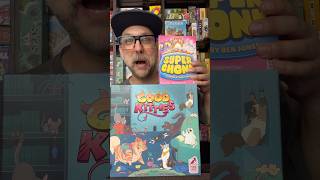
Reviewers across the board see Super Chonk as a refreshing palate cleanser in an increasingly crowded space of cat-themed board games. The game strikes a consistent chord with viewers looking for something light and absurdist. While some members of the community acknowledge a degree of cat-game fatigue in board gaming generally, reviewers of Super Chonk specifically praise the game's willingness to embrace silliness without apology. The Dice Tower and kovray both highlight the game's comedic appeal, while Neon Gorilla emphasizes the straightforward accessibility and social energy it brings to the table. Tantrum House positions it as the lighter companion to Pink Hawk Games' more complex cooperative offering, Good Kitties, noting that Super Chonk delivers all the charm with a fraction of the time investment.
Core Mechanics That Define Super Chonk
Simultaneous Speed Selection and Bowl Racing
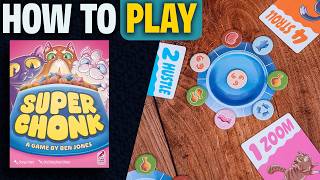
Each turn, cats choose a speed card (one through four) and secretly decide which kibble bowl to race toward. The faster you run, the fewer bites you can collect, but speed can be a tactical advantage when destinations are contested. When all players are ready, they meow in unison to reveal their choices. This creates moments of comedic chaos as cats discover who else targeted the same bowl. Neon Gorilla's pitch makes this mechanic sing: players "meow meow meow, drop on the bowl, figure out who eats first, everything like that, so we can all get our food." The designer has engineered the social element directly into the core action, turning simultaneous revelation into performance.
Collision Penalties and Kibble Accumulation
If two cats choose the same speed at the same bowl, they collide head-on and neither gets to eat. Instead, "the humans will feel bad and give us a sad treat from the bag," as Neon Gorilla explains. This creates a push-your-luck tension where greed must be balanced against the risk of blocking yourself. At game's end, players tally their kibble, but there is a twist: if you ate too much of one food type in a single turn, you throw it all up, losing the entire stack. The Dice Tower captures this perfectly: "So don't gorge yourself on one type of food." This final scoring wrinkle transforms the entire endgame math and prevents runaway leaders from coasting to victory on a single lucky turn.
The Super Chonk Experience
Farcical Absurdism and Group Laughter
The game's core appeal rests on its commitment to comedic bits. The meowing is not incidental flavor text; reviewers consistently highlight it as a centerpiece of the experience. Players are physically encouraged to participate in collective cat noises, which lowers social barriers and creates immediate in-game hilarity. The collision mechanic creates genuine moments of surprise and shared reaction, while the vomiting penalty is played entirely for laughs. Neon Gorilla's delivery of the concept sells the tone perfectly, treating the cats' desire to become "super chunky" with the solemnity of a competitive sport while the actual mechanics undermine that pretense at every turn.
Quick Pacing and Lightweight Social Play
Super Chonk lives in the space between party game and traditional board game, where the rules are simple enough to teach in seconds but the social energy carries the experience. Tantrum House explicitly positions it as a "quicker card game," suggesting playtimes well under an hour. This brevity allows for multiple rounds without commitment, and the high-variance outcomes (collision penalties, vomiting, speed luck) keep each round fresh. The game is designed for people who want the social spark of gathering around a table without the cognitive or time investment of heavier strategy play.
What Makes Super Chonk Stand Out
The Meowing Reveal Mechanic
Few games ask players to vocalize as part of their core action sequence. The meowing creates an immediate sensory marker for Super Chonk's unique identity. Every reveal becomes a performed moment, and the timing of when players stop meowing (when the last holdout commits) adds emergent comedy to what could have been a silent card flip. This mechanic costs nothing in terms of components but generates outsized social friction and engagement. Neon Gorilla's emphasis on "I'm going to meow. And then I'm going to keep meowing. If someone can't make up their mind, I will just keep meowing at them" shows that the meowing is interactive, not decorative.
The Vomit Twist as an Elegant Scoring Constraint
Most resource-racing games reward pure accumulation. Super Chonk punishes it through a single, memorable mechanic: eating too much of one kibble type causes you to throw up, negating the largest stack. This shifts the entire endgame strategy from "collect as much as possible" to "diversify your diet." The Dice Tower's reaction underscores how elegant this is: it is funny enough to land as comedy, but mechanically substantive enough to matter. No player wants to be the cat who gorged and vomited, making the penalty psychologically impactful beyond mere point loss.
Potential Drawbacks
Genre Saturation in the Cat-Game Market
The Dice Tower explicitly acknowledges this concern, with one host stating flatly, "Cats are doing it. This is from Pink Hawk Games... a lot of cat games today. And I'll be the first one to say it. I'm sick of them." Super Chonk arrives in a landscape already crowded with feline-themed titles, which may diminish its novelty factor for some audiences. While the game itself stands on its own merits, players fatigued by the cat-game trend may pass before giving it a chance.
Simultaneous Reveal Luck and the Collision Mechanic
The simultaneous-action structure means that much of your success depends on predicting or accidentally avoiding other players' choices. A well-timed collision can tank your score for the round, and since the game rewards speed diversity but penalizes destination clustering, there is a fair amount of luck in the mechanics. If players at your table skew heavily toward the same strategies or adopt predictable speed patterns, the game can feel less like a race and more like a lottery. This may frustrate players seeking deeper strategic depth, though the brevity of the game and the option to play multiple rounds mitigates this concern.
If You Enjoy Super Chonk
Super Chonk's strength lies in its combination of simplicity and social theater. Players drawn to party games like Wavelength or Fake Artist Goes to New York will appreciate how Super Chonk uses a minimalist ruleset to create maximum social friction and laughter. Those who enjoy the push-your-luck tension of games like Get Bit or Skull will find similar moments of bluffing and timing, albeit in a lighter register. For players who loved the whimsy and cat-themed theming of Pink Hawk Games' Pirates of the High Tease, this offers a faster, more chaotic sister game in the same design spirit.
What Reviewers Are Saying
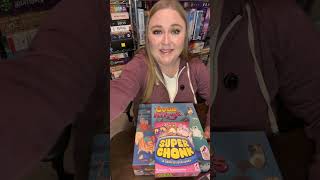
"So in Super Chonk we are cats who just want to get super chunky. So every turn we're going to race towards the food bowls and try and get as much kibble into our tummy so that we can be the chalkiest cat at the end of the game. You're going to choose which speed you want to run, where one is the fastest and four is the slowest. But these are also how many bites you can fit in your mouth when you go."
— Neon Gorilla
"I'm going to secretly choose which card I want to play and which bowl I want to eat at, and when I'm ready, I'm going to meow. And then I'm going to keep meowing. If someone can't make up their mind, I will just keep meowing at them."
— Neon Gorilla
"Super Chunk is a quicker card game about cats trying to eat as much as possible. And we've got a play-through coming up so you'll be able to see both games in action on our YouTube channel."
— Tantrum House