




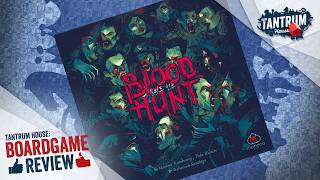

Blood Hunt Deep Dive
What the Community Thinks About Blood Hunt
Blood Hunt arrives in a unique position: it is simultaneously a reimagining of an admired predecessor and an accessible gateway to a beloved but hard-to-find game. The community consensus is warm but measured. Reviewers across Board Stupid and Tantrum House see Blood Hunt as a thoughtful expansion of Dracula versus Van Helsing that succeeds in its core mission: scaling an intimate two-player experience up to four players while maintaining the core identity that made the original compelling. The game benefits from Weberson Santiago's striking artwork, a distinctive aesthetic that draws immediate attention. However, some reviewers openly question whether the expansion justifies itself as a standalone purchase, especially for those fortunate enough to own the original two-player game. The game finds its strongest advocates among players seeking an easier-to-acquire title that shares the mechanical DNA of its predecessor while lowering the barrier to entry through its reduced rarity and more accessible player count.
Core Mechanics That Define Blood Hunt
Card Powers and District Control
Blood Hunt's primary system revolves around drawing and deploying cards across multiple districts of a city. Each turn, players draw a card and face an immediate choice: play the card for its special power, or place it facedown in one of the city's districts. This dual-use system creates constant tension between immediate tactical advantage and long-term board control. When a district accumulates four or more cards, it resolves: the cards are revealed, and the player with the highest-value card wins the citizen tokens from that district, representing the successful vampire's hunt for blood. The designer, who also created Dracula versus Van Helsing and Saucy Sea Salt and Paper, refined this core mechanism from the original two-player design. Reviewers note the card powers add meaningful moment-to-moment decisions without overwhelming players, making Blood Hunt feel both strategic and straightforward.
Hidden Information and Simultaneous Gameplay
The second pillar of Blood Hunt's design is information control. Because cards placed in districts remain hidden until a district resolves, players must reason about their opponents' intentions based on incomplete data. Which districts are rivals investing in? When should you trigger a resolution to catch an opponent off-guard? This hidden-information layer transforms the game from pure statistical optimization into something resembling trick-taking, though without the formal trick-taking structure. Players manage their hands in secrecy, building toward payoffs that may take several rounds to materialize. The mechanic creates space for bluffing and misdirection, allowing skilled players to manipulate when and where conflicts occur. This system scaled successfully from the two-player head-to-head dynamic into a four-player multiplayer free-for-all, where territory becomes more fragmented and alliances more fleeting.
The Blood Hunt Experience
Predatory Multiplayer Tension
Blood Hunt captures the vampire fantasy through emergent gameplay rather than heavy thematic layering. Players are competing for influence over a quiet town's citizens, each hoping to build a coalition of followers to sustain themselves. The image of multiple vampires descending on the same districts creates a predatory, chaotic energy. Reviewers describe the experience as one of constantly jockeying for advantage while watching opponents' plans materialize before your eyes. The game's relatively short runtime (30 minutes) means the tension never overstays its welcome; the hunt concludes before frustration sets in. The multiplayer nature amplifies the feeling of scarcity and competition: there are only so many citizen tokens to claim, and rivals move quickly to block your path or outbid your offers. This competitive pressure is the heart of the experience, creating moments where players feel the weight of their decisions.
Light, Approachable Strategy
Despite its tactical depth, Blood Hunt presents itself as an inviting game that does not demand extensive rules overhead or lengthy table talk. Reviewers frequently note that the game's accessibility is one of its strengths, particularly compared to the predecessor it spins off from. Players grasp the card-playing and district-placement system within a single round, and the rule set remains stable throughout the game. There are no surprise mechanics or hidden scoring conditions that subvert player understanding. This clarity allows new players to focus on strategy rather than parsing instructions. Reviewers appreciate the low cognitive load paired with meaningful decisions, making Blood Hunt suitable for both casual and experienced gaming tables. The half-hour playtime reinforces this feeling: the game feels like a delightful appetizer rather than an all-consuming commitment, perfect for players seeking something lightweight but engaging.
What Makes Blood Hunt Stand Out
Accessible Scaling from a Celebrated Predecessor
Dracula versus Van Helsing is widely regarded as a gem in the two-player card-game landscape, but its scarcity is legendary: reviewers from both Board Stupid and Tantrum House describe it as nearly impossible to acquire, particularly outside of specialist markets. Blood Hunt addresses this bottleneck by licensing the core design and expanding it to accommodate two to four players. By opening the game to larger tables, it democratizes access to the mechanics players loved in the original. Reviewers see this as Blood Hunt's clearest value proposition. For players intrigued by Dracula versus Van Helsing but unable to locate or afford a copy, Blood Hunt offers a legitimate alternative that preserves the design's essence. The same designer stewarded both games, ensuring mechanical continuity. Moreover, by reducing the game to a two-to-four-player format rather than strictly two players, Blood Hunt creates a different social dynamic, appealing to players who prefer multiplayer chaos over intimate duels.
Weberson Santiago's Distinctive Artwork
Weberson Santiago is widely recognized in board gaming circles as an elite artist, and Blood Hunt showcases their unmistakable style. Reviewers consistently highlight the artwork as a primary draw, describing it as striking and immediately attention-grabbing. The visual design sets Blood Hunt apart on shelves crowded with competent but visually forgettable games. Santiago's work creates a thematic coherence that elevates the vampire fantasy without requiring heavy mechanical theming. The aesthetic appeal extends beyond pure aesthetics; it signals that the game was crafted with care and attention to presentation, suggesting a designer who cared about every element of the player experience. For many purchasers, the artwork alone justifies picking up a copy, and reviewers note that the box art and card designs will drive initial interest even among players unfamiliar with the Dracula versus Van Helsing lineage.
Potential Drawbacks
Incremental Rather Than Revolutionary Expansion
While reviewers appreciate Blood Hunt's faithful scaling of its predecessor, some note that the expansion feels more evolutionary than transformative. The core systems transplant directly from Dracula versus Van Helsing with relatively minor tweaks to accommodate additional players. One reviewer openly asks whether the game is different enough to justify ownership for players who already own the original. The four-player mode does introduce new strategic variables, but the fundamental card-playing and district-placing loop remains unchanged. This conservatism is a trade-off: it preserves what made the original work, but it also means Blood Hunt does not offer a dramatically new experience. Players seeking bold innovation or a substantial design evolution may find themselves underwhelmed by what amounts to a multiplayer variant of a beloved game rather than a wholly new design.
Reliance on Predecessor's Reputation
Blood Hunt rides significantly on the coattails of Dracula versus Van Helsing's positive reception. For players unfamiliar with the original, Blood Hunt must prove its worth as a standalone title based on its own merits. While the game succeeds mechanically, reviewers note that much of its appeal derives from solving the scarcity and accessibility problem posed by its predecessor. New players encountering Blood Hunt without knowing Dracula versus Van Helsing's cult status may not grasp why this particular two-to-four-player card game deserves attention among countless competitors. The game lacks the prestige or legacy weight of the original, and it cannot claim to be a necessary purchase for players content with other card-game options. Additionally, as more copies of the original Dracula versus Van Helsing circulate in the secondary market, the relative urgency of acquiring Blood Hunt as a substitute diminishes. The game must ultimately stand on its own mechanical merit rather than simply serving as a proxy for a harder-to-find classic.
If You Enjoy Blood Hunt
Players drawn to Blood Hunt's card-play mechanics will find significant satisfaction in Dracula versus Van Helsing, the predecessor that inspired it. While Dracula versus Van Helsing is strictly a two-player head-to-head duel, it refines the core card-power and district-placement systems into their purest form, rewarding players who have mastered Blood Hunt's fundamentals. The asymmetric player roles (Dracula versus Van Helsing) create a thematic richness absent from Blood Hunt's symmetric four-vampire framework, making the original feel like a deeper dive into the vampire fantasy for those seeking it.
Players interested in other designs from Blood Hunt's designer should seek out Saucy Sea Salt and Paper, which shares the same creative vision but explores entirely different mechanics and themes. This title demonstrates the designer's range beyond vampire-themed card games, offering another avenue for fans looking to explore what the design team can accomplish beyond the Dracula versus Van Helsing template.
What Reviewers Are Saying
"Bloodhunt is a spin-off of Dracula versus Van Helsing, where you're competing for influence over the citizens of a quiet town while secretly managing your hand of cards and trying to claim the right combination of citizen tokens."
— Tantrum House
"One of my favorite artists in the board game space is Weberson Santiago. And whenever I see that sort of unmistakable art style, I'm like, 'Oh, what is this?'"
— Board Stupid
"It is an expanded version of Dracula versus Van Helsing, if you're familiar with that. Basically, you have cards in a display. People can't see what cards you have, but they are tied to a specific region on the map."
— Tantrum House