






Dragon Overload Deep Dive
What the Community Thinks About Dragon Overload
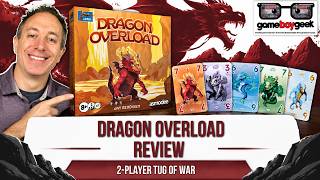
Dragon Overload is a two-player card game from Lookout Games, distributed in North America through Asmodee, in which players commit elemental dragons to five landscapes and compete for majority control. Reviewers consistently present it as a quick, light game with more strategic weight than its rules suggest. TheGameBoyGeek described it as excellent for players who have not played many hobby board games, while still offering enough depth that experienced gamers will enjoy it as well.
Opinion is favorable but varies in detail. The most thorough analysis comes from TheGameBoyGeek, who spent most of a video walking through the rules and the reasoning behind each decision. Ryan and Bethany Board Game Reviews encountered the game through a rundown at Gen Con and called its push-and-pull mechanism interesting. The Dice Tower team played it during a Wednesday evening session and described the match as very intense.
Core Mechanics That Define Dragon Overload
Five Elemental Tug-of-Wars
Each of the five suits represents an element, numbered one through nine, and each suit has its own terrain. TheGameBoyGeek described the whole game as a set of small tug-of-wars running at once. Cards are placed on each player's side of a terrain, and whichever player has the higher total there will claim that element at the end of the game. The reviewer highlighted a doubling rule as the mechanism that keeps the contest interesting: if one player has double or more the total of the other on a terrain, that terrain flips to the other player. A player who holds all five elements at once wins immediately.
Face-Up Matching, Face-Down Bluffs, and the Forced-Play Rule
On a normal turn, a player plays a card face up onto the terrain that matches its suit. The card that had been on top of that terrain goes to the opponent's hand, so every placement hands the rival a card they may be able to use on their next turn. TheGameBoyGeek described the resulting standoff as a game of chicken, where neither player wants to feed the other a strong card and both eventually give way. Each player may also play a card face down up to three times per game. A face-down card can be a real card or a bluff, and it does not have to match the terrain it is played on. If a bluff is revealed at game end, it is simply discarded. The reviewer also stressed the forced-play rule: a player who cannot make a legal play on their turn loses immediately.
The Dragon Overload Experience
Reading the Table and Tracking Hands
TheGameBoyGeek emphasized that the game rewards players who track what their opponent has taken. Picking up a seven, for example, lets a player work out which totals the opponent can reach on their next move, and that calculation shapes whether a low-value play is safe or whether it invites a doubling. Each decision reshapes the options available to the other player, so the experience is built around anticipating responses rather than simply responding to them.
Timing is a major part of that anticipation. Reviewers noted that holding face-down cards until later reduces the risk of being boxed in with no legal play, because a face-down card can be placed in places a matching card cannot. The reviewer described this as a constant push and pull between keeping options open and committing to the board.
Tension Built on Restraint and Bluffing
Several of the most discussed moments involve holding back. TheGameBoyGeek described waiting on a strong card rather than playing it into an unfavorable terrain, and described sometimes offering an opponent a powerful card so that they overcommit and hand over a terrain. These choices are where the bluffing comes in, since a face-down play forces the opponent to wonder whether a high card is real. The Dice Tower team reported that their session was very intense, and Ryan and Bethany Board Game Reviews noted the unusual idea of pushing cards into an opponent's hand as a central mechanism.
What Makes Dragon Overload Stand Out
Depth From Simple Rules
The most repeated praise is for how little the rules demand. TheGameBoyGeek summarized the core turn as playing a card and letting the opponent draw from the choice that was made, then argued that this simple structure produces a great deal of strategy and tactics. TheGameBoyGeek compared the game's accessibility to Ludo, saying a person who has only played Ludo could learn it quickly, while the depth on offer is far greater than that comparison suggests.
Two-Player Tension and Clear Win Conditions
TheGameBoyGeek said they love two-player games that have immediate win conditions, and Dragon Overload has two. The first is holding all five elements, which ends the game at once. The second is the forced-play rule, which can end the game for a player who has boxed themselves into a corner. Because both conditions can arrive without warning, the reviewer described each turn as carrying real weight, and the game as one that keeps both players engaged from start to finish.
Potential Drawbacks
The Memory Requirement
TheGameBoyGeek's main reservation concerns the memory element. Players must watch what their opponent takes, and when those cards are not revealed right away, they have to remember what the opponent may still hold. Toward the end of the game, that memory can decide the outcome. The reviewer said they do not generally love memory elements in games, but felt that this one works because the game is short enough that the burden stays manageable.
A Tight Endgame and Forced Plays
Because players can commit several of their three-card limits to a few terrains, the forced-play rule can become a sudden threat late in the game. TheGameBoyGeek noted that when neither player wins outright, the game often comes down to one final terrain, where the result depends on what each player remembers or can infer about the other's hand. The reviewer framed this closing tension as part of the appeal, but it does place heavy weight on the last few turns, and players who prefer steadier scoring may find it demanding.
If You Enjoy Dragon Overload
Ryan and Bethany Board Game Reviews said Dragon Overload looks a little like Lost Cities, a comparison that points to a similar two-player feel built on card decisions that carry consequences beyond the current turn. Players who enjoy bluffing, hand reading, and quick matches with sharp endings are likely to find the game appealing. TheGameBoyGeek's emphasis on agency and on being able to teach the game to almost anyone suggests it also suits mixed groups where one player is new to hobby games.
What Reviewers Are Saying
"There's so many layers of depth to this game that it has no business having for how simple it is."
— TheGameBoyGeek
"You actually push cards to your opponent's hands. Pretty interesting mechanism. It sounds pretty good to me."
— Ryan and Bethany Board Game Reviews
"This was very intense."
— The Dice Tower