

Fable Quest Deep Dive
What the Community Thinks About Fable Quest
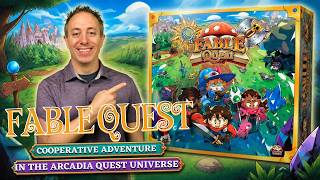
Fable Quest is a cooperative, story-driven campaign game from Tycoon Games, set in the world of Arcadia Quest and designed by Guilherme Gualhard and Fred Perre. Reviewers agree on its basic identity: a party of one to four heroes moves through a sequence of chapters, each with its own map, objectives, and story, and the choices made along the way shape what happens next. The Dice Tower's Sal Martinez, in a "Friday How to Play" teaching video, frames the game as a living storybook in which every decision can lead to new discoveries or consequences nobody expected.
The Game Boy Geek approaches the game as a crowdfunding preview and spends most of the video walking through a full round of play, from setup through combat and the camp phase between chapters. Both channels stress that the copies they show are prototypes, so artwork, components, and rules may still change before the game ships. The Dice Hour, the news and discussion show from The Dice Tower, comes at Fable Quest from the Arcadia Quest angle. Its hosts describe the project as Arcadia Quest's world with a new cooperative design, and they say they are eager to see whether a simple system holds together.
Reviewers find the card-driven core more compelling than the story framing alone. Opinions split mainly on the injury system and on how far the art departs from earlier Arcadia Quest releases. Session length also varies by source, with Sal Martinez describing roughly 90 minutes per chapter and The Game Boy Geek giving a 30 to 60 minute estimate.
Core Mechanics That Define Fable Quest
Action Deck Tests
Every hero in Fable Quest has a personal action deck built from the hero's own action cards, the cards on their travel clothes, and the cards on their starting weapon. When a hero faces a test or attacks an enemy, the stat on the hero ID card sets how many cards are revealed from that deck. Strength, agility, mental, endurance, and social each drive a different kind of check, so the choice of which option to attempt matters as much as the draw. Sal Martinez explains that once a player commits to an option, they can return one revealed card to the top of the draw pile, discard another without using its effect, and then resolve whatever remains. Effects boxed off on a card are exclusive, so only one of them can be used among all the revealed cards.
The Game Boy Geek shows the same logic in combat, where a hero's attack uses the stat tied to the equipped weapon and is compared against the defense on a drawn enemy behavior card. Test results then send the party to a specific passage in the Book of Reactions.
The Injury Chain and Deck Clogging
Injuries are where the design gets its bite. As Sal Martinez describes the rules, a scratch is the first step of an injury chain that can escalate into a wound, a serious wound, and finally a fallen card that cannot simply be healed away. Injuries go face up into the discard pile, and because discard piles are reshuffled into the draw deck whenever equipment changes, injuries keep returning to future tests. Poison and shame cards stay in the deck until a hero spends healing to remove them. The Game Boy Geek calls these cards "pretty terrible" because they reduce the hero's chance of success and then get upgraded into something worse. Healing at a fountain works in the other direction, letting a hero search the deck or discard pile and downgrade a wound into a scratch, which is why the same mechanic can feel like a trap and a relief depending on the moment.
The Fable Quest Experience
Shared Storytelling Around the Table
Reviewers describe the table as a place where the group, not any single player, makes the important decisions. Sal Martinez explains that the party decides together which hero goes first in each hero phase, and that the group also picks targets or paths when the rules offer several equal options. Coins earned from defeating enemies go into a single shared pool, and the story book is organized so that players read only the entries the game tells them to read. The Game Boy Geek highlights the same cooperative tone. The feeling is less like a competition and more like a group of companions deciding how to handle a bad situation.
A Campaign That Carries Your Hero Forward
Between chapters, the camp phase gives the party a chance to reset. Each hero can take two camp actions, such as resting to heal injuries with coins, meditating to remove a fallen card, tinkering to trim unwanted action cards from an item, shopping from a fresh set of six items, or sharing cards with another hero. Sal Martinez notes that a hero can also retire in favor of an unused character, keeping the items and injuries the previous hero collected. The Game Boy Geek describes it as a way to reset and rebuild before the next chapter, so the deck carries the story forward.
What Makes Fable Quest Stand Out
Equipment That Reshapes the Deck
Reviewers consistently point to the way equipment changes how a hero plays. Each equipped item adds action cards to the personal deck, so gear does more than adjust a number. Sal Martinez summarizes it as new equipment making a hero stronger while injuries weigh them down, and both channels describe the item list as a source of flavor. The Game Boy Geek mentions items such as a harmonica that moves a hero without provoking an enemy, along with consumables like the Chibi Cola and a fortune cookie that lets a hero reorder the top of their draw deck. Trading at the same table can therefore alter a hero's whole deck, which keeps the loot meaningful.
A Cooperative Spin on Arcadia
The Game Boy Geek stresses that Fable Quest marks a change for the Arcadia setting. In earlier Arcadia Quest play, players competed for glory with rival guilds, but here the heroes stand together. The Dice Hour adds that Arcadia Quest and Starcadia Quest are the reference points for fans, and that Fable Quest's chapter structure is a welcome return. The result is a game that keeps the familiar Arcadia atmosphere while asking players to work toward a shared chapter objective.
Potential Drawbacks
Injuries That Escalate and Clog the Deck
The injury system is the most frequently raised concern. Reviewers agree that a single scratch is a small problem, but that it can grow into a much bigger one if a hero does not heal it in time. The Game Boy Geek notes that injury cards replace the cards a player would otherwise reveal, so they reduce the odds of success while also making the deck less effective over time. Players who prefer lighter attrition may find the chain punishing, though fountains, camp actions, and lucky cards offer counterweights.
A Prototype Still Finding Its Look and Length
Every reviewer frames Fable Quest as a crowdfunding preview. Sal Martinez warns that the artwork, components, and rules may continue to evolve, and The Game Boy Geek points viewers to the project page for the most current art and pledge levels. The Dice Hour raises a stylistic concern: while the hosts accept the chibi-style characters that appeared in Arcadia Quest and Starcadia Quest, they say the cuteness of the front character art feels heavier than what came before. Playtime estimates also differ between the two channels, so buyers should treat the published figures as provisional until a finished copy is available.
If You Enjoy Fable Quest
Fans of Arcadia Quest will recognize much of the setting and the sense of moving through a sequence of chapters. The Dice Hour describes Fable Quest as set in the Arcadia Quest world, with designers who had a large hand in Arcadia Quest, even though Eric Lang, the original designer, is not involved. Because Arcadia Quest's rivalry is replaced by cooperation, the game gives those players a new way to enjoy the setting rather than a repeat of the old one.
Players who liked Starcadia Quest should also find something familiar here, since it is the other Arcadia title the hosts compare the new game's look against. The Dice Hour mentions that Starcadia Quest shares the chibi-style look that Fable Quest uses, and the card-driven tests, touch of deck building, and narrative choices that The Game Boy Geek highlights will suit anyone who enjoys how a story and a deck can reinforce each other. Its cooperative campaign structure and deck-driven tests are the parts reviewers return to most, so players who want a shared story with real consequences will likely find the most to enjoy.
What Reviewers Are Saying
"A scratch is the beginning of an injury chain. When a scratch is applied, you exchange it for a wound. A wound can eventually become a serious wound."
— Sal Martinez, The Dice Tower
"For the first time in Arcadia, you're not competing for glory with rival guilds, but you're standing together cooperatively. It highlights card-driven gameplay, a touch of deck building, and narrative choices."
— The Game Boy Geek
"I really love Arcadia Quest, so I'm hoping this is really good. And if it's a simple system, and I like these designers."
— The Dice Hour, The Dice Tower