


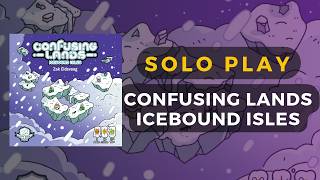



Confusing Lands: Icebound Isles Deep Dive
What the Community Thinks About Confusing Lands: Icebound Isles
Icebound Isles is an expansion to Confusing Lands that also includes an optional standalone mode. Every community take in this overview returns to that split, and the expansion route is the one that draws the most enthusiasm. DaniCha recorded a solo playthrough and called the game a very pleasant one, describing it as a micro game built around just 18 double-sided cards.
DaniCha's session also ended with a negative final score of minus two points. Scoring conditions and penalties dragged a careful run below zero, and DaniCha accepted that as part of how Confusing Lands plays. Replay value, in DaniCha's view, comes from the wide range of scoring targets rather than from the card count.
Board Game Co, through Alex Radcliffe, placed Icebound Isles on a Gen Con expansion list and framed it as a fun puzzle. Alex Radcliffe recommends owning both sets because stacking them creates a longer, more demanding game that can reach three or four players. The standalone mode received a much cooler reception on that same video.
Crimsonboardgames received a copy as a gift and summed up the set as quick, cute, and cozy. The host was unsure whether the standalone mode holds up on its own, which leaves the combined game as the clearer recommendation.
Core Mechanics That Define Confusing Lands: Icebound Isles
Card Overlay
Each turn in the solo game gives you two cards, and you can look at both sides before choosing which side goes into your play area. The discarded card is replaced by the next one below it in the deck. Every placement has to cover at least one space already in your landscape, cannot touch the scoring section printed on the card, and must keep the landscape in a clean grid with no partially covered spaces. The rules create a steady puzzle in which the shape you build matters as much as the cards you draw.
Board Game Co describes the overlay as the core of the puzzle. Goals you pick up start at minus 10 points each, so taking a goal only pays off if you can finish it. That penalty structure pushes players to commit to a small number of conditions rather than chase every one.
Spatial Reasoning
Snowflake spaces add a blocking rule. Once a card with snowflakes is placed, no future card can cover those spaces, so the open area of your landscape shrinks in a way you have to plan for. DaniCha made this point when a snowflake card appeared mid-game and forced a rethink of where the remaining cards could go.
Many scoring conditions reward alignment or adjacency. Alpine Retreat pays four points for each village space sitting closer to a mountain than to another village. Arcane Seeds pays points for crystal spaces that share a row or column with a forest. Diversity asks for a full set of seven different symbols in the landscape, which DaniCha judged too difficult to chase and chose to skip.
The Confusing Lands: Icebound Isles Experience
Setting Up and Playing Solo
Setup is light. You shuffle the 18 scoring cards scoring side down and reveal one as a shared condition that will score at the end no matter what. That single card sets the target for the entire session, so the first reveal can shape how you approach every later draw. The game ends once nine cards have been placed in the landscape.
The Scoring Tally
Scoring is where the game pays off or punishes you. DaniCha worked through each condition in turn, tallying positive points first and then subtracting 10 for each face-up scoring condition. Several conditions paid four points per match and others paid two, so the running total moves in quick, satisfying jumps. The final tally is a good reminder that a clean layout does not guarantee a positive score.
What Makes Confusing Lands: Icebound Isles Stand Out
Scoring Variety
The 18 scoring cards give the set a wide range of goals from one session to the next. Natural Selection scores points per elk space and subtracts for wolf spaces (or the reverse, the player's choice), while Snow Flurries scores for separated pockets of empty space. Because each game starts with a different shared condition, the same layout can score very differently depending on what was revealed at setup.
Combining With the Base Game
Board Game Co sees the real appeal in combining the two sets. Adding Icebound Isles to Confusing Lands produces a longer scoring adventure, and Alex Radcliffe believes the larger card pool also makes three and four player games practical. Crimsonboardgames also described the set as something to combine with the original rather than as a separate product.
Potential Drawbacks
The Standalone Mode Is the Weaker Way to Play
Board Game Co and Crimsonboardgames both place the standalone mode below the combined game. Alex Radcliffe said of playing it alone, "I guess so, but honestly, the other two sound much more appealing." Crimsonboardgames was not sure the set works fully on its own, and the host still bought it with the base game in mind. For a player who does not already own Confusing Lands, that makes the standalone version a harder sell, because the mode both critics rate lower is the only one the buyer gets.
Penalties and Negative Scores
The end-game penalty of minus 10 points per face-up scoring condition can wipe out a strong layout. DaniCha finished at minus two despite a playthrough that felt well managed. Players who want a comfortable positive result will need to choose their conditions carefully, and a few unlucky reveals can make a session feel punishing.
If You Enjoy Confusing Lands: Icebound Isles
Confusing Lands is the base game this set expands, and it is the best starting point. Icebound Isles adds snowflake blocking and extra scoring cards to the same overlay puzzle, so the expansion makes the most sense once you already know how the placement rules feel.
Hercules and the 12 Labors comes from Envy Born Games, the same publisher behind Icebound Isles, and Crimsonboardgames calls it one of their favorite solo games of all time. Players drawn to Envy Born's style of quick, tightly scored solo puzzles in Icebound Isles will find the same publisher's sensibility driving Hercules and the 12 Labors.
What Reviewers Are Saying
"This is a very very pleasant game. It's kind of like one of those micro type games. There's only 18 cards."
— DaniCha
"I guess so, but honestly, the other two sound much more appealing."
— Alex Radcliffe, BoardGameCo
"This was so quick and cute and cozy."
— Crimsonboardgames