Pampero and Why Euro Games Don't Hit the Same Anymore
Games in This Video
2 games are featured in this video — they unlock as you watch.

Transcript
Have you noticed recently how Euro Games just don't have the same impact that they used to? It feels like we've already had all the good ones, and now designers are just doing... variations on a theme. Some of this is industry-related and how releases are structured. A big, important release window for Euro Games is Essen Spiel, a massive convention in Germany, and all the recognisable designers try to have at least one game there. Which means that every year we have another Feld, another Rosenberg, another Suchy, another Lacerda, another Turczi, another Pfister, and on and on and on. There is a churn in our hobby, and it's easy to see the cynical side - especially when the end result confirms that bias. There were a number of times in the last couple of years where I read a rule book and I thought: "I don't need to play this. I'd be subjecting myself and my friends to the things that we've all seen and done a thousand times."
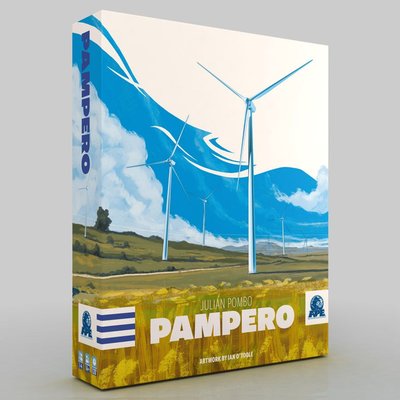
It's a genre that's been stagnating, and I say this with all the love. Some of my favourite games are Euros. Don't believe me? Here's my top 10. So now then, the subject of our video. Pampero! A behemoth, lumbering out of a primordial soup of devolution with a little ticking time-bomb inside?? Don't touch it! I mean just look at this thing - it's like someone took a crayon and wrote "Modern Euro Game" on the box. Ian O'Toole art? Check. Overproduced components? Check. Lacerda involved somewhere, somehow? Also check. But, it does not quack like a duck and, I'll be honest with you, it took me a few plays to notice just how many things this game does differently. In Pampero you'll build windmills in Uruguay. Nice environmental theme you've got there! Be as shame if someone...
...stuffed it with game trays!! Once you process that particular bit of dissonance, you might start asking questions like: "Okay, what's so different about this game Efka?" And I am getting there, but this is a Euro Game and leaning towards the heavy side, so I'm sorry but a mild rules teach is about to happen. The principal idea of Pampero is that you're an energy magate trying to electrify Uruguay. To do this you will need to build windmills, and not just in your mind. You get to place these on the board! Which is cute, right? When you do place them, the windmills will produce a number of energy depending on which zone you built it in: The agricultural areas producing the least energy, and the urban areas producing the most. Building in these urban areas is prohibitively expensive, so how do you make the money?!
Well, by spending the energy that you've made by building the windmills. Just going to tilt this one... ...for fun(!) The second thing you can build is electricity towers. After building an electricity tower in an area, and triggering a whole bunch of Euro Game bonuses, you will be eligible to collect contracts from that area by spending the energy you made. These will increase income markers from various industries as you place them on your personal player board, removing transistors which go to the space where you took the contract from. Once again, a bunch of Euro Game bonuses follow. This income will flow in at the end of every round. And if you've balanced your expenses well, you'll be able to keep doing that ad-infinitum - until the end of the game, where the person with the most...
the person with the most... Wait! Where are the victory points?! Ho-ho! I have misled you! On the surface Pampero seems very trad: Build windmills to get energy, build electricity towers to deliver that energy, collect contracts to spend that energy, and get money -except the money you've just made, and are about to spend, is your victory points. And that's just the tip of the windmill. There's a few more mechanisms hiding in the margins that feel kind of cute and nifty. For example, some contracts are linked. Meaning you can take both with a single action, paying only one lot of money. But you need to have electricity towers in both areas where the contracts are located, and you still pay all of the energy. Other contracts lock away a special bonus tile.
If you take the first contract tile, you unlock the first part of the bonus tile - but that in itself does nothing. Whoever takes the second one, not only gets the contract but also the bonus tile. Which is a weird mechanism. At first glance, you're like: "Well, what's the point? Unlocking the first part just lets my opponent snipe the second contract and get the bonus tile!" But if if you inspect the map further you'll realise that often one side of those locks is a much better deal than the other, offering the double whammy of those linked contracts. So now you're like: "Ooh! I really want those linked contracts, but the bonus tile might be an even bigger deal! Am I willing to give this up?!" These circular bonus tiles can be applied to your 'build a windmill' action, but then it stays on the 'build a windmill' action card.
Cards you play go into the two rows on your player board, but you only get to return one of them - the rightmost one - at the end of a round. You can return all of them, but it's one of your actions where you get to do nothing else, and you only have about 15 actions in the entire game. In addition to routing power to Uruguay's regions, electricity towers also unlock further access to various other game elements: Income markers can only go up to certain thresholds, contracts can only be placed up to certain spaces, only certain types of contracts can be collected, and if you want more... ...build more towers! Finally, if you've got enough towers built and enough energy stored, at the end of the round you'll produce batteries.
Which is a resource that lets you bypass spending money in certain cases. Nice! But that requires not spending energy, which means not collecting contracts, which means less money at the end of the round. Arghh! These are all lovely familiar touches, but I know... ...*I* know that *you* know that I'm still keeping the real spice tucked away, so let's not drag this out any further. The three principal actions in the game: Building windmills, towers, and collecting contracts all have a requirement. I already mentioned that contracts need a tower present in the area, but to build the tower - or the windmill - you need a bulldozer positioned at the right space. The only thing to add here is that it doesn't need to be *your* bulldozer or *your* electricity tower - you can use another player's.
The only catch is that if you do, you don't pay money to the bank - you pay it to that player. Which might seem like a nifty little rule except for the fact that taking actions is outrageously expensive. Let's say I want to take this contract from area A. My player board tells me that the cost of this action is $8. The contract will bump up my income from $1 per round to $2 per round. Wow(!) So basically I'll give up $8 and if I do this at the the very start of the game, I'll maybe have five income turns and maybe trigger income a couple more times for various bonuses, and in total... get $7... over a long period of time. What are we even doing here?! This is where Pampero gets monstrously weird and unwieldy and unintuitive, but most importantly very interesting.
It's easy to calculate that effectively every action leads you to a loss. Area C is criminally priced - $17 for one action! Better make the most of it! You can get the cost for each area down if you keep building in it. Area C eventually discounts itself to $14, but that is still so much! And now imagine not spending 14 victory points, but giving them to another player. To a true-blue Euro Gamer that is a nightmare come to life. But even then there's a catch. To reduce costs in an area you have to play cards into that area, and it's not like you have an infite amount of them. Two cards to build windmills, two cards to take contracts, one card to build a tower, one wild card with downsides, one card to take an outrageously bad loan, and finally a card that lets you move your tractor, which honestly you better off skipping your action phase.
These cards get capital T trapped, so by the time you get to the heavily discounted space, you'll be so out of options that you'll just want to take a reset turn and get all your cards back. And then we're back to paying monster money. I'm going to do something that we've never done on this channel, and hopefully never will again. We're going to go to BGG, click on the ratings tab, and see what the people are saying before I give you my actual take on Pampero. Right, so it gets 7.7 which might seem good to the untrained eye, but in BGG world - for a box this size - it's pretty much dead on arrival, so that's not good. I'm not going to bore you with quotes, but the chief complaints are: Overproduced and broken, or overproduced and runaway leader, over produced and kingmaking...
Okay okay, here is an actual quote from BGG user "JimB1" sorry JimB1. "I'm not against negotiations in a game, but other games do that aspect better. A game should know its strengths. I really wonder why Lacerda, as a contributor to this game, did not intervene. He is such a brilliant designer and must have seen the significant flaws." A few words on this in a second. "Explanation on the king-making/negotiation aspect: You have frequent situations where you can choose to give either the one or the other fellow-player money for using their equipment, which is carried over one to one to victory points." Okay we've gone over that part. "Smart players will immediately notice that the best way to optimise is teaming up to circulate money, resulting in zero costs for actions, while those players not teaming up pay money and therefore victory points for every action to the bank, leaving them hopelessly behind pointwise."
[...] Oh. First of all 'Jimby', is it okay if I call you Jimby?! Listen Jimby, and again sorry for calling you out, much love. But designers aren't some sort of gods, they're people just like you and me, and know just as well as you and me do. I once asked Mr Lacerda how he feels about the brown meeples being way more valuable in The Gallerist, and whether he feels like the game suffers that someone could gather more than others and just blow them out of the water, and he said: "Just play with that in mind, what's the problem?" This was a while ago, and now I know better, but I just couldn't square that in my brain. Surely Vital Lacerda understands that having one stronger element than others undermines those other elements. But again, designers are just people and they're subject to different preferences and the same biases as we are.
And this isn't just true for Vital Lacerda, this is true for all of them. Every star designer has that one or maybe two hit games, but for every one of those they have five stinkers. Or just, you know, mediocre stuff. And I can guarantee you that 99% of the time, the reason a game is not hitting it with people is not because the designer was having an off year or whatever, it's because of the other people that worked on the game. Design isn't done in isolation - it's collaborative, and usually the biggest impact on the game is done by the development team, which is normally on the publisher side. Although interestingly that was probably not the case here, which brings me to your other point Jimby, and I'm really glad you brought this up. You can syphon money from the bank by giving it to other players?!
Once you realise this particular wrinkle, it completely warps how you view Pampero. So, now back to that bit where I said giving 14 points to another player feels monstrous. Not if they give it back! I've played two whole games of Pampero without clocking this, and it was only after Elaine completely trashed all the other players by doubling everyone's score that I started thinking "There must be something more to this game, and it can't just be her affinity towards Frey Bentos!" Which, as it turns out, does come from Uruguay - and is depicted right here on the map. For those not from Britain, Frey Bentos are pies in a can, and when cooked they look like this. Charming, isn't it?
Obviously this is YouTube, so now I'm going to have to eat some of this. [Eating sounds] Much like the pie, Pampero has something dubious about - it but also incredibly compelling. The ability to turn the game systems around and work against them is a rare treat that few Euro Games offer. The way I thought about it at first was that with this new divine revelation, the game will be wild! Untameable! Anyone can pay for anything they want as long as they agree to just swap money around. The reality is that your impression of Pampero from this point onwards will be so subjective that it's barely worth analysing. Each table will respond to this in their own way: Some will immediately turn to bartering and negotiation, others will be more cautious about making deals.
And this nuance is further exacerbated by player count. You can get away with a firm "no" in a two-player game, but with more you are risking being left eating dust if others create their own infinite money loop, and you don't join in. But it gets even more thorny when you realise that the game constantly incentivises people to break from this loop and go it alone. To illustrate this, I need to explain how scoring works. This is the time track, and everyone advances on it by one at the end of every year. But players also advance on it individually each time they take a reset turn. Scoring only occurs when all players reach the scoring step, so the table could accelerate it if, say, everyone resets.
What you score for is highly randomised each game, and very specific. In one game you could get money for having more tractors, in another having most contracts from the residential industry. The way this actually plays out is that the game becomes highly opportunistic. Imagine a two-player game where we'll both score 15 money for having a majority of contracts from region B1. Both players have built a windmill each, meaning there's only one space left to build an electricity tower. Roger moves his tractor there. On his next turn he could build the electricity tower, which is necessary to take contracts from that region. But as soon as he does, Annabel will pay him some money to use his tower and then take the contracts first.
But also, Annabelle could pay Roger to use his tractor, build the tower herself. But then obviously Roger would be able to snipe the contracts. However, building the tower also means access to the tower bonus tiles. Some of which are a bit busted and significantly good, whilst others are not. So there's a real race here as well. Or they could just all stalemate and move on to other things, neither player opting to push the button and looking for different opportunities and Pampero does not lack in that department. It is spiky and highly tactical, always shifting to a different state. I find all of this fascinating, unconventional, and boundary-pushing. But also, I wouldn't blame you if you turned your nose at this.
But what gets to me is how set in our ways we are. Here is a game that truly asks you to explore, and the best community response is: "It's fine! King-making! Broken! Give us another Euro that does everything like all the other ones do!" Isn't it incumbent upon us players to explore unconventional designs? Might surprise you here, but my answer to that is: I'm not sure that it is. Here's the thing. Pampero is pushing boundaries, but it is also making it real hard to make itself known and understood. It's not a light game by any stretch of the imagination, so you already have to invest effort into just learning this thing, which thankfully does have iconography by Ian O'Toole that cuts that barrier in half.
But there's nothing in the rules - which could do with a rewrite to begin with - about the intention of the game; what all these mechanisms mean, what players should aim to explore, even a single page at the back to say 'Hey, this giving other people money thing? That's really important, don't underestimate it!" or "Tower bonuses are not even - snipe the good ones quickly!" I'm all for organic discovery, but when you're doing something unconventional you should really state your intent clearly. This is the sort of thing that a good publisher would take care of. Designers? They're too deep in their own game, and the developers on the publisher's side clean it up and make it approachable. Whereas here, and this might be a bit harsh, I feel like the publisher development went into making a bajillion pieces and game trays.
And the design itself, after it was handed off by Julan Pombo and Vital Lacerda, was just printed as is so you have something that is briming with potential. But without context, it just comes across as weird. Why *would* I pay $17 to take contracts from Region C to make $5 back? Well, have you considered that with a little negotiation you could make that free? Yes, but what if the other players don't want to play ball? What do we do with Region C then? Just ignore it? The trick here is that even without negotiation, with various tacked-on bonuses and sniping opportunities, you can make Region C profitable, as long as you've got like four or five games under your belt and really get into this system. And the things that this game incentivises - the strategies it promotes to do well - it specifically encourages you to *not* play ball.
This game (!), everyone this game! The more I think about it, the more nothing makes sense. You can purchase specialist action cards but they're just not great. They cost just as much to take an action as the basic action cards. But what they offer instead is a more circumstantial version of the things that the basic action cards let you do. Furthermore, because each game prioritises different scoring elements and different opportunities, some cards are just not wanted. Unless(!) there's a card that literally copies any base card you have, which is bananas. Anywho, in most cases they just get clogged and don't cycle out because surprise (!), no one wants the circumstantial cards. And on top of that, instead of taking a specialist action card, you can take a specialist scoring card instead - which is guaranteed money.
Why would you not take that instead? I'm sure that with enough plays the answer will emerge, and I might even partake in those because, I swear, each play of Pampero opens up something more. It's a design that gives back as much as you invest. But, talking of investment, I just wouldn't recommend this to anyone. Not only because it's obtuse about making its intentions clear, but also because it's £125. And that's a lot of money for something that gives you 27 wooden transistor pieces, where the only purpose for them is to track one or two scoring conditions, and one or two elements in the expansion. Multiply that by four and that's 108 of the these wooden pieces that could have been trimmed out of the box if only development gave it just a little bit more care.
But there's nothing to do, because I did say that the Euro Game uber genre is stagnant, and interesting games just don't come out anymore. It *would* be nice if there was a game with the same theme, same gameplay premise, cheaper, and more environmentally sustainable production. But a game like that just doesn't exist. Nucleum is a game where you're trying to build nuclear power plants, connect them via railway tiles, and deliver that energy to complete contracts. I know that this sounds a lot like Pampero, but if I were to admit that in contrast Nucleum action selection system is much more dynamic, its map much more interactive, and its strategy is a lot less rote, I would be undermining the entire point of this video. Nucleum costs £55, so obviously much more expensive than Pampero, and there's no game trays!
We just can't have that(!) Jokes aside, Nucleum is actually a real miss for me in the arts department, and nuclear energy is definitely a lot less sexy than windmills, but in every single other beat it trounces Pampero. It's just that it's a bit more, you know, trad Euro Game, and when I say that I really mean just a bit. It's one of the more unique Euro Games to come out in the last three years, but it doesn't have that exciting edge. It feels comfortable and reliable, whereas Pampero really could have been something different - a real breakaway from convention. Instead, much like those Frey Bentos pies, it feels underbaked. What a shame. Thank you so much for watching this No Pun Included video. At this stage, I actually have a little apology to make.
We haven't been putting out many videos lately. And the reason for that is, well, exciting news, we have a new No Pun Included cast member, and integrating them into the whole ecosystem, uh, took a little bit of time. But right now, I would like to introduce you to the new No Pun Included cast member. Elaine, would you bring the new No Pun Included cast member? Everybody, say hello to Sidney! He is Bessie's little brother, except he's not very little anymore, but growing him from little to bigger was something else, so we weren't very much in the space where we could make videos, because he was behaving like the Lord Of Destruction! As you can see right now, he's not really very chill!
Um, if you'd like to support that kind of work, instead of biting our hand, you could subscribe to our videos. And also, if you'd really like to support our work, you could, um, you know, do the Patreon thing - the link is in the description. Ow! Ow! Ow! Um, and... and also uh we're independent. Uh, we don't, like, work with publishers, or ask for review copies, and um yeah that's it! Bye! [Eating sounds] It's fine