Unmatched - Start Playing in 8 minutes - Concise Board Game Tutorial
Games in This Video
2 games are featured in this video — they unlock as you watch.

Transcript
A legendary lineup of heroes, villains, and anything in between smack each other across asymmetrical battlefields in Unmatched.
And today we're diving into a quick start tutorial for Unmatched. We'll explain everything you need to know if you want to get started quickly and pick up the details and icons as you go along in 15 minutes or less.
And hey everyone, it's Stella.
And Tarrant, welcome to Meeple University.
And hey, if you enjoy this video after watching, like, subscribe, and comments, you know what to do. Now, let's get to the classroom.
Unmatched is a modular card-driven tactical battle game, primarily for two players, but with modes for three and four. Across a chase and battle lasting up to 30 cards, the first player to eliminate their opponent's hero will be the winner.
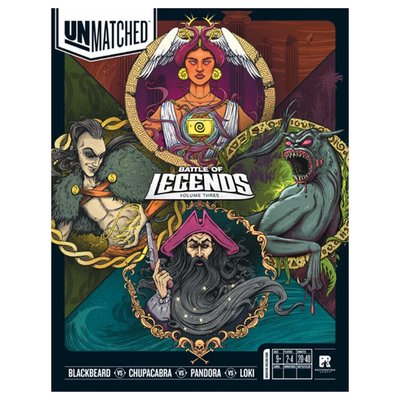
The game has many standalone releases,
each featuring its own unique characters and boards, while playing under a standard rule set with complete cross-compatibility.
Like, who doesn't want to see Buffy, the vampire slayer, fight against Medusa in the street of Victoria, London? I do.
Just be aware that the different releases are licensed and will come in and out of print at different times. Some of what you see here may now be available only on the second-hand market. Now, let's have a look at the two-player setup. Choose your map. It is made up of circular connected spaces, and this is where your fighters will move around during the game. Spaces will have one or more different colors, and those colors represent zones. Each zone loosely represents line of sight. That is, a character within one zone can be assumed to see all of the other spaces that are in that same zone. This definition gets used for some game effects, such as ranged attack.
Choose your heroes. Each player receives a character card, the matching hero mini, and a health dial set to starting health. Only if your card says you may have a sidekick represented by a token rather than a mini, and which usually also has its own health dial. Heroes and sidekicks are collectively known as fighters. Each player has a personal 30-card deck, shuffles it, and draws a starting hand of five. The first player's hero begins on the space marked one, and they [clears throat] place their sidekicks on any different space in the same zone. The second player does likewise at space two.
You're ready to play. Unmatched plays in turns back and forth between the players.
So, on your turn, you must take two actions, even if you don't want to.
There are three options for your actions: maneuver, scheme, and attack. You may take the same option twice. End your turn by discarding down to seven cards if necessary. To maneuver, you must first draw one card. Then, each of your fighters may move up to a number of spaces as shown on your character card, or further by discarding any one card from your hand and adding its boost value. Boosting like so would let my fighters move up to three. Move fighters in any order, but one must finish before the next starts. You may move through your own fighters without finishing on them, but may not move into or through your enemies.
To scheme, play a card which shows the lightning bolt. Resolve its effect and then discard it. Do note that if the fighter listed on the card has already been eliminated, then that card cannot be played as a scheme. To attack, one of your fighters attacks an enemy fighter. If your active fighter has melee attack, then the target must be adjacent. For ranged attack, the target must either be adjacent or within the same zone. The attacking player must choose one attack or versatile card which shows the active fighter or the word any.
Play it face down. The defending player may choose one defense or versatile card which lists the target or any and plays that face down. But for the defender, doing this is optional. Now, reveal the cards. If there's an immediate effect, resolve it now. Then, resolve any during combat effects. Then, the defender suffers damage equal to the attack value less the defense value plus any effects. Here, it would be one damage. Then, resolve any after combat effects and finally discard all the cards played. Whenever there's a timing conflict, resolve the defender's card before the attackers.
The game is a battle to eliminate the opponent's hero.
And when any fighter's health is reduced to zero, it is defeated. This is true for both heroes and sidekicks with a health dial, while sidekicks with no health dial simply have one health and are defeated upon any damage. If this happens during combat, still fully resolve the outcome of the combat including any after combat effects. Then remove the fighter from the board. If a sidekick is defeated, the hero carries on without. But if a hero is defeated, the game is over and the other player wins. Critically, your deck of cards represents your vigor and energy. And when your deck runs out, you are exhausted. Your discard pile does not reshuffle to form a new draw deck.
Instead, if ever you must draw a new card, each of your remaining fighters loses two health, quickly hastening your defeat. Remember, drawing a card is a mandatory part of maneuver. Having a card to play is a mandatory part of both scheme and attack, and you must take two actions each turn. Once you're exhausted and your hand is dry, you will have no option but to lose this health. Appropriately rationing the cards in your deck is critical if you're settling in for a long game. And that's all you need to know to begin playing Unmatched.
There's just a couple of other variants and features to note.
To play Unmatched at four players, you'll need to split into two teams of two. And at three players, it will be one versus two with the one player controlling two heroes. In setup, team A occupies spaces one and three, team B occupying two and four. And these starting numbers determine the heroes turn order for the game. Open communication is acceptable. The winning team will be the first to eliminate both of the opposing heroes. And a player whose hero is defeated may still continue taking turns if they have surviving sidekicks. At three players, there are also rules for playing a 1 v 1 v 1 free-for-all.
All of the characters have unique abilities and play styles, including unique decks which are tailored to their styles, and special powers which will be outlined on the character card or within the rulebook for more complicated abilities. Some of the game boards also introduce special rules, all of which are explained in the set's rulebook.
Thanks for watching, and if you like this video, maybe you'd like to watch this next one. Have a great day. Bye.