Let's Talk Board Games #9 - Strategy Board Game Reviews (Anno 1800, Bitoku, Betrayal & Pessoa)
Games in This Video
4 games are featured in this video — they unlock as you watch.


Transcript
hi everyone my name is moni and i'm naveen from before you play and welcome to another episode of let's talk board games where we basically talk about board games yeah that's right we do a few uh different reviews in one episode we typically have a theme that usually connects all the games together and so today we're talking about a few strategy games specifically i think this is the first time that we've done a strategy specific episode that's right yeah normally we like to do full playthroughs of them obviously but you cannot get to all of the games because it just takes that much time to do so we literally cannot film play-throughs for every single strategy game unfortunately and so sometimes we just kind of have to uh talk about how we feel about that yep and so today we're gonna be talking about four different games but before we get started uh we do have a shout out that we like to do and uh you know we're really surprised that uh we haven't shouted them out before because they're such such a wonderful channel and it is none other than jeff and jamie at foster the meeple that's right so we really love jeff and jamie's channel because they are just two very genuine you know authentic people they're really really fun entertaining to watch they do a lot of board game discussion videos they do top 10 lists and just talk about games that they've been playing and they're just so fun to watch yeah they have a good banter they're kind people and kind of what you see on video is who you get in real life which is great and so if you're not familiar with their channel there is a link in the description down below you can always go check them out jeff and jamie thank you for everything that you do all right and by the way we will be including timestamps to the different games that we'll be talking about in the description below so if you're interested in jumping around please feel free to do so so the first
game on our list today is one that was based off of a video game of the same name and it is it is anno 1800 designed by martin wallace and published by cosmos it's a two to four player euro game for sure yes um and like monique said it is based off of the video game both of which we have not played oh i deeply want to play that game we looked it up it's not available for mac yeah after playing this game this is not a pc household we only have max gear and so unfortunately this is a game that we cannot play but i so deeply want to we played this game with a friend who uh who who does love the game and she says that it it seems like a very good thematic uh port and so if you're not familiar with the video game or this the theme is based off of uh i think it's your industrializing a colony of violence yeah some sort of civilization yeah you're definitely building industries and trying to populate the area with residents is kind of what i gather from playing this game totally so the way that this game works in particular is there is a main board in the center of the table that has a bunch of tiles and so just so you know that's probably going to be the most tedious part of this game if you don't have an insert which thankfully we do have one and uh we'll include a link to where you can get our specific insert by the way it's off of etsy it's not ours we didn't we didn't make this nobody else made it and made us aware of it yeah they kindly sent us a copy of the insert by the way and it is a lifesaver because it basically holds all the tiles and we can arrange the tiles in the order that they appear on them on the board but basically you have this menu of tiles in the middle of the board and those are all different industries that we can build each player also has their
own board where we are going to be building out these industries onto but there are also pre-printed industries already on your player board at the top of your board you also have cubes of different colors and they represent different people like engineers artisans and just people who are going to be working in your colony and so on your turn one of your main goals is to try to build out more of these industries onto your player board and by the way this game is a little bit difficult to describe without having it out in front of you but each industry that you want to build has a requirement in order to build it assuming you have the needed industries on your map already you're using those workers by placing the cubes from the top of your board onto the industry spots yeah board oh it's so difficult it's so difficult to explain what other thing but basically that that top bar where you have different colors of different types of workers that's how you produce the goods you move those workers onto the industry signifying hey it's in the tobacco plant it's producing tobacco but you're never producing resources and collecting resources like in a standard euro game you're always placing those uh those cubes to produce the resources while you're developing an industry right right so you never have any like leftover resources or anything so the game kind of uh forces you to think like okay well that industry over there requires me to have milk i don't have milk okay so i need to build out the milk tile um okay well the milk requires me to have cotton and whatever else so you're basically going through this like chain reaction of what do i need in order to get this in order to get that but you're also managing your resident cubes right that's right yeah the different workers you want to make sure that they're happy yeah but the thing that's neat about
this game is it forces a lot of player interaction because if you don't have the industry in front of you you have an option of basically borrowing it from another player and there's a trade mechanism in the game there's a trade mechanism that we won't go into because it's very specific to the game but you basically don't have to build it all yourself you can kind of wait and see what other players are building so that you can kind of piggyback off of them in order to gain your goals right yeah that's exactly it so it comes to a point where you're like well it took me so long to build up my industry so i'm gonna just passively use your industries you get a benefit but i definitely get a benefit as well yeah and it's not something that you can refuse so it's it's a really really clever mechanism in the game because uh there's no way you're gonna be able to build it out and on my first play i thought i was gonna have to build it out but then as you get about to the halfway point you start to realize oh monique monique's building that i don't have to worry about that at all at any point i can use one of my trade tokens and just get what i need at the right time also speaking of the halfway point you also realize that these industry tiles that you're building out on your player board that you're obsessing over they're not even the way that you score points you can build out all of them if you want to and score nothing next to nothing because the main point of the game is every time you gain more people you also have to acquire these cards into your hand those cards are the main ways in which you score points so you're basically trying to build out these industry tiles so that you have access to these specific resources that those cards are requiring and so the card mechanism is kind of strange because in order for you to
continue to to build out your engine you need to gain more people by either upgrading your current people or by just gaining more people into your colony and every time you gain people you gain those cards and that is the timer of the game yes as soon as one player rids themselves of all their cards that signifies the end of the game everyone gets one more turn and then that's pretty much it yes so that mechanic is kind of the one thing that's a little bit frustrating to me besides the player count thing which we'll get to in a second i just want to briefly mention that there's a bit more to the game than that there are these like extra island boards there are different types of actions that you can take that kind of give you more points but that is the main heart and soul the main mechanism of the gameplay what are your thoughts yeah it's it's it's a really good game uh we thought we were going to film a play through yes but we realized because of that trade mechanism which we were talking about this game really shined at three players when we played it and the onus in a two-player game is on two people now to build out these industries yeah to satisfy the cards that we have i don't think there's any way to scale it down for two players like there's no public um industries that are pre-built uh that you can then go trade from from like kind of a public sector no no you can play it at two you can yeah like but it's just not as good right um you definitely want to play it at three or four it's that player interaction is just so prevalent in the game and it's just what makes the game a lot more fun it does like there was a long time when we played one three player game of this and um there was one time where me and our other friend were assuming that naveen was gonna build the
chocolate and i was like i thought i was gonna build a chocolate factory i built several rounds of strategy based off of naveen building the chocolate and we're like nadine are you gonna build this out now or what so i i found myself in a situation where i did not have cards that required chocolate so i was like i don't have to build it up yeah because why would i build it out to help you so yeah it is really interesting like having to rely on your opponents and then kind it's almost like it almost feels like a semi co-op but you're really focusing on your your board your goals everything the worker management i thought was super interesting in this game it feels quite unique like i don't know another game that's like anna 1800 yeah it's a lot of cube conversion that's primarily like what this game is uh but yes i know exactly what you mean it still feels fresh yeah uh compared to all the different kind of like turn these in to make this yeah turn this in to get that right but that cube conversion part the fact that it is so it a lot of the times the majority of the gameplay is in that cube conversion part and that is the other reason why we could not film a playthrough of it because it would just be a lot of a lot of it would have not interesting been interesting sorry it would have been like i'm taking my red worker it's going to this i'm going to make this industry your turn yeah now i'm going to do this i'm going to do that okay now your turn okay now the blue worker is going to go here to get this and it would have just been that for almost two hours probably two hours so when you're playing it when you're in it and you're strategizing and what's going on in your head versus what is visually going on yeah is completely different yeah right yeah yeah what's going on your in your head is is a really fun long-term strategy of
planning figuring out how to be optimal how to be efficient how to not get so many cards in your hand but also how to score the highest scoring cards in your hand all that is really fun um but it does kind of run long when i was when we were playing it doesn't feel like it drags but it definitely is long when we looked back after the teach because it was uh the first time we ever played it was that three player game and the teach plus the game play it felt like uh we were not too sure how many workers to take because every time you take workers you get more cards hence you're extending the gameplay so because somebody has to offload all their cards so nobody knew what a good score was we weren't sure like do i need to do i need to acquire more to score more yeah then i kind of found a way to be like i think i'm scoring well i mean i try to get rid of these cards and end it yeah and then i kind of suddenly ended it on on both of them so that that timing mechanism where you're having to get more and more cards is a little bit frustrating for me that's probably the one downside of like oh god when is this game ever going to end because you're just continuing continuously getting more and more cards but then it does end and it's a great ride yeah it's my type of euro game i'm a big fan of like uh get the cube do this do that do that you know it's very much like so like a spreadsheet and you're trying to figure out uh you know what's the most optimal way to do things in this game so i really enjoyed it this was actually on uh one of my most anticipated games list i can't remember what year maybe 2021 a while back yeah and so we finally got to play it and uh i really enjoyed it but i will say we've only played this at two and three i don't necessarily know that i would want to play it maybe i would consider playing it at four it just can feel long if people have analysis paralysis
because you're trying to be really efficient on your turn right and you know that there's potentially a right answer and because of that it might be just way too long at four anyway that is anno 1800 designed by martin wallace all right moving on to the next game this is a game that we actually did record a playthrough of half until uh and this is during the time of our top down camera fiasco where it wasn't working so we had to scrap that play through unfortunately and then we just don't have time to film it so another long one yeah we're going to be talking about it today it is yeah it's none other than bittoku designed by herman milan and published by devere games this one is a japanese themed euro game for sure yeah it's beautiful i mean this this definitely has a big focus on art it's japanese themed i think it's more japanese lore themed it's a little bit based off of um studio ghibli art style if you're familiar with that studio that produces a lot of japanese animated films like spirited away is probably the most famous one and so a lot of the art style in world building is kind of based off of those types of works if you've ever seen this board this is probably the busiest board of the year right yeah yeah definitely of the games that have been released in the past two years it's beautiful but it's quite busy it's an entire forest scene basically and so you look at the game and your your mind is screaming what is going on here right the first time i saw it i was like what how do you even play this game yeah so so monique taught this game to me and um the very first time it was laid out she had it all set up and like i came to the table and i was i was overwhelmed and like i rarely find myself to be
overwhelmed by kind of the board and the board state of what i'm looking at and so the art style is just so intertwined into the mechanisms of the the different action spots in the game that learning the game for me initially was very very difficult because i was just so distracted by some of the things i was seeing absolutely beautiful though i will say rule book wise i also had a hard time learning the game from the rule book the rule book was also absolutely beautiful it was just very long and kind of split into this like two parts so i kept having to flip back and forth from like the end part to the front part and yeah it was it was a tough learn but when you actually learn the game it's not super heavy it looks like it is it's long it's also very very long but it's not super complicated because basically the way that the game works is you're playing it over the course i believe four seasons i i don't remember the terminology for all the different cards because it's one of those games where everything has a name even rounds have their own name literally every mechanic in this game has its own terminology and that also i feel like adds to the difficulty in learning the game that's right yeah because you have to not only you know convert in your mind round is not considered round yeah it's like season yeah the whole game i think is a year stuff like that and that's that's like not bad for terminology but but all the different cards are called things right like what's a toku card versus uh something else exactly basically if you look at the board the board is split into five different regions and that is really all you need to know about how to take your turn because on your player board itself your player board is also divided into
three different sections and on your turn you're playing a i think it's a yokai card i think so from your hand right onto one of those three uh sections of your board unlocking the die that is placed next to it and as soon as you have unlocked the die then you can place the die onto the main board one of the actual institutions yeah exactly into one of those five different regions that requires you to place dice and then when you place the die there you just take the action depending on how strong of uh of a die the value of the value of the pit and so it's going to be things like collecting resources building out buildings which you can place into those five different regions so that whenever people place out their dice there they can activate those buildings as well you're getting these extra stones or dragonflies to place onto your player board you're moving your piece up the pathway at the top of the board as well as on your little botoku map that you're kind of building out on on your own player board at some point during the round if you have a die placed in one of those regions you can also choose to move it across the river to gain another benefit and so all those those combination of three things that i just mentioned you're basically doing a combination of that for all three placements on your player board over the course of one round the order in which you do that is up to you um but the first thing that absolutely has to happen is you have to unlock those dice before you can place the dice onto the main board and that's it you do you do all that four times for over the course of four rounds and that's the entire game technically and so strategy wise rules wise it's not super heavy no yeah once you understand the kind of like the the outline as to where everything is on the board and just the mechanism of play
a card unlock the dice use that dice to then go take an action yeah if i want after that dice is there i can move it across the river and that's essentially the three things are the three steps for the different types of actions you're gonna be taking in the game and then once you learn exactly what the five different regions do and what each of the mechanisms they're tied to do then you have the whole game and so you're basically trying to to acquire your own end-game scoring conditions and then spending the entire game meeting those end game scoring conditions so like if i get a stone that says you get one point for every type of this card well now i'm going to spend the entire game trying to get as many of those types of cards as i can or maybe i acquire cards that'll increase the path that i'm that i'm going on on my board that'll help me score points at the end of the game depending on set collection i don't know it's one of those games it's like a point salary there's several paths to victory several pounds so yeah you're gonna want to take like two paths and be like i'm gonna run with these hard yeah yeah because there's several paths to victory i think that part is interesting the game just runs really long for what it is for me yeah we played a four player game and because everybody is gonna take all these actions uh up upwards of i think like nine actions yeah per round a four player game ran really long like three hours yeah we enjoyed the company we enjoyed the time playing it but it was just really really long at that point where it's like okay another round uh i i felt like that fourth season was like was like way too much at a four player game and because of that i would never play this at four ever again right for me this is gonna be two or three it's just one of those those games where i don't feel like the
time put in justified what was going on while we were playing like it didn't feel like i was building up a big engine and like oh my gosh i better take that because they're going to take that there were no decisions that were really like pressing for me i felt like the decisions were very straightforward like of course i would take that because i have this end game scoring condition that would give you two points i think the most the the thing is for the worker placement spots sometimes that you know you can get hosed out on something and so you're like i really want to play this next yokai card to unlock the die but i've already played one previously and if i don't use this die right now to go to that spot i could get blocked out yeah so that is the one thing that the competition for locations does get more interesting and and uh more challenging at a higher player account especially and for that reason it's probably a three-player game in my mind because at two players you lose out on this rule um that says there's a rule in higher player accounts where you cannot place a die in a region i'm forgetting the rule now it's like your diet has to be equal to or higher than i think so yeah then the the highest place down the value of the pips yeah relative to the to the dice that's already there yes and that rule is gone in a two-player game because there's just not enough competition for that to really matter and so it is interesting at more than two just too long at four yeah i also do like the mechanism in the game though uh so we talked about the yo-kai card gets played you place a dai out into one of the uh regions below the river that clogs up one of the spaces below the river but if you can time it right and you know monique is probably going to move her die off that river so i'll withhold and wait until she clears out
changing the value of the pips that now my value die can now actually go here and take the action right and i thought that was really really cool in the game yeah yeah that's good but we do know that there are a lot of people out there who really love this game and if you're a person who is really drawn to games based off of their component quality and just the aesthetic look i know that there are gamers out there who really the the look of the game can really add to their enjoyment value then this is maybe a game that you might want to check out because the components are so beautiful the resources just everything they definitely um made sure that it was the highest quality game that they could put out totally yeah uh i will note just kind of like anno 1800 setup time for this can be quite a bit oh my gosh uh so if you are a big fan of this or if this does interest you i would look into some sort of insert or some sort of organization for it big time i open the box and it gives me anxiety it's it's just a lot of it's a lot of nerds yeah that is bittoku finally we were able to talk about it all right next up is another game that we've been trying to talk about for a long time but hadn't been able to because of the required amount of players yes yeah this is one that i definitely want to play at four or more and so this is none other than betrayal at house on the hill the third edition designed by bruce glasgow and published by avalon hill uh this is the third iteration of this game monique and i have played the second edition yeah we've never opened the original one we've never played any of the other ones yeah so because of that okay we do have a caveat um this is not going to be an in-depth review we haven't been able to play this version that many times uh it
and you just cannot give you know a super in-depth review without playing a bunch of the scenarios in this because it is a game that is scenario based uh we literally have only played this one and second edition we haven't played the first edition legacy or i think there's like a scooby-doo there are other versions of the trail out there but we were very excited to be able to play this because uh the second edition is a game that we both i don't know did you like that one it was on our games we regret getting rid of uh video that we did maybe about a year ago i came out when we realized i really loved betrayal at the house i didn't care if it was broken yo i was i'm one of those gamers who was like you know what whatever whatever the whole gameplay could just be ruined and we could lose for no reason i would still have a good time because then you just laugh about it yeah because it's it's one of those experience games it's about what happens at the table how it brings you together and like what it forces you to do that i think is is really fun about the system as a whole not necessarily this edition or the second edition but just the idea of the game in general yeah if you're not familiar with it you're going to be playing as asymmetric characters who are all working together to explore this haunted house the characters are only asymmetric in their uh starting abilities you have like four different types of uh like strengths characteristics yeah that kind of help you and dictate like what you can do in the game exactly that's the only thing that's asymmetric yeah so you're essentially building out this house by exploring different rooms getting haunted and spooked by different little uh things that can happen within those rooms uh and then eventually at some point once a certain thing triggers uh something called the haunt one of the players is gonna betray
everybody else and they are going to now have their own win condition and the group is going to have their own win condition it's actually a lot more exciting than that because you spend a majority of the early game building up your character you want to make your character as strong as possible because you don't know who around the table is going to be the betrayer and so you're trying to collect items you're trying to just beef up your stats so that when you go to when you need to get into a fight then you have all this you know stuff that you can work with in your arsenal yeah you're also building out the house in a kind of in kind of a strategic way where it's like okay if i'm on the good guys team and i'm not being betrayed i need to leave ways in and out of room so i don't get just trapped in a room with a bad guy yeah there's the a big part of the game is building out the man at the the start of the game and then at some point like naveen said a haunt happens and somebody becomes a betrayer you give the betrayer their own betrayer handbook everybody else is on the opposite team and they get that one handbook and you all turn to the same case and you separately read what you have to do and each side has their own uh win condition essentially their own like rule set that and that is what is broken and i'm not actually putting that in quotations it is broken like the the other versions of the game some of the cases are just like the rule set of the main game doesn't accommodate some of the cases the situations the situations or they're just vague and then you end up being in this situation where it's like what this could never happen there's no proper ending for this right and so that was what was wrong with the previous editions and you can also just probably from hearing that description
if you've never played the game before you could probably imagine why a game like that would be a little bit problematic to execute right it's tough to do yeah all of the cases are are unique like they're all different stories and there are so many it's just impossible it's impossible to play test every single one of those to make it perfectly right yeah because like the house has to be at least this much built out by the time the haunt happens to make sure everyone's beefed up this much yeah and then still attacks happen on the die roll so then things you know things it's going to be very difficult but that's part of the the broken kind of strange things that happen is what for me makes this game fun i know a lot of you like the fact that it's broken yeah i do i i don't mind like like oh i need a roll of six and like that's the one in six chance and i roll a six like that's awesome we also probably it's probably very likely that we haven't run across the super broken scenarios from the previous iterations that really made people angry so take that take all of that with a grain of salt but uh speaking on the third edition specifically they did make some changes some slight changes you know they weren't that dramatic but they did make some changes to try to accommodate for uh previous errors in the other editions they made some component changes first of all i want to mention that the artwork is different the artwork on this game in particular is much darker the house artwork for some people some people might like that because maybe it gives like a more of a horror feel to it i liked the other edition better i don't i i just felt like it muddied the tiles i don't know maybe i'm just looking down at the table after it's all built out like oh it's really
kind of my car but i don't know i mean that's the theme of it so i'm assuming that's probably why they did it it's either here or there for me the art i think it is fine for me yeah they also tried to improve upon these sliders because in the original game um each player's token or each player's sheet character sheet that kind of houses those four statistics you keep track of them using these like plastic sliders that they don't say this is in the old one the old ones yeah so they made those sliders tighter i was hoping that they would just change that yeah that system of keeping track of those things but they didn't it's the same thing yeah you know i thought i thought personally that what should have been done is just like a square sheet where you have like cubes that you just plop in and up and down you know like when you when you turn them into like that diagonal kind of thing and then they're just kind of recessed boards i thought that would have been better because even these sliders they're kind of like hard now they almost like overdid it yeah they're really tight and so the first time we played naveen you you pulled it out and you're like oh this is going to destroy this this is going to destroy this card a ton yeah like this is going to destroy this so it's just pinching a little too hard yeah in our copy it's better but it is quite tight they also changed the way that the haunts are structured so in the second edition if i'm remembering correctly there was a booklet and you kind of turned to this chart and it's like which omen did somebody have when the hunt was triggered and who who triggered it and then it tells you based off that chart who is going to be the betrayer and what case to turn to in this game there's a little bit more of a thematic integration there are i think like five scenario cards and on each
card is one background story that links all of the cases on that card to each other so that you'll have a more of a fluid uh story i thought that was a neat idea for people out there who are interested in the game because of the rpg elements the storytelling um then maybe you might like that method better sure the way that the haunt is triggered is different now so i believe the way that it was before is that was that when somebody collected an omen you roll six dice and if the the sum of the die values was less than the number of omens at the table then that would trigger the haunt so then the more omens you get you know the higher the chances of you triggering the hunt now in this version of the game you roll one die for every omen that's around the table so the first time somebody collects an omen you only roll one die and uh if ever you i believe reach five a sum of five or higher then the haunt begins yeah and these guys the pit values only go up to two yeah they're one or two and some of them are blanks so the first couple of times it's going to be impossible which i think is good because it does make the first two times that you get an omen card for sure not going to happen yeah but it's still not perfect you know one of the game plays that we played it totally backfired on us on naveen actually yeah i became the betrayer uh the haunt triggered way faster yeah and it should have participated i don't want to ruin anything about any scenarios but in that particular game we experienced the brokenness i guess you can call it but i still had a really good time it was awful it was because uh it was because the haunt started way sooner than it was supposed to and the scenario that we
were playing was kind of dependent on the size of the house and we're not saying which one or what happened in the scenario let's just say the house was not that big and naveen was like clearly gonna lose this game my win condition relative to the size of the house relative to what their win condition was as the people who were not part of the betraying yeah was just the combination at the timing was not right the haunt happened a couple uh omens later it would have it would have been way better it and so to add insult to injury we also just were rolling perfect perfect die rolls and when i would roll the exact opposite it was just like whoa so i i felt bad like playing the rest of this game because it was basically like us just like smiling and laughing as we're running past naveen i'm glad with me as a betrayer because for me i have no hearts feeling approach whenever i play this game so i was like that's fine yeah yeah yeah i just want to see what happens it was fine in the end but it definitely we definitely ended the game way too early so you know even though i think that that rule change is better it's still not a perfect situation obviously and i don't think it can be for a game like this and speaking of the scenarios by the way the the information is a lot more open in this game which i think is good and bad like in the old game you couldn't say anything about your case from what i remember or maybe we just played it that way but like the portrayer would read their rule book and it's kind of like i really hope you're understanding your rulebook yeah on what i'm doing not everybody is comfortable learning rules from reading a rule book and it kind of requires you to as a beginner especially yeah the
betrayer like you cannot consult now with everybody else like hey i don't quite understand this can you help me out with yeah it's like figured out like this is it so um in this version uh if you do something you can ask them like wait now why are you doing that and then you have to reveal they're actually required to read the line from their case book uh that has to do with what they're doing yeah so you're always that's a good thing allowed to clarify yeah it is a good thing because it i think that is another attempt at making it less broken if everybody around the table understands what's supposed to be happening in this case then the possibilities of it being broken are probably smaller exactly yeah but uh if you do lose out a little bit of that mystery i really like that like what is this guy doing this like what he's like behaving in a weird way gosh i just need to i just need to stick to my win condition yeah and then you know try to see yeah i will say as the betrayer with that extra information i knew what they were up to very early on and i was like nothing i can do about this other than attempt what my win condition is but there was just no chance and other than that there are also some other really minor rule changes that have to do with the way that turns work but that is pretty much the main differences and so to me it feels pretty much the same or not that yeah you do feel the differences a little bit yeah you also feel the differences in the writing but it's not a huge difference between this version and the second edition uh if you're thinking about switching i would i would recommend this for people who have never played any of the betrayal games sure if you're going to get into it and get into it with the third edition if you just want more cases more variety of cases then also get the third edition but if you still have the second
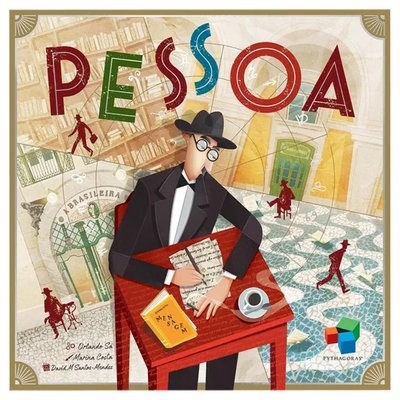
edition at home and you haven't played through a ton of it play through that yep and so that's it that is the trail at house on the hill third edition all right moving on to the last title of the day this is a game that is not quite as heavy as the first two on the list but one that is that we're really excited to talk about yeah this is none other than pessoa designed by orlando and published by pythagoras they are a portuguese company and they've also done cafe which is a game that we were really really gay and we really love yes and also uh porto was another one that we enjoyed when we played at edison yeah and so this is a game that is based off of a poet a really famous uh portuguese poet by the name of fernando pessoa and so i believe the thing that is unique and very very interesting about uh him as a poet is his use of heteronyms which is a concept that we just learned yeah in playing this game one of our really good friends actually taught us this game and he explained the concept of the heteronyms as him having almost like different poets in his head that he would write uh right you can write about different subject matter and different styles for each of these different heteronyms or these different uh kind of characters that he had built up in his mind yeah so it's the same poet but different people that he's writing under with totally different styles exactly so i thought that was super cool right like what a really beautiful artistic way to express yourself and so this game is is pretty much a play on that so you have this main board in the middle it's mainly a worker placement game and everybody plays as a different heteronym the main purpose of
the game is you're constructing poetry and the poetry is in the form of these cards each card has an excerpt from one of his poems and you're basically set collecting you're trying to get uh ascending numbers of cards to turn them in to form a poem each card is one of three different suits and the suits are the colors they they have to do with the type of poetry that he was writing right people have different abilities depending on which heteronym they are but the basic concept of the worker placement which is one of the unique parts of the game is there's only one space per area where you can place your worker and so if say naveen has placed a worker in an area that i want to go to it's completely blocked out my options are i can spend a resource to basically embody fernando peso himself which is a different meeple right and then i can go and place that that token on a spot that's specifically reserved for his meeple yeah there's there's only two spots per different uh action location and one of those two spots is if you have the pessoa meeple itself yeah so there comes a time where you're like okay i need to like become pessoa so i can take this specific action alternatively if pesos meeple is already at that location i can go into the middle which is a metaphysical space that lets me activate the location of where his token is already is exactly yeah so that is kind of the unique work replacement part of it other than that you're you're doing things like mainly gaining cards in two of the regions one region allows you to actually build the poem and then the the fourth region just allows you to kind of build up an engine of sorts there's a little bit of astrology that has to do with timing as
to when you're taking actions which round yeah because there's 12 rounds in the game and there's kind of this wheel that turns and certain astrological signs are going to be in these different pie shapes that are that correspond to the different locations so if you were to turn in cards that have the same astrological symbol on it in that location when it's lined up just right you get a benefit which is always something you're trying to time so that adds a little bit more to the strategy of the game that's the basic concept of the game it's kind of hard to describe also without being in front of you because this is another unique uh unique experience there's also an advanced variant where you can have basically these end game scoring cards but the the way in which you play them is kind of unique right you play a card then you have to you have to draft them yeah afterwards yeah yeah yeah it's called the advanced variant i would highly recommend playing with that as yeah first play with it yes if if you're a seasoned gamer um because it adds a little bit extra especially with the card drafting it's like when you acquire these end game scoring cards you can actually look out and say like i don't want to pass this to monique because she unknowingly is working towards this card so then you have to have a decision point of like i guess i have to hold on to this because this is going to score her a bunch of points so here here's another card that you know you're gonna have to take so yeah it adds a little element right there also this game scales very well at two three and four you just basically put uh kind of like dummy blockers so all the action spots are gonna still be as competitive in any of the player counts right so what are your thoughts yeah it's a fairly light game um it is more of a casual game for me uh it's nothing that like i'm gonna be like oh
my gosh like i need to get that yellow one otherwise this is gonna ruin everything for me um so it's kind of like a like this is a good like conversational game you can be hanging out with your friends you know playing a car taking an action being like oh shoot monique went there okay how do i pivot and then you just go right back into kind of your conversation so right it's it's lighter i think this is a game that i'm probably going to want to play with my family with my parents because i think they could they could understand the concepts here and and still enjoy themselves and how about yourself yeah i actually thought that the game was was really interesting it's uh it is on the lighter end it's not it's not super heavy but it is it feels quite unique you know the work replacement part of it feels different it feels fresh and that is probably the tightest part of it for me like figuring out how to get what i need to do uh with the resources that i have because you have these like creativity that you're spending as resources yeah we didn't mention this also turn order matters whoever is going to be going first so you can go from first to going last quick like because somebody took pessoa yes that's true so that part of it is interesting to me i just think that the main mechanism of the game which is set collection of the cards and turning them in for points is not the most interesting for a few reasons i i felt like it's just not that hard to get the cards yeah there are two locations that get you cards and they get you cards in different ways and i always kind of just had the cards that i needed yeah because if you feel like well i need gray and there's some there and i have the opportunity to take it that'll be my action i'll go take the cards yeah and on the other hand when you can see because there's a fourth location on the left hand side here that you can utilize
that'll help build up your board to make certain cards worth more points because there is some asymmetry in the way that you score your poetry depending on which header name you are and so that part it is also hard to stop people from like once they built up their engine and it's like oh shoot well naveen is going to score four points for every purple card stop him you can't stop him you can't do that he's gonna get all the purple cards he needs because of that taking up the cards but i really like the timing on the game it's very fast it does not overstay its welcome at all and what the thing that i really like about this game is the theme i mean it is so beautiful the art style every single card has a piece of poetry on it and it's both in english and in portuguese which i totally think that the translation gets lost in english probably it makes me want to learn you know portuguese just so i think of what is truly being said in portuguese just so i can read it the way it was written yeah and experience it the way it was meant to be experienced but um it's just so beautiful if you're into you know games that have cultural expression in them or you know portuguese games especially then this is definitely one that you should check out because it's just so beautiful and it does it does play fairly uniquely and so overall this is kind of a in the middle of a game for me it's not the most exciting it's not one that kind of screams off my shelf but it's definitely one that we'd love to keep around for a little bit longer just because it's so quick to play and it is it's a it's an interesting experience it's art in itself yeah it's art in itself exactly and so that is all right well that is it for today's episode uh we really hope you enjoy the games that we discussed today we're gonna be doing more of these you know as
the summer kind of presses on press is on i guess keep on keep keeping on right we have a lot of games that we have to talk about that have been waiting i guess for us they're ready for another let's talk board game segment that's for sure and so if you have any recommendations for games to play i am still on my mission to play as many board games as possible during the summers especially since i am doing this full time now please feel free to leave them in the comments below and of course let us know if you've played any of the games that we talked about today let us know how you feel about them and uh we'll see you later thank you all so much for watching the video we hope you enjoyed it if you like to see more videos like this in the future please consider subscribing thank you thanks bye you