KABUKI TRICKS vs. LUZ | 2 TWISTS on Trick Taking!
Games in This Video
2 games are featured in this video — they unlock as you watch.

Transcript
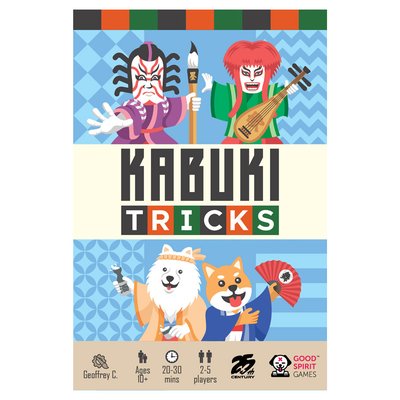
Hey everybody, Kimberly here and I've got two tricktaking games for you to look at. I'm going to talk about their style of play, a little bit about the theme, and overall which one I would rather play and why. So, I've got Kabuki Tricks and lose. So, let's take a look at these. Kabuki Tricks, it says, is uh two to five players, 20 to 30 minutes to play. Uh, and it's designed by Jeffrey C and distributed by 21st Century Games and Good Spirit Games. You can see right here it's it's trying something with the theme even though as trick-T games these are abstract for the most part. Uh, on the other hand, I've got lose over here. Three to five. So, a little bit of a, you know, fewer player count here. Um, 30 minutes. So, on the top end of the Kabuki Tricks Time designed by Taiki Shinszawa and distributed by Yellow, a little bit bigger box, but here the theme is going to be uh paired well with the abstract theme. And I guess maybe I'll just start there. When you've got Kabuki Tricks, it's all about the Kabuki theater and it's about the music. For me, it's trying just a bit too hard for the theme when honestly this is just a trick-taking game. And a lot of trick- ticking games um are just that I don't really feel like the the theme is going to really nab me. And so I prefer something that kind of fits the more abstract style of the gameplay. And in
this case, it's loose. I think it kind of pulls me in a little bit more. It's just got pretty colors and shapes. It just feels again kind of abstract. And you've got these five different suits, these colors that have great iconography. And the cards are just a little bit bigger here, which is why I think the box is a bit bigger. And you've got components for these little gem. These are just like those fish tank beads. And so you've got a couple of those guys. They feel really good and they sound really good, too. Um score pads for each. Let's dive into the actual game play. Um so with Kabuki, you've got phase one is deal the cards. But in this case, you've also got set up as part of the game. There are four different suits. And this really cool card right here says high number, but it says low number. So, in this game, Kabuki Tricks, your uh winning card of your lead suit in a trick-taking game is going to either value the lowest card in that suit or the highest. And in this case, the yellow suit is going to be um of uh it's going to break ties over green. Green is going to break ties over blue and purple and going down the line.
So, if you play a purple and uh you have to follow the lead, but then one person plays any card higher, they're going to win the hand as long as they didn't have a purple um which was the lead card play. So, this is interesting because these are going to change uh based on the hands. There's five hands and the start player is going to determine high number, low number, and the entire order of these cards based on their hand. So, players are going to be dealt their hand. They've got uh these cards. Now, these cards are going to value uh all the way from one to 10 in all the suits. And then you also have a zero trick joker. Now, this is where the game gets pretty interesting. So, in your hand, if you want to play and lose the the trick, you will play from your hand. Now, notice that every card, everybody's going to have this card in their hand. It matches the actual um cards that you're playing with. They can play this card instead of playing a number card from their hand and they're saying, "I lose." But they are going to be able to bet how many tricks they are going to win. There's a one trick card, a two trick card, or a three trick card. And every player has a set of these. And what you do is you place it above the or below, whichever way you place it above or below one of the four suits. And what you're saying, oop, sorry, put it face down. You want to make sure you place it face down.
Don't tell everybody what you have, but you'll see there it's really pretty and it matches. So, I like that. But you'll play it face down and you'll say that's the amount of tricks that I think I'm going to win. And the remaining card in my hand I will get a bonus point for if it's purple. So, I'm essentially saying I I I want to win this many tricks and this card is going to give me a bonus. Uh however, if somebody else bids the value trick that you bet, um whether they get it or not will be based on this value right here. It says that if you are correct, it's going to value the person who's highest up on the ranking and you'll get two points versus the person who is lower down is going to receive just one point. And then that says if your final card F matches your uh check value, then it's going to be the star. So, there's some interesting features to the betting. You can also go nil. If this is the last card in your hand, you're saying I'm going nil. Um, so nil is going to pay out pretty good, but every trick you earn is going to give you a point. And then getting your uh bet is going to give you a point. And having the remaining card in your hand is going to give you a point. And that is going to be your five total rounds.
Again, the the kind of variability here is that the uh order of your trump suits or the value of which suit is uh higher than the others is going to change as is the high or low value. So, that's the gist of Kabuki tricks. Over here, I've got lose. And loose is interesting in the sense that you can't see your uh value of your cards, but you can see the suit of your cards. So, again, there are going to be five suits here instead of four. The yellow suit is the trump suit always. And so you're going to be playing uh as according to again trick- taking rules, traditional rules, which is the person who leads into the hand will set the suit and then everybody has to play in that suit if they can. Um and then they get to choose their card. Now, what's crazy about this game is you're going to deal your uh cards to your players. You're going to deal them.
You're going to shuffle up the deck. Oh, look. The suits are on the back. So, I know this is a blue suit. I just don't know it's a seven. So, we're going to shuffle up all these cards. You're going to deal them out to players, and then the player uh to your right is going to be ordering your cards uh for you, and then they're going to pass you your cards with one of these guys that's going to tell you where the high value cards are in each suit. So, let me show you what the rules offer because this is really, really helpful. So, this is going to be part of that. You are going to order your cards. You'll see here there's two blue cards. 74. Then there's two greens. It's uh what is it? Oh, it's Yeah, 74 and then 86. Sorry, I had to lean down and see that guy really far. There's a seven yellow. Then there's a 62. Then there was a 421 of purple. So you do it this way or you do it this way. Again, that always uh stipulates that these are the highest. And you want to put them in their suit colors, not in just their numerical uh order. Then you pass your hand face down to the player on your left. And then that person is going to simply hold their cards like this. So let's say I get all my cards.
I'm going to hold them like this. So I can see my cards, right? I'm looking at my cards and I go, "Well, I mean, they're not going to be like this. They're going to be in the order inside of the suit color. So let me just distribute it that way. There we go." And then what they see is this. And so everybody else sees my values. I don't. So, the lead person's going to go, "Okay, I'm going to put that card down." And now everyone has to play a green if they can. And then they pick which one they want to play. Do they think they have a higher value? And do they want to essentially win the trick or not? And players are simply going to play out every single card as a hand. And that's going to be one of the four rounds in the game. Now you have to bet before unlike in Kabuki tricks you have to say I think I'm going to uh essentially win and you take these gemies in your hand. You go in turn order and you say I'm going to win three. So you take three and uh that's it. You either say I'm going to get three or I'm not. If you get two, you get one. You get four, you get five.
Whatever it is, if you don't get exactly what you say, um you are not going to earn points for each round. And in this case, every round is going to get valued higher. So if you get your bid exactly, um, you get 10 points, second round 20 points, third round 30 points, fourth round 40 points. But if you want to hedge your bets and you pick this guy right here, this is going to be um kind of like uh what do they call it? It's uh something. It's called the uh safety bead. It's like the safety dance. So, if you take this guy along with your bid, you're saying I'm going to get three or four. And you win if you get three or four, but the payout is half. So, you'll see here that if you hedge your bets a little bit, you're going to receive half points. Now, the penalty for not hitting your mark is five points per car or per trick that you are off your mark. So, there's always a penalty. There's always a payout. And your payout can be half points or it can be full points. And it depends on if you take this safety beat or not. So, when you're looking at your hand and you're looking at everybody else's hand, you can see their values.
You're kind of figuring out where do I think I lie and like what my values are, what strength I have. Particularly when it comes to the suits as well. If you've got a lot of the yellow cards, those are going to be the trump cards that are going to probably win you a couple hands. Uh depending on the order and depending on how many other cards are yellow in the game, which all the cards are not dealt out to players. So, there are still some values and some suits that are just not in every single hand, yet they're shuffled back together for the next round. So, you're looking at everyone's cards and you're wondering, "What can I actually win?" And the player order of who's going to tell what tricks they're going to earn changes every round. So you need to really listen to the information from your fellow peers. Like how how many are they taking and then how many do I think I can take. So lose has a lot of variability and flux. And I will say that my very first game of this was pretty wild. And uh a player in my game was last last and then won big in round four and won the game and and actually it was on a tie. Um and ties they do resolve ties with one tiebreaker. So it was pretty wild, pretty exciting. Um I think bidding with your safety bet is a good way to go, but it's also half points, so you may not be getting those big leaps and bounds. Missing your mark definitely hurts with five points per trick that you've taken. But the the kind of catch here with L lose the kind of like pitch is that you can't see your
values, but you can see your suits. And that's really interesting because you're you know where like if you play your highest card and it's a four, you know that everything is going to be lower than a four. So you don't really have very many high cards. So you're going to get information. You're going to have to remember some things. Um but it's interesting. Kabuki Tricks over here on the other hand has this valuing system that goes to uh the start player and it's a really powerful move. Um they can essentially say I want I have low cards so I'm going to say low number and you can um order these however you want. Now, one cool thing about this game is that when you play your joker, not only do you get to put your bid out for one, two, or three tricks, you optionally have the choice to change low number to high number, or you can swap two adjacent suits. And now the order of suits and the value of these um going up in Trump or going down in Trump uh order changes. And so every person that does the Joker is going to be able to do one of those modifications which changes up the game in the middle of the game. This game is always in flux. This one you have to bet from the start and really work towards getting it and making sure that you are in the right order for it.
Both are going to be 20 to 30 minutes to play. This one does require 3 to five, which is a little bit harder for my group. And then Kabuki Tricks is for two to five. I will say though that the game I'm leaning a little bit more towards that I found a little bit more engaging and trick-taking classically with a twist is going to be lose. For me that's the game I would prefer to pull out more often than Kabuki tricks, but for me both of these are kind of like those middling trick- takingaking games. I have played more engaging ones that probably overall I would want to play a little bit more, but I do find loses pulling me back a little bit. It does have some big big fluctuations though, some really big twists in earning. And Kabuki Tricks has a little bit more of a consistent round uh structure with five rounds and you get to earn tricks um even if you're not meeting your mark. Um unless you do of course nail and you don't get it, that's a big five pointer. It's a risky move to make, but it's five points or it's none points. So you're kind of just doing a you know go big or go home kind of thing. So, that's going to be it for me with LSE and with Kabuki Tricks. Uh, both out now. Check them out if they sounded interesting to you, particularly the twist that they have on trick taking. All right, everybody. I'll see you later. Bye.