Gezockt 10 SPIEL 26 Neuheiten im Intensiv Check | Nokusu Dice vs. Schadenfreude - Neuer alter König?

Transcript
โ So, it got dark for a moment and then light. There's a lot to report. Lots of exciting new things were on the table. You've already seen them in the thumbnail, right? A Koso DB game, ten years old, which is unfortunately not available in German right now. Only Kosu Dai, 6 years old, half game, soon to be available in German. We are looking at a battle here, and for me, there is a completely unmistakable winner. But before we get to that, I just want to respond to two comments that I'm really happy about. I receive a great many positive inquiries, but there is something I truly ask some people, and I would like to take this opportunity to ask it once more, since the question that was on my mind was, how do you manage to do that, and how exactly is it that you go about doing it? Playing so much, preparing so much, showing so much? That is quite a bit of work, and there is a large amount of preparation that goes into it. Just summarizing a game in three to five sentences. Sometimes there are one to
two hours of work invested in every game. That might be a bit much, perhaps a little too much, but obviously I have to invest all of this time into the preparation, and then I also have to play everything on top of that. New releases have arrived today. I'm really excited about them. Batman is here, and we have a game that was created by Christian Kudal and Michael Löder Andersen right here for you. It's called Combo Creatures and is supposed to be really exciting. Then Black Flag has arrived here. You can see it in the back, there's a Bang. It's kind of like a pirate Bang. I like to watch it too. And probably a bit less well-known, but maybe you've seen it somewhere, a cute little family game called Rainrops, also by DV Games. And here are a couple or three things lying around and yes, they all have to be played and wanted to be played. And the one answer to how I manage all of this is, of course, that I have now become self-employed with this whole endeavor, which is basically my primary occupation, and that I am earning my living through it and through all the projects that have developed around it. And that is simply the beauty of it: it does happen sometimes that people turn their hobby into a profession, and then it truly becomes a job, so that one no longer engages in the aspects of it that were once enjoyable. And I recently saw that a YouTuber stopped after over 10 or 15 years, a YouTuber from the English-speaking world, who said: He has not enjoyed it for 10 years anymore and only plays the games because he thinks that he must continue doing it, simply because he has a Patreon account running. But now he is doing something else that he has prepared for, and he is much happier with that particular situation. And I am, thank God, extremely lucky—and I am incredibly grateful for this—that it is possible for me to combine my hobby, my passion, and my profession all into one, and
that I am able to work as a freelancer, which is always a risk, which is not always easy, and which also must continue to develop further in the very direction in which it is currently evolving and moving forward for me at this present moment in my life. It is not as if I am able to do hundreds of thousands of games every single year and then retire comfortably on the proceeds. It's really risky, but it's just fun. I can do what I feel like doing, what interests you, and what enough people are interested in, so that it sustains itself and I can put all my time into it. And that is certainly a major advantage, having your hobby and passion in one, but none of that would work out in the way that you might expect. Take a look at last January. We had the idea to do a classic January. We thought about it on Wednesday. On Thursday, we had the first classic on the table, and from that Thursday until three weeks later, we have had between one and five classics on the table every single day.
And I can't do that alone. This is only possible because I have such wonderful friends who are just as enthusiastic about gaming as I am, who share that exact same passion and fervor for it, even though they obviously cannot dedicate the same amount of time to these games as I am able to do myself. I basically don't do anything else, right? He still has a family, a job, other things, but his passion is strong and he himself, as you probably know, is usually the one in gaming circles who brings the games and you have to convince other people to play them. I have some great friends who bring along games themselves that I have never even heard of before. They get every Kickstarter and can put them on my table if they have the time. They are still so deep into it themselves and play so much that, in a way, everyone ends up playing along as well. And without my friends, and without those who are now both close friends and people within my circle who are merely acquaintances—the ones you encounter here and there, with whom you do not interact much but still meet up with occasionally to play—they simply would not be part of this group if they were not also truly pleasant people, and that is, above all else, the key to success. So without the help of my friends, I simply wouldn't be who I am today. And it is not just Flo, Karl and Vincens that are involved here, it is also Markus as well. I do not want to start listing any names here, because I would inevitably end up forgetting someone, and everyone who is there every now and then every few months to say: "Hey, I am taking part in this, I am joining the stream, and I am playing along with everything," that is simply super wonderful. For that, a huge, huge , huge thank you. And that is truly the secret as to why I am able to play and show so much, because these are also people who say: "Yes, of course, let us play it once, let us play it twice, let us play it three times, so that you can also say something about it." So, in
any case, another huge, huge, huge thank you to everyone who is involved. And that is the secret: good friends, plenty of time, and the very opportunity to do this whole thing independently. We will come back to that point later on. But for now, let us move on to what we are actually here for, namely the little disclaimer first , shall we? As always, these are merely initial impressions, personal opinions, and group experiences that can continue to evolve, and that is certainly the case regarding the very first game. We played Ras Dance of Love. It's being released in German by Pegasus, I'll have to adjust that again. And, uh, yeah, it takes 30 to 90 minutes. Complexity 2.5 out of 5. I think that's almost a bit much. One to six people. That's the beauty. Many people found Fromage interesting because you can simply play it in parallel with up to four, five, six people—I believe it is six people, no, wait, four is four —that is something you can do. And you can do that with Last Dance of Love too. And I personally think it looks like a mess of plastic paint, but then again, what do I really know? I'm completely red-green colorblind. For starters, it is quite nice that this tableau here in the center is meant to represent dancers, where the costumes swing and circle around, and in that regard, it really is quite a nice sight to behold. There is also, as you can see here on the cards, which always tell you which dice value is counted in which round. There is also a QR code on the top side, and it is possible for you to scan this QR code. We can never do that during the live streams, in order to listen to Indian music that fits the theme. And that is of course quite nice as well, and it has a
completely different sort of impact. And in terms of its basic principle, it is more of a family plus connoisseur game, I would classify it, especially in the basic version. And we have already talked about it during the Pegasus press day; that was where Karl, Flo, and I sat down and played the game together for the first time. And yes, it was somehow okay, quite nice, though I am not entirely sure. And last Sunday , we just watched you sometimes and played it once again here, that is what we ended up doing anyway. There were four or five of us, five people. And it was very well received. So, it was fun. It was clear that in the end it's a case of we're going up the ladders, because what do you do in the game? You have a small board here and on this board, if you show it with an F, I have the multiplier located right here in this specific position on the display for you. The more matching dice that I have, the more points I will receive for them. Let's say we score the two in a round and I have a two right here, I have a two right here, I have a two right there; that gives me three twos, so in that specific case, 12 points would turn out to be a total of 66 points. And we have the same thing here for these dancing sticks, which you can also see here, right? She's holding them in the drawing. These are the ones you collect here. If they happen to match the dice, then I also have a multiplier there that I am able to increase accordingly. Or we also have clothes here, right? That means that these round discs, which we normally place in here, are always used in this position, aren't they? When they match the die that is lying there, and once we have driven that multiplier up, we are going to receive a very large number of points for that move. So that is, in principle, what you do in this game, where you make sure to obtain matching dice with the corresponding round circles, the matching markers, and the matching numbers, which can certainly change over time, and then
you proceed to drive up those multiplier bars accordingly. We also have a bar, this heart bar, you can see this heart marker here, whenever there are couples, when there are weddings, that are coming up, then the marker here moves forward. Then I can simply move the markers here on the tracks forward, I am able to use actions again , I can advance various different markers and so on and so forth as the game progresses. And the basic mechanic is really just that when it is my turn, I look to see which wheel I would like to have, and let us imagine for a moment that I was sitting right here and looking out across the playing field. That means, no, all the things, in this case it's always pink, which points to me, right? In this case, these are two very different wheels. We have a card on which C is written. I can consider for myself which of these wheels I would like to move to, and if I now decide for some particular reason that it must be wheel A, then I would simply place the A card face down in front of myself to indicate my choice.
Once everyone has finished that, we reveal them, and now I receive a die which is a bit difficult for me in terms of color, but I am hoping that it is brown, or perhaps red, though it is likely brown. I receive it with a two, can then place it somewhere here on my board, and subsequently, I can examine the action that is linked to it, which would consist of me advancing my starting multiplier further ahead. If I had said D, I would receive a five-value die, which I could place anywhere on my board, and that would allow me to advance my die modifier further along the track. Or here I could roll a die to any number. Here I could look for a piece of clothing from the bag. It also has transparent loot, which is very interesting. Or draw two random ones. I could take one stick here, or perhaps I could draw two random ones instead. Here I could place my clothing marker further to the front , and these are, in essence, the kinds of stories that one typically goes about creating. That means we take a look at the game board and consider what we want, because we can also see that, okay, the twos are going to be scored during this current round. That means I can already start looking around, where can I get a two here? Aha , here on wheel A for example. And then it's also quite practical. I said that marriages are also good if either two wheels that are adjacent in a segment display the same color, or if it happens the way it is here, where it occurs nowhere else at the moment, right? If these were both fives here, then we would also have a marriage in that case. And every single time that I now choose the Aad, I would receive one of those brown dice on a two instead of anything else. I would be permitted to push my starting module modifier forward, and I would then move my heart marker one space further on this track here for a wedding. Should I have another wedding, I would be allowed to move it one more space further and would then be permitted to perform both of these actions as well. And that's
all we do in the game, right? So just look, right: What is being scored this round? What actions do I have? Which multipliers do I want to push forward? Do I want to have a lot of rods? Do I want to have specific dice, specific dice numbers, or perhaps even certain colors for the dice? Because I always receive 15 points here whenever those three matching colored dice are placed, I also have to consider: How can I best combine these elements so that I am able to advance effectively along this track? So what do I do if there is no die that fits the round? If we are still in the first round, should I perhaps take a die that already fits round three, provided that I have the opportunity to do so at that point? Or should I rather try to obtain some kind of die, which I then place somewhere to create a match with the sticks, and in return for that, advance my multiplier or get more of those specific sticks instead? Or–or is that how the whole game works in the family version? And the cool thing is: We all play in parallel, everyone looks at: What do I need? Okay, there you get the die, and I receive the action, we place the card face down, reveal it, and then, provided that one is playing it for the second or third time, it is also possible to carry out all of those steps in parallel. We played for 30, 40 minutes. That was the basic version, and if you reduce it, it really just comes down to moving up on ledges, where we have these plastic pieces placed on the game board. You may or may not like it, but it was well received in the group, especially the short playing time with the idea of: " Yes, we do an achievement here, there too and get the things there." Doing puzzles, but just a small one that you have to solve to see: what is it that I am supposed to be doing right now? The action, not passing? And then there's the advanced version, which I don't have any photos of right now. In the advanced version, because you can see it right here, there is this outer track located on this particular game
board that we are looking at. This is the bar where the points are tracked, and then there is this inner bar, the prayer bar or encounter bar, which is not utilized at all during the normal course of the game. It's only used in the advanced game. And then it's like this: You are always looking, and then these internal actions count here as well. And incidentally, it is also the case that after every round—depending on the dice roll—the inner wheel is turned by, let us say, two positions; then all the outer wheels turn with it through some gear mechanism, just like in what's-it-called, like in Witness. And the markers that are on there are also just discs that turn a certain number of times depending on how often the people have used them. There is also a relatively high amount of variation in it. And exactly, when I then go onto a wheel alone in the advanced version and have chosen the B card for my own sake, I am permitted to perform the action that points towards me, as well as the other one. In this case, it is this pink action involving the two items of clothing, and I am also allowed to perform the action that points to the middle tile, which is this one here; I am moving my starting module tifier to the front position. If two of us move onto such a tile together, that is not permitted; instead, you must look at this symbol which indicates that multiple players are allowed. Then I get as many of these prayer points as the number indicates. Sometimes I also just want to be somewhere where other people are present, because that is how I continue to make progress along this specific track. And then there are also goals that are displayed, I haven't photographed them yet. That's just the way it is. Maybe they are on here. No, I can also complete them at some point in the game if I have fulfilled the prerequisite and I want to fulfill them
. Because the very moment that I fulfill them, I receive the number of my prayer points for it as victory points awarded on top of my total. And that increases the strategic depth once more significantly, as does the assessment of what the others are doing , where they are heading, where I am not alone; that whole aspect has also worked out well. It didn't drastically increase the playing time, although sometimes it took longer, sometimes she thought about it longer, sometimes he thought about it longer, but it also felt like, we checked it, it was no more than 40, 45 minutes. It went relatively quickly, and it is definitely on that Family Plus level, a sort of light connoisseur game that you can play through quite comfortably, where you always have something to do and are always considering which path you should take next. Aha, I have my dice, I place it down there, and I push the marker up. Okay, that was already the next round. So it was played quickly and simply a nice thing. If you play this within hardcore circles of heavy gamers who want to min-max everything, then it may be—let us say —somewhat dependent on whether I obtain it or not, and whether the correct nations for my specific purposes were available to me or if they simply were not. But playing it in a group of five people, as we did, was something that was definitely a lot of fun for us to experience together. So, I hope the picture and sound worked, a lot of things worked, and a lot of things worked. I'm already halfway into the chat. The new features that I have introduced are of course quite diverse, which is why I hope that there will be something here for everyone to enjoy.
But I know that some people would rather say, no, no, it has to be something like a Kings Crown, it absolutely has to be something like a Grenville. That's the beauty of it. The gaming world is so diverse. I don't believe there are that many people who would say that they find all the games which B showed to be great and that they want to purchase every single one of them. Uh, that's easy, and that's the art, right? Some people are just more involved in the hobby than others, and they spend significantly more time on the research aspect, wouldn't you say? What I am doing here, the pulling out of everything and the preparation, that naturally takes time, and then there are of course also people who are perhaps simply grateful for that, I would hope at least for it. If you are presented with a video in which twenty new items are shown to you and you think: "Yeah, no, I am not interested," although one might have looked halfway exciting, or perhaps none of them did, it is actually quite liberating to realize that you already possess everything you need and desire nothing new anymore. Someone even wrote: "So, is shopping closed for you now?", to which I responded to myself: "But there are still a few more videos on the way. " So yeah, it's always very nice, isn't it? Some people go to a game and think, I don't really need anything from two expansions, and say: "Wow, that's that.
" Maybe not perfect. I do not know if I have already mentioned that in a video before. We definitely played it recently, the one by Friedemann Friese, but it is not called Faby Fot Perfect; instead, it is actually titled Maybe Not Perfect. That is the reason why it was not published by 2 F-Spieler, but instead by Edition Spielwiese. Two to six players, 15 to 20 minutes playing time, ages 8 and up. And basically, you get three cards with three professions. For example, there were blacksmiths, researchers, and pilots, and then you have a card—which is not visible here —that basically displays exactly these symbols arranged in a specific sequence for you to follow. Check mark X question mark or question mark check mark X or whatever combination works. I have to arrange the cards in my hand somehow, lay them down, and then I must say something like scrap metal. Now he and the group have to consider, okay, what exactly does he mean by that?
Which of the various terms that are lying there actually fits the concept of scrap metal in a way that is perfectly suited? Which one fits scrap metal a little bit, and which one does not fit scrap metal at all? You just need to think about it, discuss it together, then sort through the cards in some way, and after that, the whole thing will be resolved at last. That's actually the whole game. It's entertaining, it's funny, it's entertaining. We will talk about another game in a moment, which we played before in our group of five, and which entertained us much more, even though it is significantly simpler when you look at its basic underlying principle. But it was quite nice, the kind of terms you sometimes have to come up with, and how you have to pull them out of thin air just so you have something for the others to guess, and then a little discussion simply follows as a result. It's the kind of game that doesn't hurt. For those cozy, casual rounds, you can definitely put it to good use. Then we have, huh, that is precisely the game; maybe I should have played it in a different order, huh, which is something that I have already spoken about before. I have played a few more rounds now, and it is just as simple as it is truly great. In the Monday and the Sunday rounds that we held, where we were first four people and then eventually five, that is when we just played through it. And we did not play just one round, we did not play two rounds, and we did not play three rounds; no, we played a total of four rounds through to the very end of the game. I wouldn't have said, "Hand me that green game in the corner," and then we would have gone on to play another five or six rounds together.
Although, once you hear it for yourselves, you will not believe how much fun it actually is. That's exactly the story, right? We have a card here that is marked as category 2, so I am going to go ahead and take that one into my hand. On the other side, there are terms like in the forest, in the gym, or something poisonous, and then on the other card, there would again be something like category five. That means, okay, category five would be something poisonous, and then you have to start—well, you can then give four tips by using the letters that are available to you there, which you must use for the task. In this case, BndM, and we also have to think about something poisonous, which tip do you give that is as clear as possible? Because every single time that we provide a tip, we are required to take one of these yellow markers and place it down on top of that spot. And we are able to use up to four tips in order to guess the whole thing, but after that, all the tokens are placed back into the game box. And when we have played eight cards, we check how many turns we needed, and if it is more than ten, we are already outside of the best category, and then precisely that which occurred on Sunday happens again. One more time, we can do it. And then we needed about 12 the first time, and wow , we are definitely going to crack the ten mark this time around. Let's do it again, let's do it now. Yes, for the second one we needed 20, now we have another one immediately, we are going to manage that. Then we needed 15, then we said, let's do it again. Then I believe we needed 30 clues, we say come on, we can do this one more time, and just like that, we do it all over again . And we did, I don't think we ever made it to the top, but the group could have played it over and over again, and it wasn't just a "we only play Humlumti games" group, it was also a "we play all the big expert breaker games group" , but we had fun and it was just the right group. There were five of us, it was such a fun group, and the kitchen
was packed once again, wasn't it? Unfortunately, we have been getting such large groups together here quite rarely lately, but we definitely will not have that problem anymore starting the week after next. And then it's not the kitchen, but our studio. And um, yeah, that was entertaining, entertaining, good. As I said, it sounds way too simple to be any good, but not in that specific "Just One" kind of way. I do not believe that we will see that here at the Game of the Year awards in the coming year, to be honest. Anything is possible. I would be a little bit worried, I don't want to rule anything out. The jury was capable of one thing, but it was entertaining in every single round, and through the four different rounds so far, the thing has been an absolute smash hit, which has taken me by surprise to some extent. Because when I heard the pitch, when I read through it differently, and when I looked at it all by myself, I thought: You are just playing this to do the publisher and those two guys a nice favor, and then you report on it once more, and then it will simply disappear. It is quite entertaining, and this specific concept has already been featured in countless different variations of various games.
What can I do? Games should be fun. It's fun, I can recommend it. Then we played Zitters Duel and underneath it, it says that it is the German edition. They could have called it Duel with Two , they could have saved themselves that . They could have simply called it Fearless and Noble without any further ado. It might have been a better marketing decision, as Citadels is the international title for Ohne Furcht und Adel. If you belong to my generation or are even older, the name Citadels might not ring a bell for you, whereas Ohne Furcht und Adel certainly should. It originates from the early 2000s, I believe, and it is a game designed by Bruno Faidutti. It is the type of game where one is, well, expected to pass various character cards around the table as part of the core gameplay mechanic. You take one at a time and then they're called up in turn: I call up the assassin, I call up the thief, I call up the builder, I call up the abbot, and each of them can do something, and the goal is to build as many houses as possible, so that they score as many points as possible. And yes, internationally, Zel is marketed as Duel, but in German, everyone knows it under the title Fearless and Nobility, and Fearless and Duel might have been quite a nice alternative for that particular version of the game as well. Now there is this specific two-player version available, and that is what we have played. It was okay, so I have to play it again, but I have also read about it on Boardgekon now and have taken the time to watch a few videos about it as well. A lot of people who are a bit older or younger than me will get it. War Without Fear and Ad was a cool game back then. It's still fun today. The market has naturally grown a bit, and we have to see whether it is still capable of surviving as a game in the current climate or whether it is not. And I would say that it is entertaining, but
there are truly a lot of good alternatives and always things like, yeah, it says Batman on it, uh, it says Tets on it, I simply have to have that, because I watched that during my childhood, don't you think? You can do that. Everyone is naturally free to spend their money as they please, but I question whether it is necessary to just acquire items that sit on a shelf and are never actually played. You can also invest the money in other ways. And the basic premise of the game remains the same to begin with. We have two, so you can see on my player board that I have two buildings here. These are special buildings that only I have, that only I can build, but that can be taken over by the opponent. We have two starting buildings in the middle. We have 4 x 4 buildings on the right, a pool of 16 buildings. And as soon as the building grid is 4 x 4 in size, the game comes to an end. Then the round is somehow played out until the end, or I believe that it is all over immediately . The building is still being dealt with. Then it is scored whoever gets the most points. That means who has, you see, the buildings, in this case, are always either light or dark. If they are dark buildings, they are mine.
If these buildings are light-colored, they are Kar. That means, whenever you are building them, you require the exact amount of money that is indicated on the tiles. Then you can build the building, you have converted money into points. If similar buildings are adjacent, you add extra money markers to them, which makes them more valuable , and yes, exactly, those are basically the points and so on, with the four by four grid signaling the end of the game . When I play something like this, there are cards such as the Warmonger; when she is activated, you are able to take over a building from someone else, and provided that certain conditions are met, you then turn it over to the other side. That means, of course, also taking care to ensure that the good and valuable buildings are held within your own personal possession. This is also the reason why the game ends immediately at the 16th building, because the effects that could still take over buildings later on are no longer being activated at that specific point in time. And the buildings usually don't do anything. They just have some sort of symbols on them that, in turn, interact with something else again. Um, my special buildings can give me some advantages. There are these seats within the wheel, which act as a sort of soft power that you possess, where you can also choose to spend resources in order to acquire more gold, perhaps for the purpose of flipping buildings. When you play the king, you can place a city guard somewhere, which ensures the buildings are protected; they cannot be taken over, and it means that no money can be taken away from them, nor can any money be placed onto them. Of course, that's always very practical. B, which I believe only moves a single time, and here as well we have eight, nine, nine character cards available in the game, don't we? Take the king here, for example; we can see whether we are able to read what is written on it, if we can read it. Win a seat in the wheel, and gain one wheel for every single crown that you control. That means there must be crown tokens on the cards
here, and then we will receive even more of these seats in the wheel; furthermore, when you move the King's Guard, you are allowed to place one gold from the general supply onto the King's Guard building, is that correct? That means I am able to do that, since there are nine cards available at the very beginning. One is always removed each round, and the other four are distributed among the players, so everyone receives four. Then I select two of them that I want to keep, pass the others to the two fellow players, receive two from them in return, and then I have four cards in my hand, from which I will take one more card out. That means it is highly probable that I know what the other player has in their hand. I am not familiar with the card that was laid out at the very beginning . So I really do not know, is the builder in there or is he not? Is the thief in there or not? Is the assassin in there or not? And I do not know, of the two cards I once gave to another player, does he still have them in his hand or has he already discarded one of them? And also regarding the other cards, of which I know four, I myself know four, because he could have the 35 , and I do not know which one of them was laid down there, nor do I know what was played by him. That means that you have a little bit of information, you already have a lot, but you don't have all the information. And of course, one could also consider: Okay, what would be the best thing that one could possibly do with the player by a wide margin? And then, once you have the Zin , you have to consider: Okay, do I take the figure out now or do I leave it in?
Alternatively, one might consider that my opponent could hold the assassin, and he will therefore assume that I am planning to pursue this or that strategy. So I'll just leave that one be, and in doing so, he will have wasted a card for nothing. I have more action than he does, so it is also a bit of a mind game, but that rarely has a significant impact, and I can see right now that some things are not working at all in this situation. We must keep you all updated, but that is not current information at this moment. Then we'll quickly turn it off again. Um, let's get to it in a moment. Exactly. And that's Z Duol. A two-player game with a card-drawing style where you build buildings, take over buildings, and a wheel-in-seat currency that's also included. That was nice. We're currently in the golden age of two-player games. For two years now, one hit after another has been released , and I've already made a two-player video for you, where there were only, well, lots of really cool and exciting titles. And well, it is for two to four players, but this combo creature also looks quite cool, and it is just like: "Okay, it is here now, a large number of people will definitely purchase it because of the nostalgia." The board game violin rating is also just a totally galactic 6.6 in that case. So I would say, make sure to inform yourselves before you buy it. Then after the zoo, we've already played that too. It'll be released in German as Basmod. Mario's objective remains to get all of the animals into the Z. This is a game created by Thomas Schollek.
Weight Rating 2.25. So a nice, action-packed family game plus. Connoisseur game Leid and for me this is still an absolute top recommendation . Here you can see the setup with four people. Everyone has a game board in front of them. We have animals around us and we want these animals to go to the zoo. To do that, we have to build paths here so that they can walk along them. The animals all have a special feature. These are all special animals from the expansion, I don't know them by heart right now. I only know that the crocodile can eat other animals on its own game board, but if those animals do not reach the goal, they are each worth one point to the player who owns them. If the crocodile eats them, they get three points. And yes, take the sloth for example; whenever you move it around, it will simply fall fast asleep. With the next move, you have to stand it down. That means you can move in very slowly. The penguin is sliding, and it just goes along an entire row that has been built for it to move across. That means if I were a penguin here, if this green one here, this crocodile, if that were a penguin and I were to activate it, it would slide all the way to the edge here and it would skip as many of the fields as possible in the process. But you have to be careful not to build routes in a way that makes it impossible to get the penguins to their destination at the end of the line. And the basic mechanic is that we have a collection of tiles available in a pool right here. That means that there are 3, 4, 5 pieces here depending on the player time. They always have a specific color assigned to them, and they also often have an action depicted on them. For example, here's a magnifying glass, I can discover new animals, bring animals into play. I can move animals with these arrows. With a plus sign somewhere on it, I can take one of these special pieces, and then, when it is my turn, I consider my options
because I usually have a significantly larger selection to choose from right here. Here below is the piece that wasn't taken. It's determined where there's another special move. And then I take a piece and consider where on my game board I am going to place it. If I cover specific symbols, I receive a free move here, I earn points here, I gain additional tiles here, and that is where the clue comes in, which is the real trick to playing this game. When I take a tile like this, regardless of which specific tile I might choose, once you understand how to play— having played it twice and gone through a few games already—you will find that you only perform an action every three rounds. This is because I am able to store up to two of these tiles here within this designated area during the course of the game, which is quite important for your long-term planning. That means that in the first round I take a tile, you place it there, in the second round I take a tile, you place it down, and in the third round I take a tile. By then I have three, well, three parts that I can use to create some cool things, and that is when I begin to assemble my puzzle pieces.
That is how you play the game, because it is never an advantage to take a piece and then proceed to place it on the board straight away. It simply does not make any sense when you are aware of all the options, when you are required to make a choice; then you lay out the pieces and you can consider, okay, I will place that there, then I can move it, but that is something which I must discover first. Uh, no, then I'll take this here, then I'll put a piece like this on there and then I get a plus piece. With these plus pieces, it is also like this: If I were to take such a green piece now, then I could either puzzle it onto this plan and then receive an advantage, such as a placement bonus, or I could have built a track where people or animals could walk along. Or I could discard it . And that works with these extra green pieces you receive through those plus pieces, or if I take this green piece here, instead of actually taking it and trying to puzzle it in somewhere, I can also decide to say: I am discarding it instead, which is another option that remains open to me in this situation as well. And then all animals that are currently standing on a green surface receive an additional move in accordance with their movement rules, which is quite a powerful effect. Of course, you have to put the puzzle together to make it work. Now you think , "I'll always take green pieces." Yes, you think, you don't always have only green pieces available. You really have to do quite a bit of puzzling to make it work well, particularly because the starting pieces always look a little bit different every single time. And I think the game is designed in such a way that you usually can't get all the animals to the finish line, or in any case it's very difficult and demanding.
I have already played three or four rounds of the game with Mario at this point. I think that if Mario were to get this game, it would only be because his goal is to get all the animals to the finish line, regardless of how many points he scores, and because that is something that is simply fun to do. I saw a video of Rado about it, where he was really enthusiastic. I watched the gameplay and thought, well, laying tiles and moving the animals along, I am just not entirely certain if that will provide me with any real entertainment once I sit down to play it myself. And now I've played, what was my temptation? I don't know, five or six games. I could bring that back to the table at any time and play another round. If it happens to be on and someone asks me, Ben, do you feel like playing a round, and I do not currently have anything else going on that requires my organizational attention, I would be more than happy to participate and play a round whenever that is the case. It only takes, what do we have here? 30 minutes , now that I know that much, thinking about it takes a bit longer, but not much. Because we basically do it, right : remove pieces here and then put this piece down, five times. That means we have three extra moves. After 15 moves, after three rounds in principle, we're done and then the scoring starts. We played that with Luna the other day.
Luna, who is ten years old, is generally quite clever. When it comes to board games, she will play Nemesis and simply explain the rules to you. At the station beforehand, she also tells you exactly what each person can do, where every single item belongs, how they are placed, what they are used for , and all that sort of thing. Um, that's no problem at all. And I know that Luna had just as many actions as we did, as Mario and I, but she simply had 50%more points. This is because she not only brought all the animals that were worth a lot to the finish line, but there is also a set collection mechanism up here. When you collect those different symbols on the tiles, they serve no other purpose than to score you additional points, which allowed her to pull ahead of us in the overall final ranking so effectively. She also had that, so I really do not know how she managed to do it. We watched. She plays very precisely, and it all worked out well. I honestly have no idea how that even happened, but nine or ten-year-olds could play this without any problems, at least if they are already experienced players. And then, she somehow just ended up beating us all by taking everything away from us in the end. That was pretty tough.
But as I mentioned, this game has, I believe, a slight mini-hype somewhere, and it is not necessarily the greatest thing since sliced bread, but it is certainly still quite an entertaining experience. So, if you decide that you enjoy this, I will produce an introductory video, and you will hear everything explained exactly as I am describing it here now in that intro, because not everyone watches the game, but instead only view the game preview videos, and that is certainly a recommendation I would like to give to all of you. If you now say, wow, that is great, I will go to Spiel right away and I do not have a local game store, please feel free to use the Spieloffensive link. You can purchase the games there, and by doing so, this channel here receives a small commission for it. I would be very happy if you do that. Spieloffensive of course as well, but that is a deal we have; they sponsor my channel, and if you also help finance that by purchasing games, then that is naturally excellent, as it makes them even more pleased that they are sponsoring the channel. You can be happy because you get more content. And just this week, three people have already used it to place an order, and that resulted in a commission payment of € 1, € 2, and even € 5, which is quite interesting, don't you think?
Of course, that also adds up over the month. And especially now during gaming season, if you simply buy games there, pre-order the whole thing, then I'm very happy to do that. It is certainly a nice way to provide support, which in my opinion costs only a single cent in additional fees. Then, excuse me, we played Minikin City. We have already discussed this a few times, and I have only played Minikin City with two people so far. Now, as you can see here , we played it on that specific Sunday as well. I believe that we played ten games, which means that we probably played everything that is included in this set with a group of five people, just as you can see demonstrated here in the footage that is being shown. What is Minikin City? One might say: Let's assume that if you enjoyed Farway and Castle Combo and you feel that those games are appealing, offering a pleasant level of complexity that is suitable for your gaming group as well as your own personal mental capacity, then you should definitely take a look at Mikin City, because it fits perfectly into that exact category, wouldn't you agree? Exactly the same synapses that are triggered there are also triggered here, just with a completely different game. That is the beauty of it; it is not just a mix or a copy, but something entirely unique that still retains that specific, pleasant gaming appeal. We build a city . In front of us. Finally, play eight cards. On these cards, you can see it here, right? You can't see it here, but you can see it a little bit here. Then there are symbols in the top corner.
You know them from Farway, for example, and here I would simply get one point per heart. I currently have a Z D heart , which means that I am simply receiving three points for it, right? Or here I would get two Minikins and a tile, like this heart tile here. I need the Minikins. These are the little critters that are lying here, because there are three slots on this card. Only if there are Minikins in these three slots do I get this score. That means I have to figure out how to put it together. How do I obtain cards that provide the necessary symbols, where I also possess the correct Minikins for them, and where I might have additional symbols that reinforce these cards or even allow me to trigger some other specific effects? And then the game functions such that we have a row of cards here which simply dictates: In the first round, we all choose one card from our hand, place it face down before us, and then reveal them all simultaneously. The player who has played the highest red card is then permitted to place the marker all the way up here, while the next player places theirs here, then there, and so on, until each of them receives some kind of reward for their efforts during the round. For Minikins, medals, point markers. Yes, that's essential, playing an extra card in the very last round, and you really want to have the reward up there. Medals in particular can be worth a lot of points in the end. You simply need some of the points that are available for Minikins, and you want to have them so that you have more points than the others. Then you are allowed to take a card from the display right here. But now the person who is at the very bottom wins, because whoever has received virtually no rewards in this round is allowed to choose the card here first, which either best suits their own city or, alternatively, if one says, aha, there is a 20 in blue here, then that is the one that they select. In two rounds, blue will be scored again. Then I will take the 20
in hand, so that I can hopefully reach the very top and secure all of these various advantages for myself in the process. And once you have played up to the very last card here, which in this particular instance is green, then all green cards—so, after you have effectively dealt with that final card and assigned the position here—will have all of the cards from your hand revealed. Whoever holds the highest sum in green moves all the way to the top, is allowed to play another card, which is extremely powerful, and also receives all of the other rewards that are available. Everyone gets a reward here. The cards are also always being adjusted to the number of players here. For example, there is just the wrong card here, which we will turn over later, because of course everyone should get a reward and in principle it is also a super simple game. It's my turn. Look, which card do I want to play? Place the polygon in front of me, reveal it, see what the others have done? Look where I fit in there, get my reward. When it's my turn, I choose a card, then the next card is played. I look again to check what I have, what I need, and what I can get. I select a card for myself, place it face down, reveal it, then I place my marker, and after that I proceed to select another card for the next turn. The basic principle is very simple, but to play it in a way that allows you to win big, I still need to practice a few more rounds, because I have already seen players achieve scores that made me wonder: How? I'll get three points sometimes and five points sometimes, I'll be happy if it's seven points, and you somehow get 12 points with one score-what, in the name of the devil?
But I was watching and supervising the process; it was indeed correct, and the people performed their parts very well throughout the scene. As I mentioned, we played it a few times with two people, but with five it was fantastic and truly great—even better than with two people, I would say, it was definitely more enjoyable. Then we played Karak Labyrinth. And I just told you about Luna, who is ten years old, a gaming enthusiast, and generally quite passionate. She plays Stationfall, Nemesis, Heat, and Food Chain Magnet with her dad—and she actually prefers playing online rather than at the table , because it turns out that playing online is much faster that way. And yes , we played a great deal, with ten players present on that day. I asked Mar what was the highlight? Someone in the chat or in the comments had asked that too, and yes, you are simply still a child after all. Then just say: "Yes, Charaklabyrint was your highlight of the day." I watched it beforehand and I thought to myself: "I have no idea whether or not that is actually going to work." There are not that many children of the appropriate age in my surroundings. Well, if someone comes along and brings a child with whom you can try it out, then you're welcome to do it. Maybe they shouldn't be too old.
13 or 14 is already a bit too old, but I immediately thought of Mario, who has a son who is about six years old and a daughter who is 10. I thought he was 19 now, but he is 10. And yes, we then selected it; he was very open-minded right away, and we actually played it together, and it was quite an entertaining experience for us both. And with such players, there is sometimes the following danger: Either the adults completely rip off the children because they can simply see through everything much better, or the adults have no chance whatsoever because the children understand the matters much better and the adults simply fail to grasp the situation at all. Here it was quite good. So nobody ripped off here. Mario immediately tried the usual Stef Clank in and out strategy. It worked at first, but then it didn't anymore. Why? First of all, we have a game board here that acts as some sort of a labyrinth. At the beginning, we have a map which indicates where we start at the favorite sector, and it tells us that every single diamond we collect earns us one point. It tells us that if we choose to visit one of these ghosts, we will receive three points in return for doing so. If we flatten the skeleton, we get six points. If we collect this scroll, we get one point. If we collect this scroll, we lose one point. And if we happen to exit through this entrance , we will receive three points. And if we happen to be the first ones to finish, we will receive another point as a bonus. Then it's sand. No, then everyone does it first. That means they start looking for the entrance somehow.
I think I started here and then I just went ahead to draw in their path right over there. The problem is that lines aren't allowed to cross or anything like that. That means it simply cannot be the case that it is written somewhere that I am now forced to walk into such a trap. That would cost me one life point, and if I happen to run into a skeleton like this one, then I have to find some way to take it down and flatten it. And for a rat such as this, I require a sword, whereas for a skeleton I am in need of a bow to defeat it. How do I get to it now? I walk along this path here, then I reach the bow, and once I turn it around, there is a skeleton in front of me. Now I have to figure out which of these entrances I must choose so that I am able to successfully strike the skeleton with my arrow. Then I see, here, that's where I go. Then I quickly sketch this in, and afterwards I am able to continue my path through the labyrinth, which allows me to say: Okay , I have now been by the archway, I have been here at the creature, I have collected the scroll, now I am proceeding along this route, having picked that up, I have been to the scroll again, I have also defeated the creature right here, and now I am heading toward the treasure chest, although there are no points awarded for that, so it really makes no difference at all, and then I run out of here and I am like: Phew, I made it, I managed to score a few points and that is just great. Yeah, and I also realized, wait a minute, I could have just gone back out through any random exit, and I am not getting any extra points for that now. I still have to complete that end boss thing there, and there are other games, like when I want to open a treasure chest; in that case, I go to a key, and then I am required to draw all the keys that possess exactly these specific shapes for that task. The others can all check that afterwards. Or if I want a sword like this, then I have to do this, and I find that quite tough even for a six-year-old, but the good thing is that there are actually two sets. There are simple and more complex sets, but even the ones with numbers starting at six. I don't know if everyone is even able to read numbers yet, but am I also required to simply pay them in as well?
1, 2, 3, 4, 5 and so on. And they're all great, for example, this one is from the final boss, where you just have to look and see what there is the most of and circle it. These are intentionally things that aren't supposed to keep you busy for 3 minutes . They're not supposed to keep you busy for a minute. They are supposed to keep you occupied for 20, 15, or 30 seconds, so you try it out, observe the result, then draw it in, and proceed to move on to solving a labyrinth. After you have finished playing a round, you pass everything on so that you do not memorize it, but even in the event that you have remembered those things, you are still obligated to complete the tasks that are required of you. It is the time aspect that represents the factor by which you are then simply being hindered. But of course, when I play it more often, I find that I have managed to remember a few things quite a bit more easily. That means if I am playing the game for the very first time, it might be wise to have someone look over things once or twice, so that one can at least understand how the process works on a fundamental level.
And when you look at the crew in the game, you think, yes, that is the crew, that is the crew, that is the crew; all those tasks that you are required to sign off on, that is just what the crew in the game is, and that certainly loses its appeal quite rapidly. At least those were my thoughts when I first became familiar with this game and also selected it to be my one and only choice. The clue, however, is that you can also play it in a harder version, where you do not turn the sand over the moment the first person is finished, but instead a 2-minute timer simply runs immediately and everything must be completed by the time that it runs out. No matter what the cost. The crew uses these cards here because we are always playing the same labyrinth; there are two different sizes, but we have different priorities every time: items that are worth a lot, exits that we want to get out of, things that we want to take along with us, and things that we do not want to go over. And then you are so under stress and say: " I have to start here, okay, I make a path, can I take the treasure here, there is the rat, then that, then that over there, and then I am going to get out of here through this exit." No, wait, it seems the rats are only earning me such a small amount of points. The skeleton got me so many points. Uh, I didn't need the treasure at all, there were no points for that.
And I defeated a boss enemy here, but the truth is that I should have just run out towards the stairs instead of staying to fight. Ah, so this pressure that you experience; and regarding these cards, there are level 1 cards, level 2 cards, level 3 cards, which means that there is quite a lot of variety to be found there. Of course, you can play it differently. For instance, one could also play it such that the adults receive a more challenging card while the children receive the easier one, although I am uncertain if the points might end up being equal in the end, or whether that more challenging card is also designed to provide a higher number of points in total. But we played four or five rounds, and Luna would have kept on playing, I am fairly certain of that, even though things did not go quite so well for her this one time. It was only a simple child's game after all, but she still had plenty of fun playing it. I hope Mario had fun too. I definitely had fun and, as the crew says, it is quite a labyrinth. And since you are always facing the same labyrinth while using different cards—and there are truly a great many cards included— there are always new pitfalls where you find yourself thinking: "Ha, damn, I missed that one." And that's happened to me with every labyrinth. So, it has the same—well, I have not played Charak that much so far, but it contains the same characters inside, and it also features the exact same graphics throughout the entire game.
This is how the Cara Wibes come into play. The gameplay is of course entirely different if you have children , the characters—it really is a family game, a game for children, which you can let them play amongst themselves, and it is a title that you can play well together with a new kit. This is not a game that you should necessarily acquire for purely adult groups, but it did end up being a rather pleasant surprise indeed. Then we have Spaceelab. It's sometimes touted as the better Farway. No, I would not say that, definitely not, because it is in any case a very classic style, if you look at it that way, wouldn't you agree? Since we are playing, we have our space station right here, where we are able to attach a maximum of ten cards to it. We then have these conditions. That means, for example, here I want three blue cards, that's 6 p.m., right? Yes, immediately 10 V6. That's when the church bells start ringing. That means that once I have played three blue cards here, I am going to place one of these scoring markers on top of that spot. The earlier I play, the more points I get, right? Here I have already scored my seven points, and as soon as I have placed another blue or red card here, even though it will not be of much help , I will also place a scoring marker on it and will then receive additional points for that as well. Then, if I put a card with a wrench symbol down here, I'll get three points for that. For each red card that I currently have in my display area, I receive one point in this instance. For this red card that I have in my display, I receive three points right here. That means I would already receive a total of four points for the red card display. In this spot I had to have played three red cards, as one can clearly see, don't you think ? Red, red, red. That only gives me six points. How do I play the cards? When it is my turn, I will be the one holding the stack of cards. I then reveal three cards. Excuse me, I am then able to take all of the cards of
one color. The probability of drawing three cards of the same color, based on my own calculations, is approximately 5.5 percent. In 55%of cases, there will be two cards of the same color. That means I can take two cards for myself, or I can say no, no, no, no, no, I think that I will not pick them up. There are already a few cards lying out there that, for some reason or another, have not been picked up by anyone. They are always sorted according to their colors, and I can say: "There are three yellow cards there, I would like to have those," and then I take those three yellow cards into my hand. Or a third possibility, instead of revealing cards, is for me to choose to take one of the card colors. It can also be the case that there are three cards of different colors; then I only get one. Or I can say, I'll take the cards from the display because they suit me really well at the moment. I can also say, wait a moment, because the cards have suited me so well, I would like to use my action now to play a card, and then I am able to play a card, and here, for instance, I am now in the fortunate position of being able to play two zero cards that I currently hold in my hand.
They don't do much either. I could simply put them down and wouldn't have to give up another card. If I want to play this triple card, which might feature a good symbol or perhaps a cool point value, then I am required to discard three cards from my hand in order to do so. And I also cannot suck up cards into my hand, the way that Kar always does in Zug um Zug, where you are more inclined to struggle with luck ; instead, I can simply continue to perform this action for as long as it takes until I possess five or more cards in my hand. Then I have to play a card. And here, once again, if I play a card up here, it should ideally have such a value, because with that, I can then proceed to draw these special cards here that possess a corresponding value. And these special cards, those are what we can see here on this small pile. These are these orbital cards here, these satellite cards, and there are stories with them. If you possess three of the same card from this pile, you are awarded 12 extra points, or alternatively, the first card brings you one, the second two, and the third then provides 10 points. Or for every helmet you get another three extra points, or, well, these are definitely the types of cards that you really want to have. Karl was definitely driven to despair because I had so many of them, while Karl, on the other hand, had relatively few. I was like, "You're going to win anyway" and blah blah blah . I said, "Let's wait and see." The dead are counted at the end. And yes, I held many of these cards and scored solid points with them, but Karl simply accrued so many points here, utilizing many synergies and occasionally symbols where he received four points for every single card of this specific type that he possessed. If he has four or five of those cards, one can manage to score quite a large number of points with them. So it was balanced. It's not really a revolutionary game, Farway
isn't really that. It has this snap-snap, we move the cards around and trade them back and forth, and that is something I simply have to factor into the pricing. This one does not have that, but instead it features this interesting card reveal mechanism. But then there is this story element where I receive cards for other cards of a certain type, I simply gain points, and there is a race to fulfill a set of specific goals throughout the game. That is not really anything special, in my opinion, yet it remains entertaining nonetheless. The card drawing mechanic is fun, and contemplating which of those cards I should actually play now is quite engaging. Should I play the low-value cards to fill things up and perhaps end the game quickly, or should I instead go for the ones with the high values? Should I try to get the matching cards and then the spots to earn the extras, or do I say: I don't care, the main thing is that I simply play my cards out as quickly as I possibly can right now? Which card color do I go for? Which cards from the draw pile should I go for now? Because that's a bit like Farway again. I also receive these small special cards, which I have right here, and that allows me to specialize a little bit more, specifically when I have the opportunity to make a draw from a selection of several cards. So, he has Sparter and yet he ended up winning the house in the end, but yes, that was something which was just entertaining to watch. Here too, we are playing a game that is at the level of a Faraway and Castle combo, just like before. If you say, no, I have rounds where this pleasantly shallow connoisseur family-plus level works wonderfully, then Spacelab is a good game for you, and that applies just as much to Miniken City, as it does to Castle Combo, and similarly to the game Farway . I believe that we are going to see quite a few games at this particular level in the near future. And then we
are in the fortunate position that we are finally able to receive these cult games in German here in Germany as well . Nokosis is from the publisher End Games. I don't know if that's the original publisher. In any case, I have always had the impression over these last few years that whenever they were at the game, they would have 500,000 Nokosois with them at the time. I am not certain if that was the only game, but if it had indeed been the only game , then they must have rented a booth for the sale of food from Thursday through to Sunday. The store opens at 10 a.m. on Thursday. At 10 o'clock and 30 seconds, a 200-meter queue stands at the booth. By 11 o'clock, they have sold everything that they have on offer there. And then I think they could have just dismantled the booth, let the trade fair run, and simply enjoyed being at the fair for those three and a half days, because they had no more product left. Everything was sold out, it was already a cult thing that was 10 years old. In 2016 it had a rating of 7.6. What is that anyway? Only KO dice is a trick-taking card game with dice.
The situation is that we hold cards in our hands ranging from 0 to 7. It then becomes a game in which we must take exactly as many tricks as we have predicted that we would take beforehand . But we don't do it like in Wizard, where we have to declare that I am going to take seven tricks or that I am going to take one trick. We still have dice, and at the beginning, each player receives one die taken directly from inside of the bag. Roll that. I just drew the blue two. These are dice that I already have there. Then, depending on the number of players, dice are taken from the loot, rolled in their various colors, and after that, we proceed to the drafting phase. That means that everyone chooses a die in turn. The final player who is up still has two dice to choose from, is allowed to pick one for himself, while the other remains in the middle, is placed into this small black box, and then that piece basically serves as the super trump for the remainder of the game. Let's assume that the blue two is left in the middle. Then all the blue twos, regardless of whether they are dice or cards—just imagine the dice as cards lying in front of you, which you can see and which you can play exactly in the same way as you would play with cards. This means that regarding all blue twos—though there is only one in the game because there is but a single blue two in my hand, which I hold right now—all other players who might also possess a blue two simply hold the ultimate super trump card, which is capable of trumping absolutely everything else.
But there are probably only one, two, or three of them in the game, so that's how it would be. You can see that here on your little board. The number is then the next highest trump. This means that all twos in the game are trumps. That means if someone plays yellow, for instance, and I have no yellow cards, if I then throw in a red two—where I would normally just discard it because it is only a two—I have effectively trumped the suit, and I am then the one who takes that trick. And then there's also a suit here. That means, as I previously mentioned, a blue card is now the super trump, and all of the twos are considered to be the next higher trump card. If blue is then the second or the bronze trump. That means all blue cards are trumps, as well as all blue dice, which can beat anything, and then we continue to play through our hands in the normal way as we usually do. This means, for example, if I play a blue 3 here, then he has no blue card, but if he or she happens to have a card in their hand, then it is simply played out, and afterwards, one is able to follow suit accordingly or simply discard a card instead. And then , perhaps Ragnar can follow suit here from his hand, or maybe it is not recognized at all, but then he can choose to follow suit here with his blue five or with the other card that he is holding in his hand, would you not agree with that assessment? You always know that you have to follow suit since you hold a card; perhaps you can follow suit with something else. It may also happen that people simply suck the dice away from me, because out of the four dice that I normally possess, I am only permitted to play all of them except for one. The last die that is still lying in front of me must not be played, for it determines the exact number of tricks that I am required to have taken. And it can also be the case
, assuming that I have a green one and a blue six lying here in front of me for this particular example. And then someone remarks: "Well, you have already gathered quite a few tricks, haven't you? Let's say someone plays a blue card and I might not have any more blue cards left in my hand. Then I am forced to discard my blue six. Consequently, I am unable to fulfill my prediction of one trick, which is then left remaining, and as a result, I do not receive a significant number of bonus points, but rather just one point for each individual trick." And I find that to be a bit absurd in the game. While you do receive one single point for each trick that you take, in the end, if I manage to fulfill my prediction using the dice, I am awarded ten points for every person who failed to accomplish their own goal as well. And in my rounds, at least most of the time, it didn't work out at some point and then you got an absurd amount of points for that. You can even play zero , which is quite risky. I tried two times and it did not work, but for Benjamin it actually managed to work out. It worked for him and, well, then two points, three points, 33, 32 points , and when the S happens, it is clear that there is no reason for me to continue participating in the game any longer. But that's just Koso diis. The trick is: We hold cards in our hand and we draft dice. We then have these dice lying in front of us for everyone to see, which at the same time serve as our hand cards throughout the entire game. And there are trumps in three different levels, and that can sometimes confuse people, especially if they are not so adept at trick-taking games, because they say: "Oh no, but it's still a trump, ah you win that one " and you already want to call the trick one. No, no, no, that was a one, and a one is simply what is holding all the trump cards right now. Ah damn, you would have gotten it if I had played a different card; you just have to get into it. It is definitely more for trick-taking connoisseurs, and as I mentioned, it was only ever available in Essen. People went out and bought it because it was a fancy game, but then
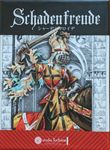
there is schadenfreude, and that schadenfreude is on a completely different level. Schadenfreude is a game in which we also hold some of the cards in our own hands. It's also a trick-taking game. Then we will play, and when it is finally my turn, I can play any card that I have. Then everyone has to follow suit if they can . Otherwise they discard. When the second highest card appears, it represents a concept that runs consistently throughout the entire game . The person who has played the second-highest card will win the trick; they then receive the card that they have played in front of them as points, and they also receive all of the other cards that were discarded during that trick as points for themselves as well. If I play the blue Z now and everyone else plays blue, and my blue Z turns out to be the second-highest card, I will only receive the blue Z. All the other cards in blue are discarded from the game. Only the card with which I win plus all the discarded cards are in front of me as points. That's what you think at first. If I somehow manage to win the yellow trick with the four and secure four points, I say: "Yay, I'm happy." Then I might play another yellow card and win yet another trick with it, but since other players have discarded their cards, someone plays a blue four, and I think to myself: "You ," because the rule is that if I happen to have the same card lying in front of me twice, both of them are immediately removed from the game. If I possess a card three times over, only a single one remains. However, that is one way through which you can suck points back out of other players, and regarding the scoring, when we play up to this point—as you can see here on the board—this point scale extends up to 40. If someone happens to exceed 40 points, then they crash. That is what happened to the yellow player here; I have no idea who was playing as yellow in that particular game. Um, and they are then out of the running, they cannot win. Whoever then holds the
second most points, meaning they are situated directly behind that player, actually goes on to win the match. This creates a remarkably interesting dynamic within this game, namely the fact that you are constantly forming alliances of some kind, because at the beginning you think, oh yeah, this is great, I am scoring points, yay, I got the nine, great, the seven, great, the six. If I also managed to succeed, wonderful, I have somehow reached 20 points while the others all have only two or three, and you think to yourself , wait a minute, now I am suddenly at the very top too, right? Maybe I don't want to be there. If I now if I get even more points and push the others in , then I will crash and then someone else down there is going to end up winning the whole thing. Damn it Dax, I don't want that. And then you think to yourself, well, I can crash now, so I will play in such a way that you get all the points, because then you will just go ahead and I can somehow manage to stay up there. And the dynamic that is created by this scoring system is truly fantastic, and it is also the reason why, in the duel between Nosu and Schadenfreude, Schadenfreude is miles ahead for me personally when considering all aspects of their respective performances. Nos di is a clever game. That is a real brain burner, where you have to ask yourself, must I do this, can I do that, can I actually do that? They have this and that in their hand and that's right for trick-taking Affinados. But I also have people in my gaming groups who say they don't play trick-taking games; I play them with them because I like you and I know that you have to do this here for your channel. I'll sit down, I'll play them, but wait Not that I enjoy it.
People are called Flo, for example, but also Ragner, and yes, the last conversation with Ragner was about this schadenfreude, we definitely want to have that. That will also be a small amount of fun. Uh, help, is there a stand somewhere? Where can I get to it? Do you know anything? Okay, let's go back to the beginning. You'll have schadenfreude. You say you have trick-taking games. Well, yes, most of them are also super boring, super boring, and this weird Nukos Dice that we played, for me, was exactly the epitome of everything I don't like about trick-taking games. But the schadenfreude, that was cool. That was a cool dynamic. We really played together, it wasn't just about taking tricks for yourself, but rather we formed temporary alliances, we communicated a great deal with one another, and that was just an entertaining and enjoyable experience for us all, it was something that was truly good to participate in. It appealed to him as well as to Maja, who does not usually like trick-taking games either—perhaps that is a bit of a family trait—and that is, well, the thing. is something that I have experienced in many rounds in which I have already played the game Schadenfreude. I also recently had my cinema round, which I chose not to stream, where I also played Noso di and Schadenfreude. These were all individuals who enjoy playing games, and some of whom even come from backgrounds that are deeply rooted in families that have always been passionate about gaming. Greetings to the mother in case she's watching and some of whom also like to play but aren't really into the hobby. I just showed them both Koso and Schadenfreude and the goal was unaffected by me. I am always trying to avoid making the whole thing turn out completely crap. Let us play it anyway, but I am attempting to approach it positively, so that people can also simply approach it neutrally and form their own opinions. Sometimes better, sometimes worse, of course. I say: It's really cool that I, and of course people already know a little bit about it. But the feedback was exactly
the same: Schadenfreude was clearly more fun and led to a much better atmosphere at the table, and while Ken is somehow nice, they were also still a bit of a thing that was present, which is something that we should consider. Round, yes, because everyone has a turn , the game is over and, um, Schadenfreude simply wins for me by a mile. I just know, K, that this is the kind of game I would get; I would play it a few times, then put it on our shelf and say: "We can always bring this one back out and play it again whenever we feel like it." And Schadenfreude is the one game I could bring out in all kinds of different groups, even if people generally dislike trick-taking games, because I simply know it has such a lovely dynamic and the rules are super easy to follow, so it is really just a matter of: the game is over, isn't it? The second card wins the trick; if you receive that same card again, the points are lost, and if you have the most points and exceed 40, you are simply eliminated, which is absolutely fantastic if that happens to occur during the game. If you're a fan of trick-taking games anyway and say: "It doesn't matter, there are 80 trick-taking games, I'll take 20 of them because they all sound cool", and some of them really do sound cool. If I had the time, I would love to create one more preview video for a trick-taking card game. I could name 80 different titles for you, all of which have a cool new twist, and well, as I said, for me it is most definitely a case of pure schadenfreude. After having played both of them in somewhat greater detail, I would clearly say that Nok Koso is nice, it features this nice little twist, and it is a cult game which has often built up its reputation quite naturally as being something of a grail game, don't you think? Grey games are simply those titles that you want to own, but that you cannot get your hands on because they just do not exist at all. You can't get them. They're not available on the local market, unless they're
used or something. And, um, yeah, that's what it thrived on. And if you have it, you've played it, and you really have a cool thing. And if there were no such thing as Schadenfreude, I would probably just recommend Kos, saying to people that it is a really cool game with a really cool trick involving these dice, the numbers, the colors, and everything else, and then also the prediction and other elements that you can extract from it, which makes it, well, it is certainly not a bad game. On the contrary, it's also very good. It has a cool trick. I enjoy it much more than last year, and I have played, I do not know, some 20 or 30 trick-taking games, so I would say that it is better than probably 27 of the titles that I have played in that time. But in direct comparison, if you only want to pick one of the two, the one that is my very personal volume is the one to choose. Top tip is Schadenfreude . It's really good if you say, I like trick-taking games, I want to see cool trick-taking concepts. I'm sorry, I am always speaking very quickly, and then I also become very mumbled and difficult to understand. Um, Schadenfreude is simply the new king for me. People will see it differently.
You are cordially invited to share your own experience with us in the comments section. And what I am also very, very happy to share is the simple fact that we have reached the month of Patreon October, and it is absolutely crazy what is happening here. It really is crazy. There are 328 Patreons now. I believe that twenty new Patreons have joined us over the course of the last twenty days. A huge, huge, huge thank you. That's really great. And now CJ has just joined. Karina, thank you very much. She joined while the stream was already running or just before it had started. That means we are now fewer than five supporters away from reaching 333. There are still four more supporters that are currently missing from the goal. That's crazy. That is almost as crazy as last year during the Top 100, and a massive, massive thank you for that, because it is exactly what ensures that I can continue doing this and that I am able to provide you with everything that I am offering to you right here. And Karina is not in there yet, but a very big thank you to all of the latest members; they are Robin, Marve, Sebastian and Haralo.
Many, many thanks to you for joining us . Many thanks to everyone else too, right? The Con will be over soon. It runs from November 12th to 15th. Some people who only registered with Patron at the beginning of October have now moved up, because it is always so close to the event—registration is always possible a year in advance—but of course people still cancel four weeks before the date because they are sick, cannot make it, get a new job, move, or perhaps have a baby, right? Anything can happen in a year and then spots will open up again and I'll still give you spots to the people who are on the list and now there's even someone, two people, who are new Patreons. So, there is always the opportunity to join in later, and yes, if you think that the channel is cool, feel free to become a supporter on Patreon. If you would like to come to a convention as well, you are welcome to become a Patreon supporter. In my opinion, you'll always be welcomed very warmly. And there are also a lot of old hands here who always integrate the new colleagues immediately, so that they hopefully feel as if they had already been a part of the team for a long time. And it is also a bit nicer to be here in the chat , for example while taking part in the game. The vast majority of people, when I look here, Schwarkurs, Gus, um, Gü, Jens, um, Lars, private Vendetta, they all know each other, they all know each other from Brast. Brust, come to a con, then you'll be the one who gets in too.
Ralf knows a lot of people from other events, he also likes to come to the con sometimes. So it is simply a very cool and a very beautiful community. Please do come over and say a big, big, big thank you to everyone who is new to the community, to everyone who has supported me for more than 10 years, and also to those who have adjusted their contribution amounts in the meantime, whether it be up or down, because that is something you can certainly do if you decide to give 10 euros because you think it is great, but eventually you decide that five euros would be perfectly fine as well, right? It's better to reduce it to € 5 or € 2 than to leave completely. So here's a thank you for not just leaving , but for staying. Everyone should always do it in a way that suits them. And then of course the emoji of the day . As we are currently at this point, there are two Nurc di favorites; however, if you have watched this far, please feel free to post a card emoji and a dice emoji down in the comments.
And in about 50 minutes, we will be bringing Grinville to the table here, the secret insider tip of the game, where we are going to take a look: How hot is it really? I don't know yet, I haven't played it yet. Uh, there will be four of us playing it. I can tell you that you should not have such high hopes for this game. The number is 25. There are 25 copies. My experience is that there are simply many supporters, many helping hands at the Spiel fair, and of course, if they have not yet finished setting up their own booth, they will sometimes walk around, line up somewhere in the crowd, and pick up for themselves some of the games that they find to be really cool and interesting. That's kind of nice. Of course, that's a shame for people who aren't supporters. But I assume that these 25 items will have been sold by the time the fair begins. He also manages to come in his car with two sons and had to send items by post, which he did by shipping packages that always contained five of the things that were needed. So, he is not going to make any profit anymore from the things that he is currently selling.
They have some kind of booth where they have a display table or similar, or they have a table where the game can be showcased and perhaps even be played by visitors at the event. There will be a crowdfunding campaign for it, a new one , where there will be more Grinville. It says here exactly that the Corruption Expansion is the next one. It should also have a solo mode, which should not only refer to the solo mode. The crowdfunding campaign is scheduled to launch in spring 2027. This means that it will be the exact same game, but presented in a brand new edition. I asked him a few questions, and he answered me in great detail; they are located in Hall 2, at Stand H2 E335, which is to say in Hall 2, E335. You can go there to take a look at it for yourselves, and you can even watch it live here later on this evening. And if you say, "Awesome, I like that," you might get it at the fair now if you are very lucky, but otherwise I look forward to seeing you at the crowdfunding, where you will definitely have it in your hands by the time the next game comes around. The player is not really expecting much, and yes, I am looking forward to the opportunity to try the game out for myself quite soon. I'm curious to see what it's like then and I'm really looking forward to seeing many of you at the game. Also, some important information. As for the community event, we will be at Meet and Play on Saturday, so you are welcome to come by and meet us there in person.
Otherwise, I am always at Pegasus; I will post it again in the community feed. Do not pin me down on this, but I believe that from 1:30 p.m. to 2 p.m. every day, I will be at the Pegasus booth distributing the Death Cube promo for Boss Fighters, which will be available there for everyone to pick up . And Flo and Karl will probably be there as well, provided that they have the time and are able to make it, and that is where you will meet us. That means if you would like to go there and say hello: I will be staying nearby for about a quarter to half an hour afterwards, but we have a lot going on because we are meeting many people and doing plenty at the game. However, you will always have the chance to meet us there, and I am certainly looking forward to everything that is still coming up today for all of us. I hope that we can bring something to the table regarding the other topics and then we'll see each other again tomorrow. By tomorrow at the latest, we will likely also have a Batman on the table together with Markus. And then I would like to say thank you very much for watching. Thank you very much to everyone who supported me and take care . See you soon and bye. Bye. เฮ