You have never played Tic-Tac-Toe like this!
Games in This Video
2 games are featured in this video — they unlock as you watch.

Transcript
Hello, welcome to Quackive. Thank you for being here. Today I'm bringing you a quick little breakdown and preview of two smallbox indie games that I genuinely think you should add to your collection. This is not a sponsored video, by the way. These are coming from Smart Flamingo Games, and they are exactly what the publishers's name implies. very interesting, very approachable, smart, thinky puzzle style games. One of them is probably my new favorite version of tic-tac-toe. Don't click off the video. I I know tic-tac-toe sounds simplistic. And yet, when you add mobs, power levels, an ability to murder or overlay cards, and special deity abilities, suddenly tic-tac-toe is uh moving up my ranking system in terms of fun little approachable things that I like to sit down and play. and Candy Hunters. If you're a solo gamer that really enjoys a spatial puzzle or you're a tile laying pattern building or seeing champion, unlike myself, this one might also attract your attention. I personally like ether more than Candy Hunters, but depending on what type of player you are, if you want a little bit more random chaos or strategic goodness, both of them have a reason to be added to your collection. I will leave a link in
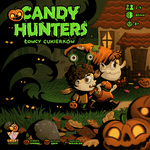
the top of the video description to swing over to GameFound to support this publisher. This is a small indie publisher who's putting out good work, self-designed products and uh doing their darnest. So, if you've got the extra time, the games look interesting, and you want to support the uh people who crowdfunding platforms were invented for, made for, designed for, swim over there and support Smart Flamingo. Okay, let's break down the nature of these two games. And because Candy Hunters is the one that is currently available to back, ether is available in the pledge manager. So you can get a copy of this right now. I'm going to talk about Candy Hunters first. Candy Hunters, this is a prototype copy that I have, whereas this is, I believe, a production copy. Candy Hunters is a lovely little spatial game where you're going to be adding tiles to this little tableau, moving ghosts around the tableau, trying your best to match a sequence of patterns, like I have a set here in my hand, scoring based off of the uh locations that you're able to match, grabbing various different types of candy, and doing your very best to keep other players from doing the exact same thing.
Everyone's going to be interacting with this main board here. And your turn will function something like this. I'll look at the board and try to imagine where I might be able to place a tile down in order to add to something that's in my hand already. And I do see the option or the opportunity up here with this. So, oh, not quite. Yeah. If I add a yellow on top of this, I'll be able to match here to this tile. So, I'll grab a yellow. I'll add it here. I'll then move a ghost two spaces. And I don't really want ghosts on the tile that I'm matching. I want to put them on my opponent's tile. The reason being is if the ghost is on the tile you're matching, you're going to score some negative points. But if your player mark is on the tile you're matching, you're going to get to claim the candy for yourself. Taking the tile, flipping it over, and scoring additional points at the end of the game. So, I can move a ghost two spaces and I'll shift this one down. If there had been, let's say, an opponent's player mark or another ghost in the area I was moving to, I'd move, be able to shift my opponent's player mark, move, and be able to shift a ghost. You can manipulate them across the board. I could also manipulate my own player mark. Let's say uh I was playing blue, and bump it up into the tile that I'll be scoring for, cuz that will give me a special ability. You'll see in just a moment. I then will reveal the card that I'm going to be scoring, meaning I'm grabbing this. If there are any ghosts on that location, I take a negative boo token because there are not any ghosts. I don't need to. And if I have a player mark claiming a location, I will steal that piece of candy. I'm walking home with it. So, I go ahead and
grab and score this off to the side. You want to get a wide variety of collectible candies because that's going to be extra victory points. You get two points for every unique candy that you have and one point for every additional candy beyond that. Then I'll go ahead and take one of my player marks and go ahead and place it down on any empty tile. But remember, because the other players will be going, I might want to shift where I put that. I don't necessarily want to put it down on the most obvious place where I'm going to be trying to scoring next because they're probably going to move a ghost on top of me and push me somewhere I don't want to be. So, you start trying to outthink and manipulate your opponents. you try try you start trying to do just next to or really close where they'll likely push you or you'll at least be able to push yourself onto the tiles that you'll be scoring next. The more you know this game, the more uh thinky and critical the decisions become. From there, I'll draw back up another card and we're ready to continue. Game is going to be played for five total rounds until all of our little uh ghoul, our little people have claimed a location on the board or claimed a candy for themselves.
And then you do final scoring. It's going to be two points for every pattern card you've completed, two points for every candy of a given color, one point for any additional candy that you have of those four originals, and minus one point for every scare token. So, if you complete a quest with a ghost on the map, you'll score negative points. Along with that, we have a system called Candy Hunter Puzzlers. These are for the solo gamer out there, the people that like spatial recognition patterns and like going through a series of escalating challenges. And some of these are actually really difficult. You build the tile out or you could just do it on paper and pen if you want, if you understand the game complexity well enough. But you build the tile out and then you have to sit there and you have to think through like how can I achieve and win the game based on uh the puzzle or the series that they have given me. So that's this little small box darling. Again for pattern lovers out there which is not me. I don't always see patterns the most clearly. Uh this is a very charming game. Let's talk about tic-tac-toe though, cuz if you back this, I think you got to get Eater.
This is a escalating tic-tac-toe game. You're going to start with a hand of cards. Your hand of cards will have something like this series of numbers in it. I might have got it slightly wrong. Maybe it's one less three and you have one extra one. I think that's right. Don't uh you know, crucify me. Uh, but we have a series of cards that each have a power value. You're going to be playing them down into a tic-tac-toe grid. We all know what that grid looks like. A three by three. You're looking to score like tic-tac-toe scores. You want a row of three by three. However, you and your opponent can cover other players cards. In the very basic game, that's the highest level manipulative force you have. They put down a one, you can put down a four, meaning that they now have no recourse. That location is locked off. So, you have to outwit, outthink, and figure out what's been played into the tableau uh while you play tic-tac-toe. I really like this adjustment to the corebased system, but it gets better from there. There's a new opportunity to play one card face down.
So, now you have the equivalent of a trap card. Does your opponent ignore it or do they try to play on top of it, revealing that card and seeing if they cover it or if their card gets booted completely out of the game, wasting their turn and revealing you on the tableau. From there, it gets even better. You have event cards. Event cards will happen when I believe the objectives have been met. So any row or column that is filled of 2x two. So so a row of three, row of three, or if you're playing a larger game, row of four, row of four. Excuse me, I've been talking a little bit today. This will trigger. This can spawn holes that make it impossible to play. This can spawn card destructing or card removing traps. And this can spawn things that make it so you bring the card back up into your hand. And the player that triggers this is going to be the person that decides how it is going to be oriented to manipulate and twist the board. Surprise. You can either choose to see it face up or you can take the one that's already face down, making a little bit more chaos fall into this tic-tac-toe game. But it gets even better. You saw those cards that I removed? Yeah. The uh where are they?
The one three two and what's that symbol there? This symbol relates to your deity. Your deity is going to be a special power card that you have. We have four of them here that allows you to do some really cool things. And each of them have two different cards on the back. So, they'll allow you to break cards, cover cards, shift cards from one location to another, boot your opponent off the top of you, any number of things. So you can play with a very handsome, very well illustrated, by the way thematic deity card. Awesome. Great. That's it, right? That's the whole game. No, tic-tac-toe can get even better than that. We have special powers and ability cards that are associated with all of these deities. Well, depending on how you're playing, you could either assign powers and ability cards to your DDS or you shuffle these up, set them out there next to the tableau, and suddenly you have on your turn once per play, meaning the first person to go and back and forth, the ability to use high-powered special deity cards or event cards that trigger, manipulate, change, and twist the nature of the game even more. And that's it. That's all the I'm joking.
It's not it. It's never it. Right. So, there's one more level. If you want to get insane and you want to play multiple versions of tic-tac-toe in a challenge mode, you can scale up to this little board here. This board here relates to the center here. And what you need to do is you need to play a series of games with your winning location being a corresponding location on this board. You then put down a mark. Then you continue playing back and forth, up and down, changing powers and abilities, getting new deities, bluffing with new cards and new attacks and new events until finally you have won by placing out an entire row or column on this tableau. There's a greater game. There's a war amongst the battles and it deals with the area where you place down your cards to actually score that final victory. It's weird. It's crazy. It's ambitious. It's for those of you that like possibly to torture yourself or love tic-tac-toe because you might get a solid, I don't know, hour worth of uh, you know, 10, 15 games of this just continuing to go back and forth playing, moving, shuffling, and going at it.
Honestly, it might actually be longer than that. It says 10 to 30 minutes. So maybe six games an hour if you're playing the quick version all the way up to a couple hours worth of play to finish an entire tournament like that, which I'll admit that is a lot of tic-tac-toe. My favorite way to play this by far is stopping at this level. So you uh use the core cards doing a headto-head, you can bluff, you might mix in events or not, your choice. And you have that special extra asymmetric power and ability based off the deity that you've summoned. I like that. Then you play best two out of three. 30 minutes in, call it a night and grab the game again tomorrow to teach a friend or play with the same person you've played with. Sher and I was shocked by just how good this iteration on a classic genre of gaming can be. Connect for tic-tac-toe, but with minions, a little bit of area control, and some ruthless powers. It's just that much better. Should really title this video like Blood Rage meets Tic Tac. Something like that. I'm not going to do that, but I should. I really should. So, like I said, I'll leave a link in the video top of the description, words and stuff. You know what I'm saying? There's a game found campaign. You can get both these games over there. Pledge Manager, Active Campaign. Go lend a indie publisher your support. And uh whatever the case, whatever you do, remember to do the important thing.
If you're playing regular tic-tac-toe, just pretend like you have this and cover up other people's numbers. They'll get it. They'll understand. It's a better game. Anyway, we'll see you later.