Tipperary: My Favorite Mechanism
Games in This Video
2 games are featured in this video — they unlock as you watch.

Transcript
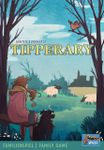
Hey, I'm Jamey from Stonemaier Games, and today I'm going to talk about my favorite mechanism in the game Tipperary, which looks like this. These are all the components in Tipperary. It plays up to five players. I played it with four players total, I believe. Um and it's a tile placement game, tile selection {slash} tile placement game with a few clever hooks. Like it has a fairly simple scoring mechanism, which I welcome. Like I I I would much prefer a fairly simple scoring mechanism. It has a few unique tweaks, like um you score your biggest complete rectangle or square, however you configure it. So and you score it um multiplicatively. So if I have uh a 7 by 5, that is worth 35 points by the end of the game. I can't have any holes in the middle of that. So you're looking at your biggest completed rectangle at the end of the game. You're also trying to surround your starting base. There's different scoring requirements or scoring for each of the different types of terrain in the game.
Uh my two favorite things about the game, my two favorite mechanisms. One, in relation to what I just shared with you, the idea of having holes in your map that you're trying to fill. I really like the game doesn't penalize you for having those holes, not directly. Uh like I I I can think of some games that I do adore that say like for every hole left at the end of the game, you lose X points. Um which is fine. That a game does that is trying to get you not to have holes in the in the map in the map. But this game does it by by using this uh this scoring system where you're multiplying the the Y axis essentially by the X axis for the complete filled rectangle, your biggest complete filled rectangle. So it is penalizing, but it but it doesn't really feel like that because it's you're still looking at your biggest completed area. It isn't saying go through your your whole habitat, your whole area, and and lose points for every gaping hole. And also the game gives you multiple ways to fill those holes, those gaps in your map.
My other favorite mechanism is what I'm showing you here. So these are all the tiles I've been talking about. But over here, we have this little spinner dial that reminds me a lot of Planet Unknown, but with a very interesting hook. Um so like Planet Unknown, one of my favorite games and definitely one of my favorite tile placement games, like Planet Unknown, you are going to have So I was playing red, so I have this I'm the red player over here. Whenever the red player Whenever this icon is facing this gap, uh there are always going to be two tiles right here, two tiles associated with each of the the players, the player colors, and you get to choose from one of those two tiles, and you place one of those two tiles. The twist on Planet Unknown, cuz in Planet Unknown, there is a current player, like an active player, who will select on this dial where it is pointing. So they get to select maybe one of the tiles that they want.
Tipperary said, "We're not going to do that. Instead, the active player is going to flick this dial and let it spin around." It is a spinner, not a dial. It's going to spin around and randomly select one of the five areas. Now I'm sure you are listening or some of you might be listening to this thinking, "I want more agency than that. I want more control. I don't want a random spinner in my game." But it actually works. And I think it works because for a few different reasons. One, I think it works because all the tiles are good for different reasons. You might want a specific tile, but you can use any given tile that are that's out there, and you still get the choice between one of two tiles, and you get the choice of where where to put it. The other aspect is that it actually takes quite a bit of time and thought. And fortunately, the game is entirely simultaneous. It takes time and thought to figure out which tile you want and where you want it to go. And so if the game was asking the uh the active player to choose which set of tiles they want, I think it might actually slow the game down quite a bit while all the other players are waiting for something that they have no control over. Cuz even though it gives that one player some agency and control, it gives no control and agency to the other players. It might as well be random for the other players. So while it works in Planet Unknown, I think it works there because often times they're working for looking for a specific tile shape. I'm not I I I can't even I'm not entirely sure why it works there but not here. But I welcomed the randomness. I was a little worried about it here, but after the first turn and first time I was the active player, I was like, "I'd rather spin it around and see what I get and then use that to the most of my ability rather than
slowing down the game for everyone else by making a very intentional choice that will take some time." So the use of the spinner in Tipperary is kind of a surprise favorite mechanism for me. I'm curious what you think if you've played this game or if you've played another game with a random element that turned out to be really really welcome to the game and still give you plenty of plenty of interesting decisions. Let me know about that in the comments below. Thanks.