










Tipperary Deep Dive
What the Community Thinks About Tipperary
Tipperary is a tile-laying family game from Lookout Games, designed by Gunter Burkhart. Reviewers describe it as a light, quick polyomino game where each decision is small but satisfying. The feature that draws the most attention is the spinner in the middle of the table. CA Couple, Allies or Enemies, and Getting Games each single it out, and their reactions are split. Some find the spinner fresh because nobody knows which pair of tiles will come up. Others say the spinner can feel unreliable, or that the game is too simple to hold their interest for long. Most reviewers see it as an approachable choice for players who want a short session rather than a deep strategy experience.
Core Mechanics That Define Tipperary
Polyomino Tile Placement
Players fit polyomino tiles into a personal board, with each terrain type scoring in its own way. The Stonemaier Games video describes the scoring as built around each player's largest complete rectangle, so a gap in the map is not penalized directly. The cost of a hole is simply that it limits the rectangle you can score. Players also try to surround their starting base. Getting Games notes that the way the tiles go together produces varied combinations, which gives the tile choices more meaning than the shapes alone would.
Simultaneous Actions
Everyone acts at the same time, so there is very little waiting between turns. CA Couple points out that the simultaneous play is a big reason the game is quick. The spinner works within this structure. The spinner determines which pair of tiles is on offer, and every player then picks one tile from that pair at once. Stonemaier Games argues that this is why a random spinner does not stall the table, since no one has to sit and wait while a single player deliberates.
The Tipperary Experience
Breezy
Reviewers repeatedly describe a light, short feel. Getting Games calls it a very light version of Planet Unknown and says it is a breezy filler that fits neatly into a game day. Rahdo Runs Through goes further and says the game is almost too fast, adding that they often wish they had a couple more turns. Players who want a long, involved session will likely find the experience ends before they are ready.
Gateway and Accessible
The game is widely seen as easy to teach. Rolling Dice & Taking Names observes that the rules are simple and that the scoring is the main part to walk through, which makes it a useful introduction to tile-laying for people who have never played one. Rahdo Runs Through emphasizes that it is family friendly, with attractive components, and notes that the publisher's family weight suits a wide audience.
What Makes Tipperary Stand Out
The Spinner as a Core Hook
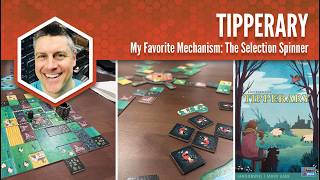
Stonemaier Games describes the spinner as a surprise favorite mechanism. The video compares it to Planet Unknown, but with a twist: in Planet Unknown the active player chooses the tiles on offer, while in Tipperary the active player flicks the spinner and it lands randomly on one of five areas. The reviewer argues that it works because every tile is useful in some way, and because the player still decides where to place the chosen tile. CA Couple likens the feel to spinning a wheel and seeing what you get on every turn, and calls that the element that makes the game stand out.
Scoring That Rewards Shape
Scoring is another point reviewers return to. The biggest complete rectangle is multiplied for points, so a player who builds a large, tidy block of land is rewarded for it. Stonemaier Games likes that the game uses this scoring structure instead of a per-hole penalty, which means the map feels less punishing even though gaps still cost points. Reviewers who value a simple scoring system tend to appreciate that the rules remain easy to follow once the rectangle idea is understood.
Potential Drawbacks
Spinner Variance and Agency
The randomness is the most common criticism. The Allies or Enemies video reported that their spinner always landed right on the line between two options, and they wondered whether their copy simply spun poorly. Rahdo Runs Through described a similar problem with a spinner that seemed to land in the same spot, which made the randomness feel less like chance and more like a fault. Stonemaier Games acknowledges that players who want more control may dislike a random spinner in their game.
Light on Depth for Experienced Players
Rolling Dice & Taking Names calls the game basic and says it is too simple for experienced gamers who already own other tile-laying games. The same video notes that it is still a good introduction for a newcomer. Getting Games would like some variable scoring so that each game plays differently, since the scoring currently stays the same from one session to the next.
If You Enjoy Tipperary
Reviewers draw the most comparisons to Planet Unknown, which shares the spinner and the simultaneous tile choice but gives the active player more control. Getting Games describes Tipperary as a lighter cousin of that design. Allies or Enemies says it has some of the look of Glen More 2 while being much lighter. Rolling Dice & Taking Names places it next to Carcassonne and King Domino, calling those more competitive. The what you played news segment notes that the designer also made All Sealand and Potato Man, so fans of those titles may find the same tile-laying style familiar.
What Reviewers Are Saying
"I think what's really makes this game Stand Out is that little spinny wheel yeah because you never know the til you're going to land on it's almost like the whole like spin the wheel and see what you get every single turn which is really fun"
CA Couple
"the dial the spinner for us didn't work great always landed right on the line between two"
Allies or Enemies
"I got it because it's just really light and lovely uh it's not something to like scream about from the mountain top"
Getting Games