Jungo Scout & Dnup Reviews - 3 Very Similar Games, Which One Is Right For You?
Games in This Video
3 games are featured in this video — they unlock as you watch.

Transcript
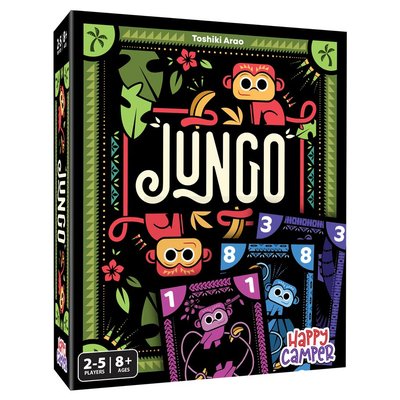
Hey, I'm Alex Radcliffe from Board Game Co. And today, I'm going to be talking about Jungle, Scout, and Down Up. Jungle is a game that I've talked about on the channel before. I have a full dedicated review on it. Scout is a well-loved, very well-known game from Oink Games that I have not I don't believe I've done a review-type video on the channel. We'll be doing that today. And then Down Up, I just recently picked up. And all three of these are very similar and yet different shedding games that all have Well, let's go ahead and dive into it. But first, before we do, this channel is sponsored by All Play. Speaking of shedding games, if you want to check out Runes, Runes is one of my favorite, if not my favorite, shedding game from All Play. And you can go to allplay.com to get that as well as a variety of other games from them as well as their partner publishers. And if you're in the US for $4 flat-rate shipping. But with that said, let's talk about these three games because these are three games that I've been enjoying a lot with my kids. I played these Well, I played some of them with Actually, I played I played this only with my kids. These I've played both with general game group as well as my kids. But it's one that I think shedding games is something that I really enjoyed introducing my children to and getting them to appreciate some of the nuances of them, of which I'm thankful for Jungle for doing that. But they've also come to like uh Scout as well as Down Up and the different ways they all bring something very similar to the table. You see, shedding games are a general category where you have a handful of cards. You're trying to get rid of your cards faster than the other players. And there are some interesting ones out there that are very They They're lots of different premises as far as what makes them interesting.
These three all share a specific commonality in the way you can add cards back to your hand while dealing with specific hand restrictions while you attempt to get rid of your cards. You see, in Jungle, you're going to shuffle up the cards, deal them to the various players, and then you're going to have the players have their hand out which they cannot order their hand. So, when you play a set of cards, maybe I played that seven, but by playing that seven, it now closes the gap between two eights on one side and an eight on the other side. So, I suddenly have three eights when before I did not. You're working with the limitation that you cannot shuffle or order your hand. It is as it is, but the good news is you can, when you play cards, you can take the other player's previous set. So, when I play a set of cards on the table and it beats your set, I can add that set to my hand. Which adds an interesting tactical element to the game where you're trying to decide, "Okay, sure, I could beat your heart your hand right now, but I don't actually care about the cards that you have on the table. So, maybe it's in my best interest to just go to the Jungle, draw a card, and save my hand of my set of four cards for a time which I'll benefit by being able to reclaim your cards and add them to my hand for an even stronger finish." The ability to be able to play over somebody else's set is very strong.
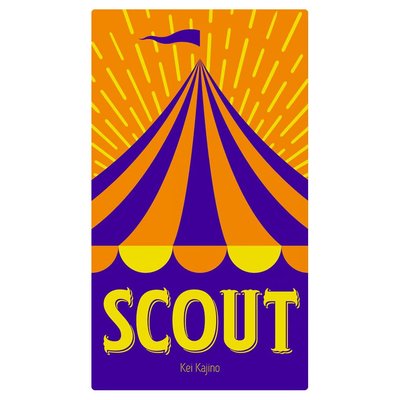
And so, timing is everything in the game as far as when you actually try to beat others' cards. Past that, the game is very straightforward and simple. Scout is the game that came out first from all of these. Jungle feels very inspired by Scout. You cannot shuffle your hand, but then it removes a lot of elements that make Scout a little bit more complicated. I think of Jungle as more accessible Scout. Scout is possibly my my favorite from the bunch. Well, we'll talk about my thoughts of them all after. But Scout ultimately has you performing shows. But in this game, you can play sets or runs. Whereas Jungle only allows you to play sets and Down Up only allows you to play sets. Scout lets you do the most in that capacity by being able to do both. But you have these cards that you flip them and they are other numbers on the other side. Something which Down Up does. You're starting to see patterns over here how they all share various elements. They all do seem inspired by Scout. But you have these cards that have different numbers on both sides.
And you have to choose your hand's orientation once you're dealt. But you cannot shuffle it or order past that. So, you're dealt a hand of cards, it's in a specific order, and you can flip your hand or go whichever side you want, but you pick it and then you stick with that. But then, you can either play cards to create your sets, or you can take cards from somebody else's winning set. So, if I play a set of four fours, right now no one else can beat that. But then it becomes the next player's turn, they will take one of my fours, adding it to their hand, at which point which first of all, the positioning matters as well because now they're possibly creating a set or a run by adding their card to their hand. But they've also now weakened your display. They've weakened your show. So that time has gone on, people are less excited about your four fours. Now you only have three fours, making it easier for the next person to win, to next person to beat your set. It provides an interesting mechanism of the timing of how you construct your hand.
And again, once again, the order you play things. And then once again, the fact that you are taking other players' cards from the table and adding them to your hand. It also adds more of a monetary element. So, possibly the most complex as far as the scoring of it, as far as how you balance the cards left in your hand. That's another capacity I really enjoy. The fact that in Scout, the number of cards you have left in your hand is going to negatively hurt you at the end of the round. So, sometimes you have to kind of play not necessarily for second place or first place, but just being mindful of I have to shed my hand. I can't be holding it all when the cards come folding down at the end of the round. And in Down Up, you're once again dealing with a hand of rotatable cards, similar to Scout. So, you have a number on one side and the other you have a two five, a three seven. You have different values over here, a one five. And so, once again, you have a single orientation for your hand. But then the difference is you have different actions you can take. You have four different actions you can take in the game because you can either play a hand, you can add to somebody else's hand, which has the interesting element that it makes it easier for you to permanently get rid of cards because you run the risk in Down Up of having to add the cards back to your hand. If I play two twos and you play, I don't know, three sixes, I'm good. But if I play two twos and you play two sixes, you've played a higher number, but you've played the same number of cards. I have to take them back to my hand, rotating them as I do so. So, whenever you play a set, there's a risk that somebody will force those cards back to your hand. If I instead add my cards to somebody else's set on the table, I am strengthening their set, which helps them, but I'm getting rid of those cards in a way that they won't come back to me, which helps me. But you also have the option of taking a set on
the table, putting it into your hand, and rotating it as you do so. Or the last option is to entirely rotate your hand. Which really adds this interesting timing mechanism of choosing which cards to play so that then you can then rotate or so that you then take other cards back from the table into your hand, all while you work towards getting rid of your entire hand. So, all three of these games are focusing on some restriction around the orientation of your cards or the order of your cards or in some cases, both, such as in Scout. All of them allow you to get cards back from the table. In Jungle, by doing so by gathering other cards as you beat their sets. In Scout, by weakening other sets by taking those cards. And in Down Up, by simply taking the entire set to your hand. All of them have a progressive scoring system, so you don't really have a one-and-done. Jungle, win two rounds. Down Up, it's a little more complicated than that. Winning two rounds will give you the win, but you also have second place scoring, so you can actually come in second place four times and win that way cuz you're trying to get to four tokens, the D N U P, the Down Up. And in Scout, you have a monetary system that's going to be in play. So, all of these have different progressive scoring. It's not about a single hand. All of them allow you to gather other cards. All of them allow you to start with a fixed hand and then figure out the best way to manipulate that hand, adding or removing cards from your hand to end with the best possible plays in the game.
And they're all fun. My ratings for these overall, Scout is by far my favorite. Uh Scout's going to come in at a four out of five for me. I really enjoy the system. I think shedding games in general are a system that I can appreciate the nuances of in different ways, some more so than others. But Scout has this interesting element as far as trying to make it so that you can play things working with a restricted system that has inspired the others. A solid four out of five. Jungle I've come to appreciate a lot as well. Over time, it has continued to grow for me. It's a bit simpler and more accessible. It is less intricate than what Scout does, but that sometimes means that you're interested in something that's just a little easier to table, and Jungle does so. For me, I'm going to come in at a 3.5 out of five. I still like it a lot. It's one of those ones I debate popping up like a little bit in rankings, but it's It gets a lot of plays, I'll say that, and I always enjoy playing it. Down Up is the most complicated for me because I do think that I appreciate Down Up as well. Down Up has some interesting elements Maybe I don't appreciate it. Down Up has some interesting elements as far as the hand rotation and the order you play cards that across multiple plays, I've appreciated more and more the strategy that is present in this one. I hate the production. I think Scout is charming as far as the simple color palette. Jungle, I like the production the most, the uh the art in the cards. And Down Up, I really It looks very vanilla and plain.
And I wish there was a different theme into it that made the the cards, the box, anything about it just be more visually attractive. The game itself, though, is still pretty solid. I'm going to come in at a 3.5 out of five as well. If you have played any of these games, I recommend checking out all of these games. They all provide different elements to that hand shedding mechanism and the way you're working within a constrained system while trying to power your way out of that constrained system through clever card play and perfect timing. In any case, until next time, I'm Alex Radcliffe from Board Game Co. Hope you found these reviews helpful. And until next time, I hope you have a good one.