Toy Battle VS Star Wars: Battle of Hoth - BUY THIS, NOT THAT (board game review)
Games in This Video
2 games are featured in this video — they unlock as you watch.

Transcript
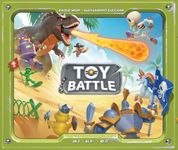
We have been deep in the trenches for the last three weeks playing two of the biggest 2025 releases head-to-head. On one side, we have the heavyweight champion, Star Wars Battle of Hoth, and on the other, the scrappy underdog Toy Battle.
Both are light games with close BGG ratings and weight.
We have played these games backtoback, switched sides, tried the different player counts, and lived through the frustration and the glory. This is our definitive buy this, not that showdown. We're comparing a $60 box of plastic minis against a $30 box of cardboard tiles to answer one question. Which one actually deserves your shelf space?
It's a fascinating matchup because they are both pitching the same thing. A two-player tactical duel that you can knock out on a weekn night. Star Wars Battle of Hoth comes from Days of Wonder in Richard Borg using that legendary command and colors engine. We went into it expecting cinematic moments. AT-AT's Crushing Rebels, the whole nine yards. Toy Battle is from Repo Production, designed by Paulo my pitching itself as this snappy 15-minute filler where you stack troops to control territory. Snappy is the marketing word. Sure, stressinducing memory test might be the more accurate description based on our play sessions, but let's rewind to the beginning. When we first got these to the table, what was your gut reaction to the setup? Because for me, opening Star Wars felt like an event. You're pouring out bags of snow troopers, setting up these hexagon terrain tiles. It feels like you're building a movie set.
Oh, absolutely. The table presence of Battle of Hoth is undeniable. Even before we rolled a single die, just seeing the AT-AT walkers looming over the Echo Bay shield generator tiles, it sets a mood. It promises a story. Toy Battle, by comparison, felt very functional. You pop out the four double-sided boards, you punch out the troop tokens, and you're ready. It was fast, I'll give you that. We were playing Toy Battle 5 minutes after opening the shrink wrap. Star Wars took us maybe 20 minutes to stick the stickers and organize the minis, but the payoff visually was huge,
right? But let's talk about the actual gameplay loop because this is where the two games diverge wildly. We've played Command and Colors games before, but Battle of Hoth has some specific quirks. The core mechanic is hand management. You have a hand of command cards, usually four or five, and each card tells you which section of the board you can activate units in, left, center, or right. And that system is the source of so much delicious agony. Remember our third game? I was playing the rebels, and you were marching those AT-ATs right up the center channel. I had my snow speeders perfectly positioned on the left flank to zip in and trip them up. I was ready for the hero moment. And then I looked at my hand. Order two units right. Order three units right. Order one unit center. I literally couldn't move the units I needed to move. You could see the panic in your eyes. You kept looking at your cards, then at the board, then back at your cards. But that's what I loved about our sessions with Star Wars. It simulates the fog of war without needing a referee. You aren't a god moving pieces at will.
You're a commander dealing with bad radio frequencies. It forces you to make the best of a bad situation. In that game, you ended up using your center card to move some infantry into a trench just to delay me, which turned out to be a game-winning stall tactic. It rewards adaptation. You have to have a plan B and a plan C. Now, compare that to the decision space in Toy Battle. In our sessions, the loop was brutally simple. Draw two tiles or place one tile. That's it. On paper, it sounds elegant, but in practice,
in practice, it became this agonizing push your luck grind. The rule is that to place a troop, you must have a continuous path of control from your HQ to that spot. It's a supply line mechanic. I actually really liked that concept initially. It felt like we were wrestling for logistics, but the draw to action is where the crack started to show for me
because of the randomness. Yes, in Star Wars the card draw is random, sure, but I can mitigate it. I can position units on the hex lines between sections so they can be activated by both left and center cards. I have agency. In toy battle, we played that one game where I spent three turns drawing tiles, fishing for a Roxy or a jumbo to break your line, and I just kept pulling ducks in scouts. I felt like I was losing because I couldn't find the tools I needed, not because I played badly. To be fair though, that's part of the push your luck design. You could have tried to win with the ducks. But I agree, the randomness in toy battle felt more punishing because the game is so short. If you get a bad run of draws in a 10-minute game, the game is just over.
In a 45minute game of Star Wars, the dice usually average out. Speaking of dice, we have to talk about the combat in Star Wars.
The dice. Okay, the AT-AT armor mechanic is the single best thing Richard Borg put in this box. For those listening, usually in these games, you roll hits and they count. But against the AT-AT, you rolled a hit and then you have to take those hit dice and re-roll them to confirm with a blast symbol.
It is heartbreaking. I remember rolling four dice against your walker in scenario 10. I got two hits. I was cheering. Then I picked them up for the confirmation roll and rolled nothing. The walker just shrugged it off. It perfectly captures that feeling from the Empire Strikes Back where the rebel blasters are just bouncing off the hull. It made the AT-ATs feel scary in a way that just giving them more health wouldn't have achieved.
It adds drama. Every die roll felt like a scene from the movie. Now contrast that with combat in toy battle. There are no dice. It's deterministic. If I play a five and you have a four on the space, I win. My five goes on top of your four.
And this leads us to the biggest issue we found during our weeks of play, the stacking visibility problem. This is the thing that nearly made me flip the table in our fourth game.
Oh my god, the station metal X game.
So, we were fighting over this central base. I placed a unit, you placed a higher unit on top, I placed a higher unit on top of that. We eventually had a stack of five or six tiles. The rule is only the top tile counts for control, but the tiles underneath are still there and they might become active again if the top ones are removed by abilities. And you can't see them. You literally cannot see what is in the stack. I sat there staring at this tower of cardboard trying to remember. Okay, I think Adam played a soldier three turns ago. Or was it a knight? If I use my elephant to blow up his top unit, does the unit underneath belong to me or him? It was maddening. We had to pause the game, lift up the stack, fan them out to check, and then put them back. It completely broke the flow. For a game that wants to be a fast, snappy filler, requiring players to memorize the contents of a six tile stack is a massive design flaw. It turned a tactical game into a memory game, and I hated that.
It's a usability disaster. In Star Wars, the board state is always 100% readable. I can see your figures. I can see the terrain. I can look at the board and know exactly what my options are. In Toy Battle, hidden information is fine in your hand. But hidden information on the board, just because the components cover each other up, that's just bad product design. It's a shame because when Toy Battle worked in the early game before the stacks got high, it was fun. The supply line puzzle is clever, but the moment the game got competitive, the mechanics got in the way of the fun. Star Wars was the opposite. The mechanics, the simple order units, move, battle, faded into the background and let us focus on the strategy.
Let's talk about that strategy specifically regarding replayability. We played toy battle a lot because the games are short, but did you feel like the strategy evolved?
Honestly, not really. There are eight maps, which is nice variety visually, but the puzzle is always the same. Don't let your line get cut. Once we both figured out the optimal defensive play, keeping your line thick and redundant, the game started to stalemate. We had one session that dragged on for 25 minutes because neither of us wanted to risk placing a tile that would leave us exposed. We eventually just agreed to a draw.
Yeah, we hit a skill ceiling pretty fast. Compare that to the scenario book in Battle of Hoth. 17 scenarios. We played the first five and they were all distinct. The first one is just a patrol skirmish. The next one introduces the shield generator. Then you have the evacuation scenarios where the rebels are just trying to run away while the Imperials are chasing them.
That asymmetry is key. In Toy Battle, we are doing the exact same thing. In Star Wars, playing the Empire felt totally different from playing the Rebellion. As the Empire, I felt this slow, crushing inevitability. I didn't care if I lost a few snow troopers. I had reserves. As the Rebels, I was sweating over every single loss. Oh no, I lost a unit of vets. I can't replace them. That emotional difference kept me wanting to switch sides and play again.
And we haven't even touched on the campaign mode. We started one. And the fact that you can carry damage over, that's brilliant. If I damage your AT-AT in scenario one, it starts scenario 2 with that damage. It makes the early games matter so much more. It turns a 30-minute game into a Saturday afternoon event. But we have to address the elephant in the room, the price. Star Wars is $60. Toy Battle is around $30. Is Star Wars actually worth double the money?
Without a doubt. And I say that as someone who usually loves budget games. When you break it down by cost per hour of entertainment, Star Wars wins. We've already poured maybe 10 hours into it, and we're not even halfway through the content. Toy Battle. I think we saw everything it had to offer in about 2 hours.
Plus the components. You're getting 74 miniatures in Star Wars. Moving them, setting them up, the tactile feel of the dice, it feels like a premium product. Toy Battle is cardboard tiles. The art is cute. I like the whimsical style, but shuffling cardboard just doesn't feel as good. And again, the cardboard causes the gameplay problem with the stacking. If they had used poker chips or stacking plastic pieces, maybe it would have worked. But for $30, you're getting a component quality that actively hinders the game play.
Wait, we need to talk about the player count before we wrap this up because this is a huge factor for some people. Toy Battle is strictly two players. There is no wiggle room.
Zero. It's a duel.
Star Wars says two to four players on the box, but we tried the four-player mode, and we need to be honest about it.
The team mode. Yeah. So, in theory, it sounds cool. One player is the field general controlling the left flank, the other controls the right, and you share the center. But in practice, it was boring. It was the definition of downtime. Remember that turn where I was the right general and you as the overall commander played a left flank card? I literally had nothing to do. I couldn't move my guys. I couldn't roll dice. I just sat there watching you play for 3 minutes.
And then you checked your phone. I caught you.
Well, I was bored. But that's the point. Star Wars: Battle of Hoth is a fantastic two-player game. It is a mediocre four-player game. Do not buy this expecting a rockus party game for four people. You buy this to play with one specific rival.
Totally. It's a 1v one system that they shoehorned a team mode into. It works if you must include people, but the optimal way to play is head-to-head. Toy Battle doesn't even pretend to be for more players, which I respect, but it limits its flexibility. So, thinking about who these games are for, I feel like Star Wars is the perfect next step game. If you've played Risk or Katon and you want something more aggressive and thematic, this is it. The rules overhead is actually surprisingly low. We taught our friend Mike in about 10 minutes.
Yeah, the command and color system is famous for being accessible. The card text tells you exactly what to do. The reference sheet handles all the terrain rules. It's very what you see is what you get. Toy Battle ironically felt harder to teach because of the edge cases. Wait, does this ability trigger before or after I place? What happens if the stack is empty? We found ourselves checking the rule book way more often in the simple game than the complex one.
Curious, is there anyone you would actually recommend toy battle to? H maybe maybe couples who have very limited table space like if you are playing on a train or a tiny cafe table. Toy battle fits. Star Wars needs a dining table. The board is big. Or maybe if you have a partner who absolutely hates sci-fi and war themes. The toy theme is soft and approachable. Uh even then I'd hesitate. The frustration factor with the memory and the luck. I feel like there are better smallbox games out there. Shot and Totten, Battle Line, Hive. Those are all better two-player fillers than Toy Battle. Toy Battle sits in this weird middle ground where it's too fiddly to be relaxing, but not deep enough to be satisfying.
That's the killer right there. Not deep enough to be satisfying. After our sessions, I never felt that good game buzz from Toy Battle. It was just, "Okay, I won because I drew the T-Rex." In Star Wars, even when I lost, I had stories. Remember when my snow speededers held the line? Remember that lucky artillery shot? The game generates memories. Toy battle just generates score.
I think we're ready to call it. We've lived with these games. We fought over them. And the dust has settled on Hoth.
Let's drop the verdict.
Buy Star Wars Battle of Hoth if you want a complete cinematic experience. The 17 scenarios give you insane value for money. The mechanics are tight, proven, and thematic. The plastic components make it a joy to put on the table. It is, simply put, one of the best two-player skirmish games released this year.
And specifically, buy it if you want clarity. The game respects your tactical intelligence by giving you a board you can read. The randomness is there to create excitement, not to invalidate your choices.
And do not buy toy Battle if you value gameplay flow. The stacking visibility issue is a critical flaw that drags the whole experience down. It forces you to manage administrative tasks, checking stacks, remembering tiles instead of playing the game. Also, do not buy toy battle if you want a balanced competitive experience. The random unit removal at setup introduces a swingy RNG factor that feels unfair in a short game. Unless you are willing to house rule it or play best of three every time, it's just too random to be satisfying.
I think that says it all. I'm keeping Star Wars on the shelf. It's going right next to Memoir 44. Toy Battle is getting donated. I just don't see us ever choosing to play it again when we could be blowing up ATAS instead
or trying to blow up ATAS and failing miserably with those confirmation roles.
Hey, next time I'm bringing the ion cannons. You won't stand a chance.
We'll see. Thanks for joining us for this deep dive. Hopefully we saved you 30 bucks and pointed you toward the better game. We're board game critique. Play more games, but play the good ones. See you next time.