Top 10 Board Games from 2024!
Games in This Video
2 games are featured in this video — they unlock as you watch.

Transcript
Hi everyone. My name is Monique
and I'm Naveen from Before You Play.
And today we're going to be talking about our top 10 games of 2024
that we've actually played.
Yes, that's right. Uh it is September after all. So we figured it's been long enough and we have played through a strong majority of the games that we have that were released in 2024. Not all, but you know, you kind of have to call it at some point.
Yeah, I think eight months deep now we're getting into this ninth month. We got to we got to make a list at some point. It's almost 2026. So, uh, any games that we were not able to consider for this list, we'll let you know in advance. But that's what we're doing today. And so, at the start of the year, we actually made a separate list that were the best uh our favorite new to us games.
Yeah. Meaning, those are games that may have come out in 2024 or um games that came out like years before, but only we played last year. These uh games that we're going to talk about today were actually released in retail in 2024. But before we get into our list, we do want to mention that this video is made possible in part by the new version of one of Mighty Boards's bestselling games called Art Society, which is coming to Kickstarter on September 2nd. In Art Society, you are an art connoisseur competing to build the most fashionable gallery by bidding on coveted paintings and arranging them in your drawing room in order to gain the most prestige. Now, Mighty Boards is releasing a deluxe edition that includes upgraded components such as metal pieces, wooden gavvels, and a redesigned storage solution, all packaged in a limited edition box. Alongside these upgrades, the deluxe edition also introduces an allnew expansion called Friends in High Places. This expansion adds influential characters to the game, such as the art curator, the socialite, and the art critic. each bringing new opportunities for strategy, interaction, and competition as you try to win their favor.
The Art Society Deluxe Edition and its expansion will be launching on Kickstarter on September 2nd. So, if you are interested in the campaign, there's a link in the description which you can check out at your leisure. And thank you so much to Mighty Boards for helping sponsor this segment.
All right, thanks so much. Now, as per usual with these kinds of lists, we do have a few disclaimers. The first being that, you know, every time we make a list like this, we do get a few comments asking why a certain game didn't make our list that you might think would be in our wheelhouse. And sometimes it's because we just didn't have the opportunity to play them.
So, we do have five games that were not considered for the list because of various reasons. Two of them are Ezrea and Nehemiah, as well as Inventors of the South Tigris. Those two we were actually really planning on playing before making this list, but they're both very heavy games. We just couldn't get the time to sit down and actually learn it, play it, and play it enough to consider it for the list.
Yes. And the reason why we mentioned them at all is because in the past, you know, we've done a whole West Kingdom uh series. We've highly enjoyed the other entries in the South Tiger series. So, these two games are possibly down our alley, but we just didn't have the time to play them. So, probably in the future, we'll do a dedicated video sort of just going through the whole South Tiger series.
We'll eventually play them all uh in secession and then be able to talk about them kind of chronologically. you know, we like to do those kind of things.
In addition to those, three other games in specific we have only played in their prototype form. So, we didn't want to consider them for the list without actually having played the retail version because a lot of times things do change between the prototype and the final release. And they are Unconscious Mind, which is one that we played in prototype version, Inventions, which is a Vatella sort of game that we had been meaning to play, but same reason. Very long, heavy game.
Long heavy. Yeah.
As well as Andromeda's Edge. That's another one that we enjoyed in its prototype form, but again haven't played the final version yet.
The other thing we are going to mention is that this is a combined top 10 list. Of course, we play a lot of games and we play a lot of games together. So, when we separated and decided on which 10 we would want to add to the list, we noticed a ton of crossovers. So,
we didn't want to do the thing where it's like, oh, well, this is my number eight and Naveen's number six. So, we just combined the crossovers
and then figured out how to put it all together in an actual top 10 list. Yes. Um, we do have a couple games that we are going to kind of mention as honorable mentions that may have been a game that I really wanted to talk about in a individual top 10 list as well as Mon'nique.
Right. So, shall I go first?
Sure, please.
All right. So, we each have two games each that would have made our own personal lists that we didn't have crossovers on. So, my first one is Gnome Hollow. So, this is a game that's designed by Aman Anderson and published by the OP. U, of course, released last year. And um it's a game that we're actually sponsored to do a playthrough of. And we have a few titles on our list, which we have done game plays of, and we'll name them as they come along.
But this is a game all about making uh Gnome Hollow. You're you're laying out tiles to connect rings in order to gain mushrooms to sell them to the pinwheel market. I know it sounds really silly, but the game itself is really beautiful. And there are a lot of tile laying games out there, but ever since its release, I have played this game a ton of times, especially on board game arena, and there's just something about it that is so addicting. And there are two ways. So, you can play like the standard version or you can play like the advanced variant where you flip over your playerboard and things change. But the thing that struck me the most about the game is actually the tie laying part. It's the part that is not necessarily new, but for some reason in this game, the way that the tiles connect, you can be really mean.
You can be mean to other players.
Yeah. You can cut somebody off, somebody who is trying to build because there's a I if I remember, I haven't played in a while. There's an element of asking for permission to do a certain thing.
Yes. Because if you position a tile in a way that also furthers somebody else's ring because you're trying to create rings of these tiles so that you can gain mushrooms from them. And if you end up, you know, connecting uh somebody else's ring, then you have to ask them permission. And if they say no, you can't actually place that tile.
The bigger the ring, the better, right? Like if you ring, you're basically creating these like loops.
Yes.
And so the higher the the bigger one that when you complete it, you get the more mushrooms.
Yes, you do. And you, you know, the mushrooms are worth different amount of points. Like they're not all the same value. So you're also trying to go for like the more rare mushrooms. It's really I find it to be really really fun. I just find it to be a very addicting experience. It's probably pretty annoying for some people who go up against like people who are like really into the game because of that kind of cutthroat thing. But I've enjoyed that one a lot.
Yeah, she's played it way more than I have and that's why she considered it for the list. I' I played it leading up to our gameplay video of it, but I really haven't played it since then. But I think you've probably played it probably 15 20 times since.
Yeah, I've played that game a lot.
All right. one for me that would make my list. Uh, and the reason why it's actually not on Mon'nique's list is because I think you've only played it in person in prototype form. Yes. But you've played it like once on BGA Game
since its actual final release. I've played the official release copy. And this is Let's Go to Japan. This is from AEG and we actually covered it uh back when it was on Kickstarter. We did a playthrough of it
and um finally got to play the production copy of course when it came out earlier this year a couple times. And it is a drafting a car drafting game and kind of a tableau building game where you are planning the most ideal trip in Japan. You're going to spend time between two different cities. There's Tokyo and Kyoto. And so you're trying to efficiently plan out these activities each day of the week uh from Monday through Saturday, but also trying to do it strategically based off of different scoring parameters that you see that's kind of laid out. Uh and you're also trying to plan your trip so that you're not going back and forth between the two cities because that can cost you time and points.
Yes. You wouldn't do that in real life.
You wouldn't do that in real life. So that's why it's thematically it's like that. We actually used uh our prototype copy of the game to plan our trip to Japan. So it kind of holds a special place for me in that sense. Um but it's also a very very good game in in the fact that I like drafting games. And so there's a little bit of it can be mean. You can do some mean things kind of
if you're looking at your neighbors and you're seeing like, oh, you're spending a lot of time in Tokyo. Here's some Kyoto cards that you're going to kind of have to now deal with. Um, so there is some gamesmanship in terms of the way you draft cards, but you're also trying to do, you know, the best that's for yourself, right?
Um, and so I' I've really enjoyed the game. I think it's it's a nice familyfriendly game. It's light enough, but also still has enough depth for heavy board gamers as well.
And the thematic uh integration, I think, is really interesting. Like there's like the happiness or like the fatigue depending on what type of activity it's going to be, right?
Expensive versus like uh enjoyment, things like that. So yeah, it's a it's a good game. If you have an opportunity to play it, I highly recommend it. So that is Let's Go to Japan, designed by Josh Wood and published by AEG.
All right. And as for my second choice that would have made my list is a game designed by my Brun and Julian Shapu, and published by Mind Clash Games, and is a game called Ironwood. So I think we did a two we did a playthrough video for this as well as a how to play. And this is a an asymmetric two-player only card- driven strategy game where basically one player plays as the ironclad and the other plays as the wood walkers. And you have different uh endgame victory conditions. One player just wants to build a bunch of forges around this map and another player wants to find these totems
totems and bring it back to safety.
Yes. Because they are sort of like the people who live amongst the forest. But the entire game is just played via cards. So each player has their own sort of asymmetric decks, but they do sort of similar things with the exception of certain things that are specific to the different factions, but it's very simple in the sense that on your turn, you're just playing these cards and resolving them. But the asymmetry plus the strategy and like figuring out how to man maneuver around the board, I think adds a lot of depth to the game. I really enjoy asymmetric games and it's hard to find uh two-player only ones that are done well. And I I just think this one is really well done. It's still in our collection. and it's going to stay there for a while. And so that is Ironwood.
And as for my second choice, that would have been very very high on my list. This is designed by John Cooper and Corey Heath and published by Cosmos Games. This is called The Gang. The Gang is a cooperative Texas Holdem style game. It it truly is Texas Holde. Um where you are trying to order the relative strength of everybody's hand by the end of the round or the river card if you are familiar with Texas Holdem. So, I think it plays best at five and six players because it's that much more challenging to kind of figure out who has the strongest hand and rank them all the way down to the worst hand. Because if you're familiar with Texas Holdem at the start of a round when you get two cards, you might have a relatively strong hand. But as the cards get laid out face up in the center of the table, things may change. And so you have to kind of figure out who is strong early, what changed because of the board state or kind of the game state and how exactly are you going to figure out by the very end of the round who has the strongest hand and all the way down to the weakest hand.
This one takes some knowledge of poker. Now there it's in the rule book.
So the reason why it's not really on Mon'nique's is because she doesn't have a very strong poker knowledge.
Yes, I feel lost.
So she feels a little lost. And then Texas Holdem is its own type of poker game. Yeah. There's several different ways you can play poker and so things uh kind of change and if you're not familiar with kind of the way things can change because of the way the cards are kind of laid out in the center of the table which is a kind of a shared communal cards um that can make things very frustrating for somebody. But if you are familiar with poker and relative poker strength I highly recommend this game. Uh it is pretty quick and there is kind of a more theme to it than just playing the Texas Holdem. you are trying to break into a vault and steal these gems. And if you're successful, then you're successful at stealing these gems. You're trying to do it three times before busting three times. Uh very very uh simple game if you understand Texas Holde. Um and it also just kind of facilitates just a good fun energy if you have the right group with you.
All right, so now that we have that out of the way, shall we start our 10 list?
10.
Again, this is going to be a combined 10 list. It's going to be in order until we get about halfway through where things were just sort of in relative order.
Yeah, sure.
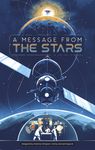
Our number 10 is a game designed by Clarence Simpson and published by AllPlay. And it's kind of a surprise entry for us because we didn't expect to like it this much. I think
it was on an anticipated list and then we finally got to play it almost like a year later.
Yes.
Uh but it's number 10 on this list
and it is called A Message from the Stars. Now, this game might be polarizing because it is actually quite difficult. Um, in this game, if you've never played it before, uh, one player plays as the alien, and then the other players play as a scientist. At the start of the game, the alien sort of prepares this sixletter cipher that, uh, the scientists are trying to decode through a series of transmissions. And the way that this happens is there is a mathematical equation that you have to sort of learn before like really understanding the game. And over the course of four rounds, each player is going to be sending uh transmissions in the form of a word that the alien will send to the scientists as well as its value depending on this equation that has to do with which letters in the cipher are actually in the word, right?
And then the scientist will also send a word back that the alien will write its value also depending on which letters from the cipher are in that word.
Because from the perspective of the alien, the alien knows the six letters that are the code. the human scientist to figure out what letters are there
and then you're going to be using this math equation to figure out like okay this is very difficult to describe by the way this game if you don't if not familiar
if you don't know the math equation
even if you're familiar with the game it's hard to describe as we are but um as the scientist you were trying to figure out with these transmissions back and forth using this math equation for all these different words that you're sending back to try to process of eliminate like okay I don't think D is in this word I don't think L is in in the cipher based off of the way that you're kind of sending uh messages back and forth to each other
because it is a deduction game. It's a deduction game at the end of the day uh that is word based but also has some math. So it's quite complicated to learn at first but we once you get the hang of it I really really enjoyed it because it's different.
It's a different type of word association game. You know each player also has this like sort of like a mad libs message that you have to sort of pay attention to when providing words. You can't just give any word because that would make the game a little bit too easy. You have to sort of follow this this code this uh card that you're given because at the end of the game, not only do the scientists and alien have to figure out the cipher,
but they also have to figure out what which words were a part of that decoded message.
Three-word mad libs kind of thing.
So, that is probably the extent of what we'll be able to describe. But really, I really really enjoyed this game. I didn't know the first time we played it, I didn't know that we would like it that much. And the more we played it, the more addicting it was. And I just really enjoyed how difficult it is.
Definitely your first game, at least for me, was very difficult. Uh very, very difficult. But uh when we switch roles and I I was the alien, then it's like, okay, this makes way more sense. So I highly recommend playing it. Uh where you just the first game is like it's whatever. We're just trying to figure out what the heck is going on.
Yeah. What's up with this equation?
What's up with the equation? And then you switch and then by that second game, it should start to kind of peel itself back.
And that is our number 10, a message from the stars. Very good. Okay, our number nine, this one is designed by Justin Kempen and published by Moon Crab Games and it is called Leviathan Wilds. Now, Monique and I have actually covered this game as a playthrough on the channel. It's a cooperative game where you're basically trying to scale these various creatures to try to free them of their curse or
they're frenzied frenzied state. There you go. So, they're these
Leviathans.
Leviathan creatures. They're not meant to be mean to you, but they have been cursed or frenzied. And your goal is to try to re restore their normal state by climbing them, scaling them, sliding, gliding, and moving around them and try to free them of these crystals that have kind of possessed them.
Yes. And the game itself is this booklet where each like turn of the page is a different Leviathan. Um, the game itself is asymmetric in the sense that each player embodies a different character with their own deck of cards because the game is card-based, but it's very fluid in the way that the co-op works and the the card play I find I found to be really interesting. It's very unique. I just really enjoyed the art of it. The the co-op sort of the co-op feel, the way that the co-op is integrated, I think, is really well done. you really have to work together to try to coordinate like, okay, if you're going to be here, then you do that over there while I'm up here and then I'll drop down and you kind of swing around. So, there's a lot of that kind of coordination that goes on in the game.
Yes. Cuz you're zipping around this huge giant and every Leviathan has a different challenge because they all have like event cards that are specific to the Leviathan that you're trying to free,
but you really have to coordinate the different types of movement that are in the game. And I don't know, I just thought it was a really interesting co-op experience. That was definitely my favorite co-op game that was released in 2024.
Definitely. There's also a campaign mode. There's several different characters that you can play as and it is a very difficult game. Like we we have lost more than we have won it. Uh and that that kind of speaks to kind of like the challenge and like the working together. So we enjoy co-ops and this was one that we really really enjoyed. That is our number nine, Leviathan Wilds.
All right, moving along to our number eight. This is a two-playeronly trick-taking game designed by two designers I believe Yasuyuki Nakamura and Anthony Peron and published by Wonderful World Board Games and it is called Lone Wolves. So this is a game that we played where its reputation sort of preceded itself like we heard about the game and we heard that it was really good before actually playing it and when we played it we were wonderfully surprised because we both really love trick-T games and it's really hard to find a two-player only trick-T game. I think I guess in my opinion
there's there's more out there now but this is one of those that are really really good in our opinion.
Yes. And so in this game you're basically playing out these wolf cards. But the thing is it is a trick- taking game. However, there is a board in the middle of the table where you are playing these wolf cards to in order to sort of win in an area control sort of way. You want to have area control over the different areas of the board so that you can score for those territories. But if in a trick you're the player who played the weaker card, you flip your wolf card over so that it decreases in value, which is not great, but you also gain a scar token. And that's sort of the kicker of the game. These scar tokens are very powerful because they give you some sort of ability that you do in that moment that'll either allow you to maybe switch the position of the values that you'll be scoring in a certain territory.
Yeah. So maybe a territory is scoring 12. you know you're losing it, so you purposely get injured, get a scar token so that you could hope that that scar token will allow you to move that 12 somewhere else so that it's in a more opportune space for yourself.
Or there are scar tokens that just give you more value depending on the types or suits of cards that you played to your side of that territory. There there's also no trump suit to start the game until sort of halfway through the round and then that trump suit also changes potentially as you play through the round. So managing your hand is really important and sort of keeping in mind the timer as to when the Trump suit comes into play is also part of the strategy.
Yeah, because like you can trigger it. Uh so you want to make sure like okay I think green is going to become the thing. So I need to hold these back so I can really control.
But sometimes you have to play because it's a trick taking game because you have to follow. Game really doesn't overstay its welcome either. I think the the kind of the flow and the tempo and the timing is really really well done.
Yeah, I really really enjoyed it. Um, I think this is probably climbed up to one of my favorite two-player only trick taking. And I think the main sort of heart of it is the fact that if you're on the losing end, you have tools to become more powerful.
And I think a lot of two-player trick taking games sort of lack that or they sort of lack the control aspect, right? Like you can easily just get played.
Yeah, that's true. when it's a two-player only.
We've played some
two player trick taking games that we have not liked that felt that like you just kind of get just like squished and you just have nothing to do. This one is kind of like there's an eb and flow. It's like yeah, you want to win so you can put into the area control, but also you're okay with losing so that you can have a little bit more control on how the area control scores.
Yes, just way more strategy than we've encountered in other games. And so that is our number eight, Lone Wolves.
Very good. Okay, our number seven. This one is from Repost Productions and it's designed by Bruno Catala as well as Anton Baoza. This is Let's see if I can remember the whole name. The Lord of the Rings Duel for Middle Earth.
Yeah.
Okay. So, that is I got it. Yeah. So, this one is uh based based off of uh Seven Wonders Duel, a similar type of game where, of course, it has the Lord of the Rings theme now placed on it, but it doesn't it's not a pasted on theme, which I really enjoyed about this one. It's funny because it's based off of another game called Seven Wonders Duel, which is based off of another game called Seven Wonders. So, this is a few steps removed now.
Yes. Uh and so this one um it has the same overall mechanics as Seven Wonders Duel, but there are some little changes that were very welcome for my in my opinion or our opinion, I guess.
Uh in this one, one player is going to play as Sauron and his evil forces while the other player will be uh Frodo and the Fellowship. And Froto's job is to try to get to Mount Doom so he can throw his the ring into Mount Doom while the Nausegoul are trying to capture or catch up to uh Froto and
you know do bad things to him.
Uh there's also an area control aspect of the game which is very different than uh uh Seven Wonders Duel. Yes.
Um in which there are these different towers and you're trying to basically have control over them cuz that is one of the endgame triggers. So you're trying to do this tug-of-war game. uh you're also trying to do this area control game, but you're also trying to do this set collection game with the type of different cards that you're acquiring over the course of the rounds,
right? Because there are three different ways the game can end. And this is not new. Like this is something that is Seven Wonders Duel u characteristic of that game, but I I just think that the game is really really well implemented. It's not just a pasted on theme. Like they made changes to the original game to make this game stand on its own. The art is beautiful. It's very, it is Lord of the Rings but done in a very um artsy way. I believe the artist is Vincent Detroit. So, he has a very specific art style and I think it made the characters look really nice. The table presence of this game is beautiful. But the game itself stands on its own from Seven Wonders Duel and I thought that it was really well implemented especially because the original Seven Wonders Duel was released in like 2015. So nowadays, you know, newer gamers aren't necessarily going straight to that game,
2015
to play. Even though in my opinion, I think Seven Wonders Duel really stands the test of time. That was a game I really, really enjoyed as a two-player sort of really tense uh dynamic, I guess.
But with this new version, this is a new sort of entry point into just the whole dual series.
Yeah.
And I don't I don't necessarily think it's better than the original. Just
they're both very good. They're both on par,
but they're both very good. And this is a one that I thought was really really well done. that was released last year.
Yeah, there's there's a lot of like things to consider on your turn. There's a lot of decision points and things that you have to be aware of. There's also that area control aspect. So, that's another uh endgame trigger that you have to be focusing on. Yes.
Uh so, this is there's a good amount going on in this game and we both really really enjoyed playing it.
Yes. And if you've never played either game before, by the way, uh the real heart of the Seven Wonders Duel I guess series now is the fact that it's two-player only. It's tense but simple because on your turn you're just taking a card from this, you know, formation.
Depending on the card that you take, you do something with it. But the fact that there are three different ways in which the game can end is makes the game really tense.
It kind of keeps you just focused on everything. You know, if you see your opponent is running away with something, you're like, "All right, got to switch my strategy. I got to I got to reel them back in."
Right. So, if you enjoy two player only games and you've never played either of these, I highly recommend you play both, honestly.
Mhm. Well, that is our number seven. That is The Lord of the Rings Duel for Middleear.
All right, moving on to our number six. Now, this is a game that we talked about a lot, I think, last year, so it's not a surprise that it's making this list. This is a game designed by Peter C. Hayward and another allplay game to make the list, and it is called Things in Rings. So, this is a word game, but I would consider this a party word game.
Yeah,
it's Dr. Seuss themed
where there is this vin diagram that is comprised of
three rings. three rings that is like string
and basically one player plays as the knower and the other ones are the thinker solver
something like that something Dr. Susi
where the other players are competing to try to basically play out a hand of cards and these cards are going to be uh objects and such all
concepts. Yeah.
Yeah. And the whole point of it is each ring is assigned a different type of category like one ring has to do with the words. So maybe it's like um number of vowels or something about the word itself
like starts with a consonant ends with the vowel something like that.
Another ring is about an attribute. So like it's hard or it's cold something like that. And the another one is about the context. Like this can be found in a house.
And so you're trying to play out your cards to these different circles correctly basically because on your turn if you play a card to a specific circle, the knower will know where it goes.
And again, it's a ven diagram. So attribute and context might overlap or maybe all three overlap. So you as the people that are trying to guess,
you want to figure out how does the card that you're playing
fit amongst these different intersections.
Yes. So like for example, if you have a card that says ice and like it's cold and found in a house, then it's not enough for you to put it in the circle that says it's cold. You have to put it in the intersection between those two circles. You can also find ice in a house, right? Or can you? And that is where the big uh sort of silliness comes into play.
That one. Yes, I will say. But there there are certain things that will
kind of create table talk when you see uh kind of the way that the knower actually moves the card. Because if you're wrong, if you put it in the wrong location, the person that put it there not only has to draw a card, so they haven't shed their cards,
but the knower who actually knows the actual attributes context of all these words will take that card and actually place it in the appropriate intersection
if it's incorrect. And so it's going to be based off of the knower and what they think is appropriate. So some things are not going to be cut and dry. And I think that is where the hilarious sort of table talk comes into play. That can make it frustrating for some people who want things to be you know like cut and dry like this is how it is. One of the games we had uh one of the attributes was flammable and then the word was volcano
and so volcano like well I guess you don't strike a match against a volcano but it like
but what if you do
but if what do you do like I know
so it's like so then like people will like kind of go back and forth and kind of argue like no I think that would be like flammable.
Yeah. You know
but then Noah makes the call at the end of the day. Yeah. So, I I just think that that party aspect of it while also like trying to think like, huh, is this with what are these categories? Because you don't know what the categories are.
It unfolds as you play the game, right? As you see more and more cards get seated and they go into their appropriate uh kind of intersections. Then you kind of try to figure out patterns and then you try to figure out how exactly you're going to play your cards. If you are correct about the intersection, then you get to basically keep going. Yeah.
Uh so again, your goal is to shed all five of your cards. If you're wrong, you have to draw a card.
It's very silly.
Really, really, really enjoy the game because I found it to be very unique, you know? I I still consider it a a party game,
but it's a word party game. And like we're used to playing games like the crypto and stuff like that where it's like very intense and it's team based. And this is just one that I I found the theme to be very whimsical. You know, it's Dr. Seuss. All the cards are really uh beautifully drawn and it just fits well in in like a very very nice package. And uh it plays like a high player count, but also the two-player variant is very good as well. Um so we have played it kind of in big groups and smaller groups as well as two-player.
Mhm. But there you go. That was our number six, Things in Rings.
Very good. Okay, we are halfway through the list. Our number five, this one is duly designed by Tito Loren as well as Uve Rosenberg, one of our favorite designers, published by Capstone Games here in the US, and it is called Black Forest. Now, Black Forest is a Euro style game, uh if you're familiar with U Rosenberg's designs, of course. Uh, and this one is a return to the resource wheel. If you're familiar with Glass Road or even Aura at Labbor, uh, U Rosenberg designs games that kind of have this kind of uh, puzzle where you're trying to figure out how to get resources in the right quantity.
Yeah, it's really specific to Glass Road, I would say, the way that it's implemented because it's almost like the same. It just has like different I guess resources. But basically in Glass Road, the resource wheel was the heart of it and then there was some card play and you're just building these buildings onto your playerboard. And it's also important to keep in mind that this is dually designed so it's not just U Rosenberg
but with Black Forest it sort of takes that design and makes it heavier. It like builds out a larger game from it and I was very surprised by it. Like this is one that I I was almost like hm I don't know if we'll be able to get to it because Glass Road I do I did enjoy but it wasn't my favorite Uber Rosenberg game.
Yeah. So when I heard like Black Force was coming out designed or duly designed with Uve Rosenberg influence, I was like really excited and then I heard that it was a take on Glass Road and it like dropped my interest level a little bit. But then over time we're like, well, we got to play this game. So
we got to see what what it's about, right?
Yeah. Once we finally did, we realized we actually really enjoy it.
Yeah, it was really it's really good. Like they take that aspect of Glass Road as well as building the buildings onto your playerboard, but that's pretty much it. Like the rest of it is there's a main board where you it's a worker placement game. You place out workers. You take actions depending on what your where your worker is and which actions are to its sides. There are a ton more buildings to build on your player boards. You can complete jobs. You know, there's just a lot more to do in the game and the strategy is just uh deeper, I think. But the gameplay is not that long which I found to be really interesting because you sort of get into the game and there's so much that you can do but the game sort of ends
it always feels like it ends a little bit earlier which is kind of a sign of a good thing like you know you want
you don't want to have to be you don't want to be able to do it all.
Yeah. Yeah. Exactly. So you always feel like you're working on something to try to enhance your kind of your own little like building and your plot of land. Uh this one has animals that you can put uh on uh you can kind of expand your fields uh to get more grain um and different types of resources. And then a lot of buildings, they have text on it. So it's like it's going to enhance your own asymmetric game. Uh managing the resource wheel is also kind of complicated in the game because it's kind of like uh okay, if I move this wheel, then I'm going to lose out on all these other resources. So I have to time this just right.
And it's the timer for the game.
It's also the timer for the game. And then also uh some of the buildings or the the locations on the city board, the main map, uh they can be moved to different areas and that's also another strategic aspect of the game as well.
That's true. And it's it plays well really well at two players. Like I think the game was really well done and it's very different from Glass Road. Like it's just it's just the resource wheel
and the buildings, but like Glass Road was really card-based and this is not at all. Like if you enjoy especially Uber Rosenberg games, I think this is definitely a return to design. like it's really well done. I really enjoyed it.
Yep. And that is our number five. That is Black Forest.
All right, moving on to our number four. This is a game designed by Thomas Hol and published by CGE. It's actually very popular game. Uh it's called SETI, the search for extraterrestrial intelligence. Right,
that's it.
All right. So, this is a heavier strategy game where we are basically searching for extraterrestrial intelligence by playing cards. There's actually a lot that's going on in the game. There's like eight different types of main actions, but in general, the game comes with a few of these aliens, and
I think there's five aliens.
You shuffle them.
You shuffle them, and you only play with two of them, but you don't know which ones you're playing with. So, throughout the game, you're trying to place out probes, and you're basically searching for signs of life so that you can eventually flip over these aliens, and now they are ways for you to score, but they are asymmetric in that way.
Yeah. So, you're going to be like the the life cycle is like you're going to try to build probes on Earth because it's actually the the the the solar system that we have here.
You're building probes on Earth. You're going to try to launch those probes into space. You're going to move them around trying to navigate and try to avoid asteroids cuz it's going to cost you more energy to move through asteroids.
Get them close to planets, land on the planets, and then search for signs of these extraterrestrial uh life. M
use that information to then try to eventually get to a point where you're flipping over these aliens and then you're going to try to use kind of your knowledge of how these aliens work to try to score some points.
Yes, that is generally the game flow.
So much to the game like there's multi-use cards. The way that you gain resources is kind of difficult especially at the start of the game because resources are quite scarce. You have to sort of you know develop your income engine uh throughout the game in order for you to be able to do more. But it's one of those games where you have to do one thing that leads to another thing and everything sort of kind of flows into one another in order for you to discover these aliens and start scoring on them.
Yeah. And then things get kind of complicated because the solar system starts to shift. So you had this kind of route that you were planning but as kind of things start turning then it's going to cause you to have to figure out other ways to do things and you're like okay I'll actually wait for it to cycle back around. I'll take some other actions somewhere else in the game and wait for a more opportune time to actually move my probes. So, yeah, really, really clever design.
Really interesting. Um, I think it's better at higher player counts, although the more players you include, the longer the game becomes, which is why it's probably not it might have been higher on the list if it weren't so long. So, that is one thing, but the game itself is really well done. You know, it's an action selection game at its heart because you're just choosing what you can do with the limited resources that you have. And that's like really the big thing. You don't ever feel like you just can do everything. It's like
you don't feel like you're always in abundance. At least in our plays. Maybe, you know, maybe we're not good at it, but yeah, there's there's a lot of to to kind of focus on and try to figure out how am I going to squeak out some points so you can edge out your opponent.
Yeah. Also has very very nice table presence and you're just constantly engaged. You know, it's just one of those games. And so that is our number four. Highly enjoyed this one, STI.
Yes. Very good. Okay, number three. This is another space themed game, one that we have actually covered on the channel as a playthrough. This is duly designed once again by Nester Mangon and Fabio Lupiano and published here in the US by Pandasaurus Games and it is called Shackleton Base. There's more to it.
A journey to the moon.
A journey to the moon. There you go. Now, this game uh you are playing as people who have been corporations who have No, you are playing as scientists that have been sponsored by corporations to go do their bidding.
We're a team.
We're a team. or a team that are that are being sent to Shackleton base which is on the moon.
Yes. It's like a base on the moon and you're basically trying to go there to exploit the moon of their resources. Use those resources to build structures on the moon.
Uh go and take these actions so that you can kind of do things that the corporations want you to do, which is basically try
all in the favor of these corporations and what their endgame goals are.
Exactly. But you score points if you do what they want you to do.
Yes, that is true. The game comes with seven different corporations, but you only play with three. And like I was mentioning, they are asymmetric because they all have their own agendas depending on the corporation. So, some of them might be environmentalists, some of them might be all about uh tourism.
So, it really just depends on which three you are playing with, but the the sort of base of the game remains the same. And the reason why I really really like the game is because it's simple but very strategic because each round you are drafting this combination of astronauts that you're going to be bringing with you to space and there are three different colors. It's like red, blue, and yellow.
Blue and yellow.
And depending on what you do with them, they do something different because they are thematically a different type of uh professional.
Yeah. Like one's like an engineer. Um there's like a scientist and a technician. So those are I don't remember exactly which color does which one but the way they behave on the moon as well as taking other actions you can get kind of a boost if you use the correct type of astronaut. All of them can do the actions but if you use the right color in the right place then you get a little bit extra favor
right and when like for example sending one type of astronaut to the moon will gain you resources as opposed to one that gets you credits or you know gaining you corporation bonuses. So managing your scientists, choosing which ones to get and choosing which types of actions to take and when super interesting. And there is a little bit of of semi co-op in the way that uh one of the resources which is energy I believe is used. And just the timing of that I found to be super interesting.
Yeah, there's kind of like a shared pool resource and like so as there's more in it you can do more things but as somebody depletes it then you have to find a way to build it back up but you get semi-rewarded for building it back up but maybe it's not the reward that you want. you'd rather take the energy. Yes.
So, there is kind of that kind of watching what everybody is doing. Um, I do recommend it at three players over the two-player experience. The two-player experience is fine and it's enjoyable, but the three-player experience is really where it's at because on the moon there's actually like almost like an area control aspect where you're building out your buildings and that just gets a little bit more dynamic and interesting at a higher player count
as well as that shared energy aspect and building out the solar panels and such. That was a nice surprise for us in terms of strategy games that was released last year. Uh there's a lot to explore because there are seven different corporations and you can sort of uh choose which combination you want to play with.
Yep. So that is our number three. One we highly enjoyed that is Shackleton base.
All right, moving into our final two games of our shared top 10 at 24. Uh number two is a game designed by Fred Curval published by GMT Games and it is called Aest of Robin Hood. So, this is a two-player only asymmetric game that is, if you're familiar with the coin series, this is a coin adjacent game.
Irregular conflict series is what they call it.
Yes. Now, this is a line of games that were published by GMT, which are typically like war games. So,
simulations almost.
Yeah. Yeah. Almost like that. They're um they're themed after historical events typically. And coin stands for counterinsurgency. It's basically a line of games where it's typ they're typically card- based. There is a very uh strategic turn order system and there's always a map that has to do with the theme of the game and you're basically just trying to depending on which faction you're playing as or which side you're playing as. You're trying to win certain areas so that you can uh secure your own victory condition.
Yeah. And typically it's it's highly asymmetric. Everyone typically plays with different factions and you have your own particular win condition. Yes. And they can be very different than everybody else's. So, it's one of those games or coin games are typically one of those ones where you need to kind of have an understanding of what everybody is capable and needs to do before you actually get into the games.
Right now, Adjusted Robin Hood is part of a different series, but it is coin adjacent because it follows all of those things that I just said. Uh, but it's two-player only
and it is themed after Robin Hood.
Yeah.
So, it's a it's not a realistic theme. This is a theme that I think a lot of people could relate to. And the thing that's neat about this game is it's sort of a two-player tugofwar where one player plays as Robin Hood and the merry man and the other player plays as the sheriff of Nottingham. And one side, which is Robin Hood, just wants justice. And so you're sort of pulling the token over to the justice side, whereas the sheriff wants order. And so the sheriff is trying to pull this token to the order side. And just like other games in the coin series, there are ways that the game can end prematurely. But both sides have different types of actions that are thematic to what they are trying to do. But the game itself is played just like the other coin games where it's card driven. You're really trying to strategize like which the turn order I should be taking.
Turn order in these style of games is absolutely imperative and it's huge. And sometime sometimes when you take earlier turns
you're stuck with decision making of like I want to go first again but man I really want to take better actions. And so sometimes you're like, I'll give up turn order to be able to take a really sweet turn. Yes. But now you're giving kind of the decision making over to your opponent who now can can have the decision of, oh, maybe I want to take a really sweet turn to kind of counteract something or try to push their endgame or position themselves so that they can kind of really cause uh like analysis paralysis for your opponents. Um, there's a lot going on in this in this one just like any of the other coin games. Uh, the theme of this one I really enjoyed. when I first heard that they were gonna do a Robin Hood one. I still to me I still think of Robin Hood as like the Disney movie.
So like every time it's one of my favorite Disney movies. Uh yeah. And so every time I think of Robin Hood, it just brings up some nostalgia for me. I know it's goes way before the Disney adaptations of it, but that is my home base kind of understanding of Robin Hood.
So this is like a Disney game.
Yeah, it's a Disney game for me. Exactly. And the thing that's interesting is if you look at a game like this or a game in the coin series and you've never played any of these games before, it's very easy to think like, oh, it's a war game or it's just an area control game. And I am not typically into either of those things. I don't really like area control or just war games in general, like moving around pieces on a map. But if you've played one game in this series, you'll sort of understand the feeling of a coin game. And there's a very specific feel to playing any of these games. you sort of understand that it's not just about the map. It's not just about the area control. It really is about timing. Like these games are all about timing and sort of making decisions based off of how you think the timing of the game is going to go. And I think that is really really well done and it's really well implemented in a Robin Hood specifically for two players.
Yeah. So this one is a two-player only uh game. Um highly highly recommend it. If you are interested in a playthrough of it, we did one on watch it played so you can always check out that video there.
Well, there you go. That is our number two. a very fun but challenging game called Adjusted Robin Hood.
All right, and finally, moving on to our number one game from last year that we both actually agreed on on this one.
Uh, this one is designed by Keith Pigot and published by Office Dog, and it was a surprise game for us called River of Gold. Now, this is a Euro style game where you are basically sailing a merchant ship down a river, trying to collect different resources, gather those resources so you can satisfy the needs or wants of your customers. M
you're trying to gain influence in the various regions so that you can score points at the end of the game. And this is all done by just one die that you roll at the start of your turn.
Yes. Now, keep in mind this is a game that we were also sponsored to do a gameplay video of. So, we do have one on the channel. But the simplicity of it is what makes it really interesting. The game itself has a really nice table presence because you have this board that features this river.
But on your turn, you have to basically follow the number on the die that you had rolled. And the number is going to pertain to a specific region. And there's six different regions on the board. You can either use that die to sail down the river that number of spaces or you can use it to build a building along that river. And wherever you land or whenever boats land on specific spaces, they gain the benefits of all the buildings that are attached to that space.
So there's like up to four buildings that'll feed into a space. And if all of them have buildings, then the player that lands on it will get all four of those benefits.
Yes. And if you own a building along that space, then you also get a kickback of some sort. you get like passive benefits for building a building in certain locations.
You're also trying to deliver custom orders and these customers will give you either additional endame scoring or ongoing abilities or they'll upgrade your ship. There's also public mastery goals which are like public objectives that players are racing to score. And then at the end of the game, depending on how much influence you have in the various regions that you'll gain from building buildings and landing on certain spaces, you also score additional points. You'll score a lot of points from that endgame uh regional majority sort of aspect. So, you're sort of trying to juggle all of these different things, but you're only doing one thing per turn.
Yeah. You just have one die. There's a way to manipulate the die. There's a certain resource that allows you to kind of put it up from a six to a one or one to a two. And so that way you can take the actions that you actually want to take because sometimes if you roll like a four and you're like, I really need a three, you do have a way to mitigate the dice so you're not kind of locked out.
Yeah. And so I think the simplicity of that was what really called to us the most. Like we typically really enjoy heavy games. There are other heavy games on this list, but this one was really interesting in just the way that it it sort of was implemented. It's so simple,
has just the right combination of actions, the right game flow, the right decision making, like, okay, I want to build this building here. Oo, that that location has three buildings. I'd love to get the fourth building in there because whoever wants to go there is going to definitely want to try to manipulate their die to stop there and I'll get some kickbacks here. The flow and the timing of the game is very, very smooth. Um, you don't really get bogged down.
It's not long. You can teach it to anyone, you know. It's a highly approachable sort of game. I've played a lot of this game on Board Game Arena since it's been released. Very well. Yeah. Very well implemented. Really easy to get into. And I don't know, it's just like the right combination of mechanics.
Yeah. There's just enough competition. There's like enough like strategy. There's enough uh chance with the dice, but there's enough chance to manipulate those dice. So, it all just as a package like there it's not anything groundbreaking.
Yeah. But all of the components and pieces just work so well in harmony. Yeah.
That it just makes it such an enjoyable experience.
But there you go. There's not much more to say about it because it really is very simple in its design and it was a very sort of a surprise hit for us.
Yeah. We weren't sure what to expect because we don't have a familiarity with the Legends of the Five Rings, which is kind of the universe that this is in. So we weren't Yeah. the backdrop. Okay. Um so we weren't sure exactly like how much carryover there is. So this is completely standalone if you've never played that. We've never played that game and uh yeah, we both really really enjoyed it. It's still in our collection. We play it on BGA a lot and that is our number one game from 2024. That is River of Gold.
And there you go. That was our top 10. We named a few more games than that, but that was our our main combined list. Now, the relative order, like I said, could be different, uh especially because, you know, you really like the game such as The Gang.
Yeah, I think if I had a top 10, The Gang would probably be number two.
Oh, okay. Yeah, I would probably put it there and still keep River of Gold right above it.
Yeah, Ironwood for me would be quite high as well. But in general, that is our list uh of crossovers.
So, as usual, please let us know what your favorite games were that were released in 2024. We will work on playing the other games that we talked about in our disclaimer because
there are several to go. Yeah.
Yes. We really do want to get like the South Tigers series played and all that, but hopefully that's going to be uh some future content. Yep. And again, thank you so much to Mighty Boards for helping sponsor this video.
And thank you all so much for watching the video. We hope you enjoyed it. If you'd like to see more videos like this in the future, please consider subscribing.
Thank you.
Thanks.
Bye.