


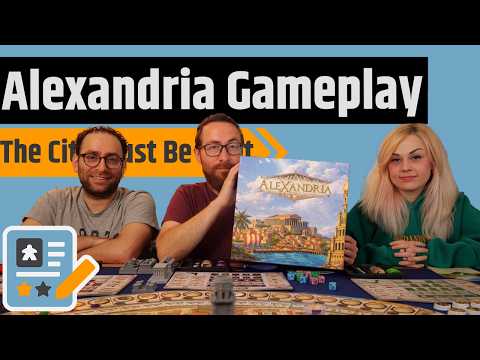









Alexandria Deep Dive
What the Community Thinks About Alexandria
Alexandria presents one of the most ambitious asymmetric faction designs in modern board gaming. Reviewers acknowledge its promise and mechanical sophistication while recognizing the challenge it faces: delivering strategic payoff that justifies the rules overhead and faction complexity. The consensus is that Alexandria is a compelling, well-crafted game with genuine innovation in how it structures player interaction through an economic commons, yet uncertainty remains about whether it will sustain long-term appeal beyond the initial discovery phase.
BoardGameCo's host positioned the game as a "Euro with a high degree of interactivity," unusual among the genre. Professor Meg from BoardGameCo emphasized that players are "playing into their particular roles for their faction, trying to use that to get the most victory points possible," with everyone following the same pacing but diverging in meaningful ways. Janna from ON TABLE Board Games highlighted the spatial and positional elements, focusing on how player boards power up and how positioning units on the main map creates scoring opportunities through adjacency and district formation. The Dice Tower team, including Tom Vasel, expressed enthusiasm about both the components and the design, with particular praise for how the asymmetry is implemented.
Core Mechanics That Define Alexandria
Dice Drafting and Activation
At Alexandria's heart lies an elegant dice economy. Each round, players roll action dice representing different abilities and strengths, then draft them in initiative order until all players hold three. What sets Alexandria apart is not the drafting itself, but what happens next: each die activates both the die's own action and the board action positioned above it on the player's board. This dual activation creates a puzzle where placement matters intensely.
Reviewers highlighted how this mechanic distributes power asymmetrically. A Harvester might use the same dice as a Crafter, but each die triggers different effects on their respective player boards. Professor Meg noted that "you're slotting your die into a zone" to activate both the die value and what sits above it, creating cascading effects down action lines. Reviewers also described scrolls and other modifiers that can be chained along these lines, adding another layer of optimization. The dice values themselves matter too: higher values draw more resources or cards but cost more to acquire, forcing constant trade-offs between power and economy.
The Timeline and Market Basket System
Alexandria's most distinctive feature is its central market economy. Rather than a static shop, goods exist on a timeline track where they slide progressively leftward each round. Early in the timeline, prices are high. As goods move along and eventually exit the track, their value diminishes. This creates genuine urgency: goods don't wait for buyers.
Players interact with this timeline through requests and offers. When a player wants to buy, they place a request token on an empty basket. When they want to sell, they place goods up for offer. Other players can fulfill these requests by paying the current price, which varies based on position. Janna emphasized how this system forces players to time their purchases and sales strategically: "you're buying and selling goods, but you're also going to be purchasing things from the different baskets, but things are always going to be in flux at the end of the round." The system creates a genuine economic simulation where supply, demand, and timing all matter.
The Alexandria Experience
Urgency and Economic Tension
The game generates constant, pressing decisions. With only five rounds and each action consuming a precious die, every choice carries weight. The timeline advancement mechanic ensures that opportunities vanish. Goods slide off the board. Buildings degrade. Raids intensify. Players are always aware that time is finite and options are limited. Reviewers captured this sense of urgency, noting how the design forces players to make meaningful sacrifices each round. The factions reinforce this urgency in different ways. Harvesters rush to produce. Crafters scramble to convert. Architects calculate building placements carefully. The Phalanx prepares for inevitable combat.
Collaborative Competition Through Trade
Alexandria creates a paradoxical space where players help each other achieve victory. Professor Meg noted that "you all get points through helping each other. We get points when we sell goods to each other. We get points when we buy goods from each other. We're kind of just helping the city grow. We're just trying to be the one who helps it grow the most." This dynamic is genuinely different from zero-sum competition. A Crafter who transforms Harvester goods into luxury items benefits the Harvester through purchase opportunities while building their own position. The Architect's monuments benefit neighbors through adjacency bonuses. Even the Phalanx's raids, seemingly antagonistic, create opportunities for other players to earn points by helping defend.
What Makes Alexandria Stand Out
True Asymmetry That Respects Shared Systems
The four factions are not merely reskins. The Harvesters produce raw goods in the fields on the board's edges. The Crafters refine goods into luxury products through activation cards. The Architects build monuments and generate passive income from other players' building actions. The Phalanx eschews luxury goods entirely, instead scoring through raid victories and combat tokens. Yet all four operate within the same turn structure, use the same dice, and interact through the central market. This is asymmetry that works: factions are distinctive without feeling like different games.
Reviewers consistently noted that this separation of concerns is well-executed. Janna explained how "the phalanx faction specialized in dealing with raids," with its own scrolls and combat mechanics, while others work the market. The designer (Meeple Pug, responsible for earlier successes like Byzantium) managed the difficult task of making factions feel thematic while maintaining mechanical elegance.
Beautiful Components and Presentation
Multiple reviewers praised Alexandria's production quality. The miniatures are impressive. The boards are layered and functional. The timeline track itself is a visual centerpiece. Alex Radcliffe spent considerable time in their unboxing discussing the care taken with the component design. The Dice Tower crew called out how good the buildings look on the table, with one host admitting the dice-placement grid alone made them want to dive in. The aesthetic doesn't distract from gameplay; it reinforces it. Monuments actually look monumental. Unit placement on the map feels consequential because the pieces themselves matter.
Potential Drawbacks
Rules Overhead and Learning Complexity
Alexandria demands respect. Professor Meg cautioned that "this game is a lot of game" with terminology that feels confusing when explained but becomes intuitive when played. The asymmetric factions mean that four different player boards operate by different rules. Scrolls have specific effects. The timeline phase involves multiple substeps. Raids have their own resolution sequence. Reviewers noted that "there's a buying and selling as well as requesting and offering" and that players need reference materials to keep track of faction-specific rules. This is not a gateway game. New players will stumble through their first play, and teaching will require patience.
Uncertainty Around Strategic Payoff
Reviewers articulated a meaningful concern: despite the impressive asymmetry, they questioned whether the factions deliver enough strategic differentiation to justify the complexity overhead. Some reflected after experiencing the game that they wanted there to be a bigger payoff in mechanical depth given all the teaching burden. This touches on a deeper question: is playing as a Harvester meaningfully different from playing as a Crafter in ways that matter strategically, or does the game eventually collapse into similar optimal strategies regardless of faction? Early reviews suggest the asymmetry holds up, but this remains a live question for the community.
If You Enjoy Alexandria
Players who engage with Alexandria's asymmetric faction design will find kinship in Root, a game that similarly embraces fundamentally different factions with divergent win conditions and mechanics. Both games ask players to embrace faction identity and think strategically within unique constraints.
Those captivated by Alexandria's economic simulation should explore the Meeple Pug lineage: Byzantium features card-driven engine building with economic interactions, and Mesopotamia (though more area control) shares the publishers' commitment to systems where player actions create shared opportunity. Castles of Burgundy, a classic euro, shares Alexandria's focus on spatial puzzle-solving and the satisfaction of building a functional engine across multiple rounds.
Players drawn to the dice-drafting core should consider Terraforming Mars for its emphasis on card synergies and engine construction, or other games by designer Leo Colovini (referenced alongside Sengoku in the Gamefound Feast) who excel at systems where position and timing interact dynamically.
What Reviewers Are Saying
"You are all going to be interacting with these different baskets. And you're going to be doing this in different ways where the harvesters, for example, are going to be the ones really creating goods in their raw form. Perhaps you're getting fish or grapes. And then you're going to have the crafters that are then taking those different goods and turning them into something a bit more luxurious that other players might want."
— Professor Meg, Board Game Co
"This is the track containing baskets, different products, and resources. This is the one of the game's main mechanism. This is place where the players buy and sell goods, request for specific products, and offer resources for sale that other players may purchase."
— Janna, ON TABLE Board Games
"You're going to have these tiles over here. These tiles are going to be the baskets, I think they call them. The baskets are going to go into this little range over here. We're going to be placing things out and then putting out various demands and requests and offers, as well as events and even the raids. There's going to be raids when you have the phalanx player in place."
— Alex Radcliffe, Board Game Co