










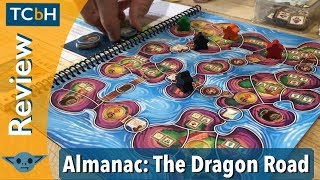
Almanac: The Dragon Road Deep Dive
What the Community Thinks About Almanac: The Dragon Road
Reviewers generally agree that Almanac: The Dragon Road is a rewarding worker placement game, though they disagree on how deep it goes. Published by Colossal Games and designed by Scott Almes, the game is played over six rounds, each on a different page of an in-game almanac. Each page represents a unique location with its own twist on worker placement. The Cardboard Herald admits to being skeptical that a game with a new board every round could feel cohesive, and says that concern proved unfounded.
The most enthusiastic voices come from reviewers who were initially doubtful about the designer or publisher. Board Games UnLocked says it was won over despite a history of finding Colossal‘s titles unappealing, and Board Games UnLocked, in a worker placement ranking, describes the game as a pleasant surprise that never felt like it needed a larger group. The more measured praise comes from The Cardboard Herald, which calls the game "strategic but not cerebral" and notes that its depth is limited. Most reviewers agree that the game is best as an approachable, thematic experience rather than a deep strategy title.
Core Mechanics That Define Almanac: The Dragon Road
Worker Placement
The game‘s signature system is worker placement, but each page of the almanac changes how placement works. The Cardboard Herald describes restrictions such as the inability to place workers adjacent to one another, or having to place them further along from your last worker. On another page, players must balance their workers on either side of an island. Board Games UnLocked shows the variations in a full playthrough, where one page allows only one worker per guild hut and another prevents a player‘s workers from touching orthogonally, with the rule tightening to include diagonals in a two-player game. In the review, Board Games UnLocked notes that the core placement stays the same while each location adds a slight twist, which lets the system feel familiar even as the rules shift.
Resource Management
Goods and money drive the economy. The Cardboard Herald explains that goods sit on each page with varying scarcity, so a player holding goods that are plentiful on the current page should use them to fulfill contracts, while a player holding scarce goods should sell where they are needed. Contracts are the main source of victory points and often grant permanent bonuses, such as extra production or the ability to treat a particular good as a wild. Unfulfilled contracts cost points, which keeps resource planning meaningful. Caravan extensions add capacity for goods and workers, so long-term investment competes with immediate needs.
The Almanac: The Dragon Road Experience
A Storybook Journey
The game leans heavily into its presentation. The Cardboard Herald calls it whimsical and says the artwork "looks like it‘s straight out of a gorgeous children‘s book." Each location carries its own fantastical mechanics that reinforce its theme, from a cloud monastery where players must keep their distance to a sky gate built on floating jetties. Board Games UnLocked describes the outpost, the mouse-sized craftsfolk, and the caravan crossroads in similar terms, emphasizing how each stop feels like a new chapter. Reviewers say the storybook framing gives each page a sense of discovery.
Strategic Puzzles Under a Light Surface
Beneath the charm, reviewers find real planning. The Cardboard Herald describes each page as "a unique puzzle to frame the same fundamental goals," where players gather goods, sell for cash, extend caravans, and complete contracts. Board Games UnLocked, reviewing the game, says it is light enough to teach quickly and keeps an engaging pace, though they add that every new page introduces a layer of rules that can slow the table. The result is a game that feels approachable on the surface but rewards careful reading of each location.
What Makes Almanac: The Dragon Road Stand Out
Page-by-Page Variety
The most consistently praised feature is the variety created by changing locations. Board Games UnLocked, in its worker placement list, describes each page as a storybook spread with its own rules for placing workers, and notes that the winner of each page‘s encounter influences where players travel next. The Cardboard Herald calls the approach a "choose your own adventure strategy game" in spirit, since the six rounds draw from a much larger book. Reviewers note that the encounter deck is arranged in groups of increasing danger, which adds tension as the game moves forward.
Closed-Fist Bidding for Turn Order
The Cardboard Herald highlights the bidding system that determines the round leader. Players bid with a closed fist, and the winner pays only up to the lowest bid. The reviewer says this "does a pretty fantastic job of encouraging players to bid big," and because money doubles as points, the bids carry real weight. The leader then chooses one of two locations, which creates a meaningful choice about where the group heads next.
Potential Drawbacks
Rules Spread Across Many Pages
Several reviewers note that the page-specific rules create clarity problems. Board Games UnLocked, reviewing the sequel-style Almanac: The Crystal Peaks, observes that the placement rules for each map are printed on the map itself rather than in the main rulebook. In their experience, some maps needed clarification, such as a setup rule requiring players to start on one of three spaces, which raised questions when four players were involved. Board Games UnLocked also reports that the core Dragon Road game left a few situations open to interpretation, which can stall play when a group does not agree.
Limited Depth and Replay Value
The Cardboard Herald concludes that the game is strategic but has limited depth, and that its core systems are interconnected but few. Board Games UnLocked, in its review, says the game‘s replay value depends heavily on the novelty of new maps, and notes that the underlying substance is less exhilarating once the surprise fades. The same reviewer recommends keeping the game on the shelf and bringing it out occasionally rather than playing it often. Board Games UnLocked also points out the absence of a scoring pad in the Kickstarter edition, though they note that the components are otherwise well organized.
If You Enjoy Almanac: The Dragon Road
Readers who appreciate the mid-weight strategy The Cardboard Herald describes should explore the work of Alexander Pfister, whose titles are often compared to this style of resource-driven planning. Cardboard Countdown featured Almanac: The Dragon Road as a viewer-picked highlight and credited acclaimed designer Scott Almes for launching the series, which speaks to how much the page-by-page format resonated with its audience. For players who like the game‘s variety but want a different theme, Board Games UnLocked recommends Almanac: The Crystal Peaks, which reuses the core rules with a colder setting and new maps, so players already comfortable with the Dragon Road can jump right in.
What Reviewers Are Saying
"What really struck me about this game is the delicate balance between strategy and theme. This is a whimsical game, and it has this wonderful artwork that looks like it‘s straight out of a gorgeous children‘s book. But at its core, it‘s actually a pretty dope mid-weight strategy game."
— Jack, The Cardboard Herald
"Almanac: The Dragon Road is not only the first game our viewers picked this month, but it‘s also the first entry in the Almanac series of games from acclaimed designer Scott Alms. Each round of the game is played on a different page in the game‘s game book, and each page represents a unique location with a special twist on worker placement."
— Matthew Jude, Cardboard Countdown
"I have tried a lot of his games, and Colossal is still a relatively new company. All of their games have usually been flops, but this one, this one, they, they really hit a home run on."
— Board Games UnLocked