









Aftermath Deep Dive
What the Community Thinks About Aftermath
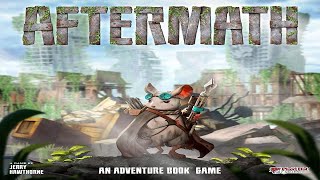
Reviewers agree on the premise. Aftermath is a cooperative adventure book game for one to four players, in which small critters leave their colony to scavenge a world that humans have abandoned. Opinions split on how well the systems deliver that premise. Meeple University came away enthusiastic, describing a light to medium complexity campaign with a rich, funny story that players can really settle into. Board Games UnLocked took the opposite view. That channel stopped partway through the campaign, called the rule book bare bones, and described the card-driven core as frustrating enough that it lost interest. Rob's Gaming Table plays the game as a shared, ongoing story and treats it as a one-time experience to be enjoyed rather than replayed. The most detailed view of intent comes from The Dungeon Dive, an interview with designer Jerry Hawthorne, who explains that the game was built around a colony that carries forward through the campaign.
Core Mechanics That Define Aftermath
Campaign Play
Aftermath is organized as a sequence of linked missions played from one adventure book, and the colony connects them. Meeple University explained that players work through each scenario's objectives together, and that what happens in one scenario feeds into the overall campaign. Rob's Gaming Table shows how that carries into play between missions: the group tracks food and population on the colony dashboard, and a shortfall becomes a real risk when a mission drags on. The designer in The Dungeon Dive interview described the colony management as the legacy element of the game, with side quests letting the group leave the main story and return to base. Jerry Hawthorne compared this to a West Marches style of play in tabletop roleplaying, in which a base camp anchors a series of independent adventures.
Hand Management
Actions in Aftermath are largely governed by the cards a player holds. Meeple University highlighted drawing up to five cards at the start of a round and deciding whether to move, search, or attack, with the option to pass cards to a teammate and pool them for group tasks. Board Games UnLocked described the same system as the game's central weakness. A turn can hinge on whether the drawn cards include the right colors for movement, attacks, or scavenging, and threat cards drawn from the shared deck push enemies toward the group at unpredictable moments. Players who enjoy planning a hand will find the choices satisfying, while players who dislike variance should expect some turns to feel dictated by the draw.
The Aftermath Experience
Narrative-Driven
Aftermath is a story first. Meeple University described the game as rich in story and quite funny at times, with characters that invite players to commit to a role. Those characters are a misfit group of critters, each with a personality and personal goals that shape how the group approaches a mission. The designer framed the central idea as a sudden transition, with humans thrust into the position of small animals who see a mundane, ruined world through new eyes. Board Games UnLocked, which was otherwise critical, singled out the shrunken-scale concept as creative, citing a mission set in a vending machine, but found the writing heavier and darker than it expected.
Collaborative
Aftermath is built around a shared goal. Meeple University framed play as a team effort in which players work together to survive the wider world and keep the colony fed. Rob's Gaming Table plays the game as a pair making decisions together, and it recommends that campaign players rotate groups and let different people make the choices, since outcomes are easy to forget and new decision-makers keep the story fresh. The result is a game where cooperation is the default, and the table talk around each decision is part of the appeal.
What Makes Aftermath Stand Out
A Colony That Grows Between Missions
The most distinctive feature reviewers identify is the colony itself. The designer described colony management as a favorite element and said the intent was for the settlement to act as the main character of the campaign rather than a backdrop to it. Players grow the colony by building structures and improvements with the spoils of their missions, and those improvements are what keep the group alive as the campaign continues. Because the designer built the campaign from the start around the colony, the progression feels cumulative rather than a series of unrelated scenarios. Rob's Gaming Table's food and population tracking shows this in practice, since decisions made in one mission continue to shape the colony's condition in the next.
Characters With Distinct Powers
Each critter in Aftermath brings a different ability to the group, and Meeple University pointed to that asymmetry as a source of enjoyment. The reviewer described the strongest character as the one who can charge ahead against bosses, and said that playing that role is fun because the group's strengths complement each other. The character-first design also supports the immersive quality reviewers praise. Players are encouraged to live inside their critter's perspective, which makes the story and the group's decisions feel personal rather than abstract.
Potential Drawbacks
Rule Book Clarity
The rule book is the most common complaint. Board Games UnLocked argued that it leaves gaps that matter in a campaign, including unclear guidance on leaving a location, on when numbered book entries should be read, and on how safe encounters with other creatures are supposed to resolve. The reviewer found that players are often left to improvise rulings, which becomes harder to sustain across many sessions. The designer acknowledged the same issue in The Dungeon Dive interview, explaining that the technical writing passed through a long editing process and that Aftermath's book still lacks enough visual examples, although later rule books from Plaid Hat Games have improved.
Randomness and Limited Follow-Up
Board Games UnLocked was also frustrated by how much the card draw and dice affect outcomes. The reviewer described situations where a player saves cards for a defense, only to have a negative die modifier undo the plan, and where threat cards cause enemies to act all at once. The same channel was disappointed that the expansions the publisher promised never arrived and that the online how-to-play resources were thin. In the designer's account, the expansions were already finished and waiting at the printer when the game's publisher relationship changed, which left them unreleased. Reviewers who value the artwork and miniatures still gave Board Games UnLocked credit on those points, so the production quality is not the concern.
If You Enjoy Aftermath
- Martin Mistakes: Meeple University compared Aftermath to this cooperative adventuring campaign game, noting that Aftermath uses different mechanics. Both are by Jerry Hawthorne.
- Stuffed Fables and Mice and Mystics: Both are earlier titles by the same designer, and The Dungeon Dive interview traces how the designer's story-first approach developed across them.
- HeroQuest: The designer named this board game as an early inspiration, describing it as a way to recreate the feel of a roleplaying group at the table.
- Descent: The designer pointed to Descent, alongside Runebound, as one of the few adventure games on store shelves when Mice and Mystics appeared.
- Freelancers and Forgotten Waters: Board Games UnLocked cited these later Plaid Hat Games titles as more polished than Aftermath, and The Dungeon Dive described Freelancers as an excellent app-driven game.
What Reviewers Are Saying
"It's fun to let her charge ahead and kill the boss. The game is rich in story also quite funny at times and you can really get into the character you play for more immersive experience because it's fun to do so."
— Meeple University
"When you're looking for things to help clarify how you actually do anything or what happens whenever you leave a location or when certain situations arise it's just not there so whenever you're trying to play a campaign game that you're going to be doing over an extended period of time you just have to wing it because it's just not clear in any way. And for the most part you can kind of just make edge case decisions whenever you're going through certain scenarios but that eventually just ramps up into well I'm just going to keep doing whatever I want to because there's no clear indication on anything that I'm supposed to be doing."
— Board Games UnLocked
"These type of campaign games are not meant to be replayable. This is like you're playing through a story. I believe this is like for the price you're getting a ton of hours of game out of this, put it on the shelf or give it to somebody else."
— Rob's Gaming Table