



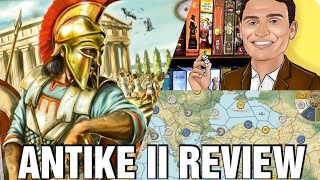

Antike II Deep Dive
What the Community Thinks About Antike II
Antike II is a strategy game designed by Mac Gerdts, and the Chairman of the Board channel treats it as a notable addition to the Gerdts catalog of rondelle games. Reviewers describe it as a hybrid, a euro style economic engine bolted onto a war game. Players race to a point target that shrinks as the player count grows, and the reviewer in Chairman of the Board describes a session of roughly 90 to 120 minutes for three to six players. That length sets expectations for a game that is long but never idle.
The overall tone across the channel's coverage is warm and admiring. In the monthly ranking episode, Chairman of the Board places it near the top of a strong month of new-to-them games, ranked behind Scout and Acropolis. The reviewer in the first video also calls Gerdts one of their favorite designers ever, which gives the praise for Antike II a comparative weight. In the purchase episode at Chairman of the Board, the reviewer says they had been hunting for a copy for a long time because it was hard to find in the UK, and approaches it expecting it to be a fit for their tastes.
Core Mechanics That Define Antike II
The Rondelle Action Wheel
The rondelle sits in the top corner of the board and drives every turn. The reviewer explains that a player's first placement can go anywhere on the wheel, but after that each turn moves a player one to three spaces around it. Discarding resources buys extra steps, so a player can travel further at a cost. The individual spaces are simple. There are resource production spots for marble, iron and gold, trade spots that convert resources at a two to one ratio and then a three to two ratio, a science spot for buying upgrades, defense and movement upgrades, a temple spot, and a militia spot for spawning troops.
The strength of the design is how these spaces interlock. Marble funds temples, temples raise the output of the regions they sit in, the extra output pays for troops, and troops are needed to move and claim cities. The reviewer praises the decision to handle city building as a passive step after the rondelle action rather than as a wheel space. Because a player can found as many cities as their resources allow, the game avoids waiting a full lap around the wheel just to expand.
Area Control and Attritional Combat
The second pillar is area control, enforced through combat that reviewers describe as clean and mathematical. Troops and cities each carry a strength of one, and opposing pieces that meet cancel each other out. A city defends with that same strength, and ties go to the attacker, so an invader can take a city by committing one extra troop. The reviewer notes that a player with fewer than two points gets an automatic extra strength, which keeps the early game from stalling. Defense upgrades make cities harder to breach without any troops on site.
Regions containing a temple carry a base defense of three, so destroying one is a serious investment. The reward for tearing down a temple is a general card, and those cards feed directly into the objective track. Ships on sea regions count as strength two, which links naval control to scoring. The reviewer also points out that players can agree to let a neighbor pass through without fighting, and combat only resolves once one side wants it. Objective cards reward control of sets of cities, seas and temples, so area control and scoring stay tied together.
The Antike II Experience
A Streamlined War Game With Real Economic Weight
The reviewer describes the feel as a war game with the overhead removed. Movement is simple, the military actions are straightforward, and nothing in the rules slows the table down. Yet the reviewer says the game never feels small, describing a balance between the war game side and the economic side, and arguing that a player cannot pursue either approach in isolation. A player can build a military force to repel attackers and then turn toward economy, or go on the warpath to smash temples when falling behind. That flexibility gives the game the zigzag quality that reviewers find satisfying.
Low Downtime and Constant Engagement
Reviewers consistently point to how little time anyone spends waiting. There is no preset round count, and play continues in turn order until a player reaches the point target. The reviewer in Chairman of the Board says that even a player who is not involved in a particular conflict stays engaged, because the board is always changing and the rondelle always offers something to consider. The target scales with the table: seven points at six players, eight at five, nine at four, and ten at three. The reviewer finds that smaller tables feel more spread out and exploratory, while larger tables are more crowded and conflict heavy, and considers the scaling a good answer to the full player range.
What Makes Antike II Stand Out
Deterministic Combat Without Dice
Antike II resolves its fights without randomness, and reviewers treat this as a defining feature. A troop or city wins or loses based on counting strength, which the reviewer describes as dry but satisfying for players who enjoy meticulously mapping out their options. The reviewer in Chairman of the Board says that the dice are never going to work against a player, and that the outcome depends only on planning. Because the attacker wins ties, the combat math rewards aggressive decisions without introducing chance, which keeps the tension in the decisions rather than in the rolls.
Depth That Teaches in Minutes
The reviewers' most consistent compliment is that Antike II is easy to explain but deep to play. The reviewer in Chairman of the Board praises the way Gerdts condenses complex thinking games into a manageable system, and says that every action on the rondelle is simple on its own. The richness comes from the choices between actions and the way resources connect, not from the rules themselves.
Potential Drawbacks
Bookkeeping and Table Layout
The most common complaint is practical rather than design-based. The reviewer notes that the rondelle sits in the top corner, so players seated on the far side must lean across the table to move their pieces, which is awkward in a long session. A bigger issue for some is the tracking of production. As a player claims more cities, working out how much of each resource they produce each turn becomes tedious. The reviewer suggests personal player boards that show output at a glance, so that a player with seven marble cities can see they produce seven marble without recalculating each time.
Zero-Sum Confrontation
Antike II is a confrontational game, and the reviewer is clear that it will not suit every group. Because combat cancels pieces on both sides and one player's gain is often another's loss, the game asks players to accept a zero-sum interaction. Some players will enjoy that tension, while others will want the variance that dice bring. The reviewer in Chairman of the Board adds that the game requires the right frame of mind, because it is more in-your-face than many euros, noting that their own taste has been moving toward games like this over time, which suggests the design rewards players who want that kind of interaction.
If You Enjoy Antike II
The reviewers place Antike II inside the rondelle lineage of Mac Gerdts, and that comparison is the most useful guide for players deciding what to try next. The reviewer in Chairman of the Board ranks the designer's work highly and sets a clear order among the closest comparisons.
- Concordia is described as the designer's magnum opus and a benchmark for the rondelle style. The reviewer says Antike II does not quite reach that level, but it shares the same logic of connected actions and resource networks, so fans of Concordia's economic engine will recognize the foundation.
- Navigator is more passive and less conflict driven. The reviewer ranks it below Concordia but still considers it a favorite. Players who want the rondelle's calmer side, with less direct confrontation, will find Navigator the closer match to that experience.
- Hamburgum is described as a less refined version of Navigator that still carries many of the same qualities. The reviewer places Antike II between Hamburgum and Navigator, which makes Hamburgum a reasonable entry point for players who want the Gerdts rondelle feel in a lighter package.
What Reviewers Are Saying
"This is a perfect hybrid that seamlessly mixes a euro economic game with a war game, and the fact that it does it in such a streamlined and simple package is quite remarkable."
— Chairman of the Board
"I think it was a really smart decision not to add the building action into the rondelle. It makes the game tick along at a much faster pace, and it feels like you can get a lot done a lot quicker."
— Chairman of the Board
"What a wonderfully streamlined war game, very dry especially when it comes to the combat. It's a very deterministic combat, as one troop will catch out the other. No dice rolling, no randomizing, nothing like that."
— Chairman of the Board