





Barbarossa Deep Dive
What the Community Thinks About Barbarossa
Reviewers tend to judge Barbarossa on its ideas first and its execution second. Tom Vasel of The Dice Tower placed it on a list of games that were ahead of their time, and the discussion focused on how the design anticipated later party games rather than on how polished it was. Board Stupid, hosted by Wayne and Matt, approached it as part of a retrospective on Spiel des Jahres winners and was openly puzzled by how it looked on the table. Other channels were more amused than analytical. No Rolls Barred included it in a list of uncomfortable games, while Board to Death TV previewed its World War II follow-up. Across these takes, the consensus is that the concept is clever and memorable, while the rules, production, and theme are where opinions split.
Core Mechanics That Define Barbarossa
Clay-Sculpted Riddles
The defining act of Barbarossa is building the puzzle itself. Each player sculpts an object out of a squishy modeling material to represent a single secret word, and the other players try to work out what it is. Board Stupid compared the core activity to Pictionary, but with a messier twist, since the material is part of the riddle and the table fills up with it as the game goes on. Klaus Teuber, the designer, traced the idea to a reading of Patricia McKillip's Riddle-Master trilogy, where wizards make and solve riddles. Teuber wanted a game that let players experience a small part of that world by creating riddles of their own, which is why the sculpting is the heart of the design rather than a decoration on top of it.
Letter and Yes-No Guessing
Movement drives the guessing. Players advance by rolling a die or spending gems, and the space they land on triggers an action. Board Stupid summarized the options as earning victory points for other players, asking for a letter of an object, asking general questions, or making a single guess that the sculptor answers yes or no. Each guess is written down and handed to the owner, and the owner's score depends on how many guesses the object received. Because the sculptor is scored on difficulty as well as on correct answers, the guessing phase becomes a negotiation between clarity and mystery. The Dice Tower's discussion of this balance is central to why reviewers keep returning to it.
The Barbarossa Experience
Messy, Playful Table Chaos
The sensory side of Barbarossa is a recurring point in the reviews. Board Stupid joked that players are already making a mess on the table before the first guess is made, and the reviewers returned to the practical cost of the clay. Once the modeling material dries out or runs low, players need to replace it, which the reviewer treated as an unusual and slightly comic part of the hobby. Board Stupid also described the material as closer to Play-Doh than traditional clay. For many groups, this sticky, hands-on atmosphere is the appeal, since the game feels more like a craft session with a guessing game attached than a typical card or board game night.
The Tension of Guessing Just Right
The Dice Tower describes the central pressure of Barbarossa in a single phrase: players do not want their object guessed too early, and they do not want it guessed too late. A sculpture that is too obvious gives away the answer and costs the owner points, while one that is too obscure frustrates the table. That tension gives each guess a sense of stakes that goes beyond simple recognition. Players are constantly calibrating how much to reveal, which turns each sculpt into a small act of social reading.
What Makes Barbarossa Stand Out
An Early Sweet-Spot Design
The Dice Tower argued that Barbarossa did something that almost no other game attempted in the 1980s. Its focus on finding the sweet spot between too easy and too hard was, in their view, a precursor to the approach later popularized by Dixit. Nothing else came close until Dixit reached the table, and afterward many party games were built around the same idea of being neither too obvious nor too obscure. The Dice Tower's point is that Barbarossa was an early model for a design principle that became central to the modern party game category, even though the original did not catch on in the same way.
Spiel des Jahres Pedigree and Riddle-Master Roots
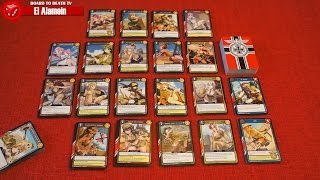
Barbarossa carries real industry recognition. Board Stupid placed it among the 1988 Spiel des Jahres winners, which is a significant credential for a game that many people now encounter only through reviews or reprints. Klaus Teuber also described the game in personal terms during the Rolling Dice and Taking Names interview, calling it Teuber's first published design, noting that Teuber worked on it for years as a hobby before sending it to a publisher, and adding that Teuber is glad it was reissued in more recent years. The continuing franchise adds to its profile. Board to Death TV previewed El Alamein, a World War II follow-up that reuses the same anime-styled artwork and the familiar Barbarossa systems while adding British counterattacks and an interception mechanic.
Potential Drawbacks
A Divisive Theme and Art Style
The theme and artwork are the most common source of hesitation. No Rolls Barred treated the game as a notably awkward pick for a pub or casual group, pointing to its over-the-top, sexualized anime-styled imagery in the context of a World War II setting. The reviewer conceded that the game is functionally good, but argued that the tone is a poor match for many tables. Board Stupid had a milder version of the same reaction, finding the look strange and the board hard to read, and calling it one of the most abstract games it had covered at that point in the series. Groups that are sensitive to the theme may find it a barrier before they get to the mechanics.
Clunky Rules and Lingering Mess
The Dice Tower acknowledged that the rules are somewhat clunky, and argued that the game would have needed a cleaner rule set to succeed as a party game. Its failure to become a standard in the category is part of why it is now treated as a historical piece. Board Stupid's concerns about the clay also count here, since the same mess that gives the game its character creates ongoing setup and cleanup work. The combination of a demanding rule set and a consumable, messy component is a reasonable reason to hesitate for groups that want a light, tidy evening.
If You Enjoy Barbarossa
If the sweet-spot guessing is what appeals to you, Dixit is the obvious next step. The Dice Tower's argument is that Dixit refined and popularized the same principle that Barbarossa tested in the 1980s, so players who enjoy balancing obscurity and clarity will recognize the pattern. For a more streamlined take on the sculpting idea, the Dice Tower also pointed to Cluzzle from North Star Games, which it described as a near copy of Barbarossa that simplified the concept. Cluzzle trades some of the messy hands-on craft for faster play, which suits groups who like the riddle but want less setup and less cleanup.
What Reviewers Are Saying
"you don't want people to guess it too early and you don't want people to guess it too late."
— The Dice Tower
"I worked on this game for five years and never thought about giving it to a company was only my hobby"
— Rolling Dice & Taking Names
"you use modeling clay to start with to make objects that need to be guessed by the other players"
— Board Stupid