










Black Friday Deep Dive
What the Community Thinks About Black Friday
Black Friday is a stock market trading game that reviewers approach with some caution at first. The box art and the title suggest a shopping theme, but the game is actually about buying shares, selling them into a shifting market, and trying to be holding the right stocks when the price swings. Once the rules are learned, the verdict is generally warm. Reviewers describe a game with a surprising amount of strategy packed into a fairly compact set of rules, and they note that it captures the feeling of trading against a looming crash without demanding hours of bookkeeping.
The main complaint is almost always the rule book. Reviewers agree that the written rules are hard to follow, and that the game works much better once someone has explained it clearly at the table. The gap between a frustrating first read and a satisfying first game is the central theme of most community discussion.
Core Mechanics That Define Black Friday
Share Prices, Briefcases, and the Shared Market
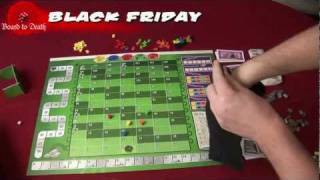
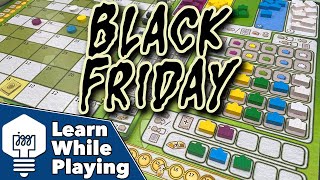
Players draw colored briefcases from a shared market and place them behind their player screens. Each briefcase represents a share in one of five stocks, and buying one also adds a briefcase to a sales track. Selling takes a share from a player's screen, pays out at the current price, and pushes that stock's price down. When a sales table fills up, a price adjustment triggers. Players pay interest on any subsidies they hold, stocks are drawn from a bag according to the current level card, and the price of each stock moves based on what was drawn. Reviewers point out that this single loop of buying, selling, and adjusting is the engine of the whole game.
Silver, Gold, and Subsidies
Silver is the second layer of the economy. Players can buy silver at its current price, and every purchase pushes the silver price upward at the next adjustment. Five silver can be traded in for one gold bar, and gold is what decides the winner. Subsidies act as loans that keep a player afloat when cash is short, but they carry interest that is charged at each price adjustment. A level track limits how many subsidies, shares, and silver a player can handle at once, and a one-time special action card gives a player a single extra move. Reviewers say the game ends when silver reaches its final value, and at that point every player sells off their stocks before the gold count is compared.
The Black Friday Experience
A Looming Crash That Keeps Everyone Watching
The most consistent emotional note in the discussion is tension. Adam in Wales describes the sense that a crash is always coming, and says that knowing it could arrive at any moment makes the game feel exciting and tense. Because the market is shared, every player is watching what the others are holding, and the decision to buy or sell is always partly a guess about what the rest of the table is planning. That uncertainty is what keeps the experience moving from turn to turn.
Drawing Briefcases and Waiting for the Payoff
The second feeling is one of anticipation. Board to Death TV describes the satisfaction of drawing from the bag and watching stocks climb, and calls it a good feeling every time it happens. Before You Play frames the game around timing: the fun comes from deciding when to get out before a stock collapses, and from trying to leave with as much money as possible. For players who enjoy trying to time a market, that cycle of waiting and reacting is the main draw.
What Makes Black Friday Stand Out
Horizontal and Vertical Price Movement
Adam in Wales highlights a design feature that separates Black Friday from many other trading games. Share prices move in two directions at once. Adam ties the feel of the game to the 18xx family of train games, where horizontal movement along a share price track adds an extra layer of strategy and complexity on top of the usual buying and selling. The combination gives the market a sense of depth without requiring a long list of separate rules.
A Lighter Economic Game With Real Tension
Board to Death TV makes the point that the game looks complicated at first glance but plays more simply than the rule count suggests. The reviewers argue that it is a simple game that still delivers strategy and player interaction, which is a rare combination in economic titles. Before You Play puts the run time at about 45 minutes, which places it between quick filler games and the heavier stock and economic games that take an evening to finish. That length makes it easier to bring to a game night than many of its competitors.
Potential Drawbacks
A Rule Book That Gets in the Way
The rule book is the single biggest drawback. Board to Death TV says that the rule book is not the best and that players will spend a lot of time guessing. Adam in Wales says the rule book has been heavily criticized, and argues that it is the main reason sales have been weaker than the game deserves. Setup also takes time, with the market, the subsidies, and the level cards all needing to be laid out before the first turn. Reviewers respond by producing detailed rules explanations, as Adam in Wales and Board to Death TV both do.
Theme and Cover Art Can Mislead
The bull and bear artwork on the cover can make the game look like a different kind of product, and it gives the impression of a crash-themed game rather than a trading game. Getting Games is less enthusiastic about the genre overall, noting that stock market games are not a favorite and that a recent experience with a different trading title left the reviewer less eager to try another one. Players who do not like the stock market theme will likely find less to enjoy here, even though the mechanics are well built.
If You Enjoy Black Friday
If Black Friday clicked with your table, look for other trading games that reward timing over pure luck, such as stock market and share trading games with clear price tracks and a shared market. Players who like the way Black Friday keeps everyone watching the same board may also enjoy light economic games with tight rulesets that reach a conclusion in under an hour. For a more demanding next step, 18xx train games offer the same horizontal share price movement in a deeper package.
What Reviewers Are Saying
"you really feel like you're playing the stock market without losing your life savings"
— Board to Death TV
"I think it's a real shame that it's it's been so criticized because of the rule book"
— Adam in Wales
"these kind of games are really fun for me where you're trying to time the market"
— Before You Play