




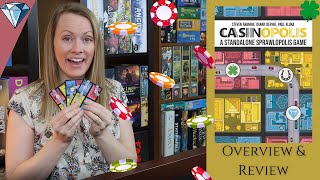


Casinopolis Deep Dive
What the Community Thinks About Casinopolis
Casinopolis stands out as a favorite within the Sprawlopolis line. Multiple reviewers called it their favorite entry in the series, drawn by its casino theme and the distinct mechanical twist it brings to the format. The game works equally well as a solo puzzle or a relaxed pass-and-play experience, making it versatile for different play contexts. Reviewers consistently praise how the theme integrates cleanly with the mechanics: the idea of building Las Vegas with casinos, roads becoming the Strip, and slot icons creating jackpots all feel natural, not forced.
Core Mechanics That Define Casinopolis
Card Drafting and Hand Management
Casinopolis plays with just 18 cards in a pocket-sized deck, making it genuinely transportable. At the start, you randomly flip three cards to establish your scoring objectives, then draw three cards to your hand. On each turn, you play one card and draw another. In multiplayer, you pass your two remaining cards to the next player, who always has three to choose from. This simple draw-and-pass rhythm creates light decision-making without heavy downtime, and the randomized goal cards ensure no two plays are identical. Even when drawing from the same 18-card deck, the order of draw and the random goal assignment create enough variation that players must fundamentally rethink their strategy each game.
Compound Scoring Across Multiple Systems
Casinopolis layers four independent scoring tracks that build your final total. First, you score one point per block in the largest casino of each color that connects to the Strip, your longest continuous road. Second, the jackpot mechanic rewards you when three or more matching slot icons sit adjacent on the same road, earning one point per icon. Third, you fulfill your three randomly-dealt scoring objectives, each worth a different multiplier (1, 2, or 3 points depending on which card slot it occupies). Finally, you subtract one point per different road in your grid. This compound system forces constant trade-offs. Building large casinos means ignoring roads. Chasing the Strip means limiting your options elsewhere. Collecting jackpots might mean sacrificing casino size. No single path guarantees victory; diverse strategies can reach the same score, which is exactly what makes replays feel fresh.
The Casinopolis Experience
A Puzzle That Rewards Constraint-Balancing
Casinopolis feels like a puzzle where you are solving for balance. Every card laid down has four blocks split across three casino colors, with one or two roads winding through it. Reviewers noted the constant tension of placement: you want to build connected casinos for points, but every new road costs you points at the end. You want matching slot icons to line up on roads for jackpots, but adjacent icons are tricky to engineer with only 18 cards and limited placement freedom. You want to hit your three scoring goals, but sometimes those goals pull in opposite directions. That juggling act, the feeling of never quite having enough cards to do everything, gives the game a satisfying puzzle quality. Players described finishing games just one or two points short of their goal, finding it close enough to believe they could win next time.
Casino Theme as More Than Window Dressing
The casino setting is woven into the core experience. Building casinos and roads becomes building Las Vegas and the Strip, making abstract tiling tangible. The slot icons, with three fruit symbols and three luck symbols, create thematic jackpot moments. Reviewers specifically praised how the theme opens mechanical possibilities that earlier entries in the series did not have. One reviewer noted that scoring objectives had names like Froot Loops, Lucky Charms, and Hot Streaks, which lean into the playful spirit. The lighthearted tone, the theme of betting and jackpots, and the presence of these icons on nearly every card combine to create an experience that feels cohesive, not just mechanically clever.
What Makes Casinopolis Stand Out
A Significant Step Up From Its Predecessors
Casinopolis introduces a new element to the Sprawlopolis family: the slot icons and the jackpot mechanic. Reviewers found this addition meaningfully changed the game without bloating it. Unlike earlier entries in the series, Casinopolis supports multiplayer naturally; players can focus on different scoring goals, one person chasing casinos, another managing the Strip, a third hunting jackpots. The addition of more "going on" per card makes it feel heavier than Sprawlopolis, Agropolis, or Naturop while still fitting in a pocket. For series fans who had played those earlier games many times, this felt like the entry that had finally earned a fresh coat of innovation.
Replayability Through Variable Bet Slots
One mechanical twist sets Casinopolis apart from its cousins: the three scoring objectives are dealt into three card slots, and the slot determines the point multiplier. One slot is worth 1 point, another 2, and the third 3. This means even if you draw the same three scoring objectives again, their point values change depending on placement. If Froot Loops is in your 1-point slot, you might ignore it entirely; if it's in your 3-point slot, suddenly you chase every fruit icon. This small variation multiplies replayability. Players reported shuffling the same 18 cards repeatedly without feeling fatigued by the format, because the randomized multipliers forced genuinely different tactical decisions.
Potential Drawbacks
Jackpots Are Elegant But Difficult to Execute
The jackpot mechanic, while thematic and rewarding, is tricky to set up. You need three or more matching slot icons to sit adjacent to one another on the same continuous road. With only 18 cards and limited placement freedom, this is easier said than done. One reviewer noted that getting jackpots consistently requires strong planning and a bit of luck with draw order. The mechanic itself is not flawed, but players should expect to play several games before they start reliably hitting jackpots. For completionists or players who prefer certainty, this high-variance element might feel frustrating at first.
Dense Information Requires Attentiveness
Casinopolis packs more information per card than earlier entries: blocks, colors, roads, and slot icons all coexist. Reviewers found themselves needing to track their three scoring objectives, the building casinos, the emerging Strip, the placement of jackpot icons, and the growing road penalty simultaneously. One reviewer admitted to miscounting icons mid-scoring or placing suboptimally because they lost focus on one of these threads. It is still a 10-15 minute game, so the cognitive load is manageable, but it demands more active attention than a pure spatial puzzle would. Solo players working through the game calmly may find this meditative; players trying to snap out a quick decision before passing cards might lose track of the full picture.
If You Enjoy Casinopolis
Your next steps within the Sprawlopolis line depend on your appetite for variation. Sprawlopolis, the original, is the most accessible entry and pairs well with Casinopolis if you want the pocket-game feeling without the theme twist. Agropolis and Naturop offer alternative themes and slightly different rule sets, though reviewers found Casinopolis superior to both in terms of mechanical depth and player engagement. If you have played all four entries back to back, consider rotating them by season or group; each has earned its place in the line, and Casinopolis' casino flavor is a welcome refresh after the farmlands and nature themes of its predecessors.
What Reviewers Are Saying
"I have to say that I was excited about a casino themed opis because I think that that's a really fun theme and I wasn't really sure mechanically how that would translate but I like the idea of having the slot icons and getting the jackpots like I do think that it's quite fun trying to get three in a row of the same icon I also think that it adds quite a bit of complexity that at least the base game other opis games didn't quite have."
— Tabletop Tokki
"This is a one plus player game but I mostly play it solo as you have a puzzle it's 18 cards you flip three of them to give you your requirements and then the rest you're putting out in a grid trying to solve that requirement I think it works really well the casino theme let you do some fun things with slots or getting symbols next to each other and of the series this one is easily my favorite of it."
— The Dice Tower
"It's so different every time even though there's only 18 cards because the three goals are different each game it really forces you to play completely different every time you play the game it's a very quick and easy game but there's a lot of thought going in."
— TheGameBoyGeek