/pic6844497.jpg)
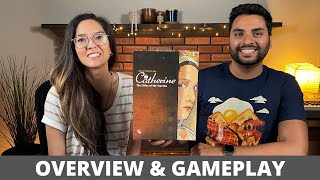
Catherine: The Cities of the Tsarina takes 2-4 players to the Tsarist Empire of 1762 to win the Tsarina's favor with the help of an innovative card mechanism. As is so often the case, different strategies can lead to different goals: Do you devote yourself to the development of the fine arts or trade, or do you perhaps prefer to secure arms and thus perpetuate the empire? With each card you hold, you must decide whether to gain the resources and use the action on that card or whether to throw it away to activate another action.
To start the game, choose three of the six project cards in your hand and place them in your action row. At the top of each project card is a list of three cities or an assortment of cannons, books, and goods; at the bottom of each project card is an action and (in most cases) a bonus.
The game lasts three decades, with each decade lasting four rounds. Players play simultaneously during each round. At the start of a round, draw two cards, then play one card in your action row and another card in your activation row — located below your action row — under any project card in your action row that has not been activated. If the activation card matches the color of the action card above it, you carry out that action, whether it's placing a residence on the map, gaining cards, exchanging cards for points or a favor, gaining favor by having cannons or books, etc. If you carried out the action and the card has a bonus, you then get that bonus once. If the activation card doesn't match in color or you choose not to do the action, you draw a project card as compensation.
If you would ever draw cards over your hand limit, you instead gain 1 point for each such card. If you would gain favor over the maximum, you instead gain 1 point.
After four rounds, an interim scoring takes place, with players comparing cannons and books in their action row, then gaining points for residences and their placement on the favor track. Players then discard all cards in their activation row, along with the cards above them that were activated, then draw two new cards. After the third interim scoring, players score points for cards in hand, their largest group of contiguous residences, and how well they've completed the order card they received at the start of play. To complete orders, you need goods from cities, which means you need to place residences in those cities, which means you need to activate the right cards and collect lots of books.
Whatever you do, do your best to make Catherine proud!
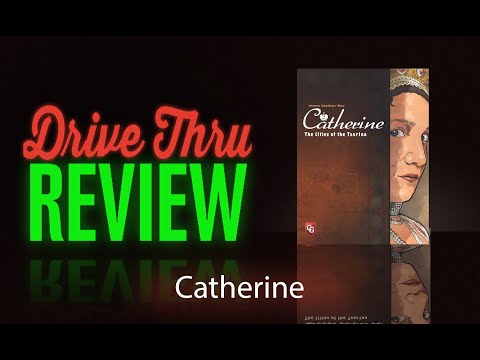
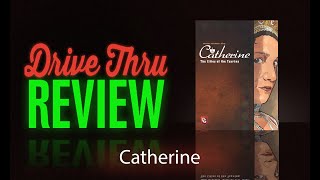
Catherine Review


- Fun and dynamic card play
- Interesting abstract mechanisms with a pseudo-Euro theme
- Offers tough choices and nuance
- Good production and art quality
- High replayability due to large card deck
- Theme doesn't add or detract
- Abstract
- Zarina Catherine's Reign Over Russia
- Flashpoint
Mechanics (from transcript analysis)
- Card Drafting — giant deck of cards you're kind of always coming at it a little bit differently
- Multi-Use Cards — crazy kind of multi-use card game game that's very abstract
Video topics + discussion points
Quotes (from this video)
- this is number five Catherine
- number four is a game from uh the folks at Prospero Hall and this is called rear window
- number three is dead reckoning
- number two is oath sworn
- number one of course this is the game uh that in partnership with restoration games uh we'll be giving away to one lucky commenter
- return to Dark Tower
- one was blood on the clock tower
- the other one is the game I have not reviewed I've played it once it's called the Crescent Moon
References (from this video)
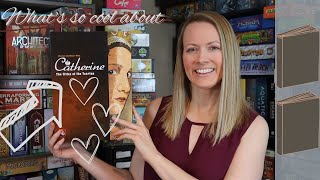
- Clean, tight, and straightforward card game
- Compact box with a lot of gameplay
- Rich, flexible card activation mechanic with multiple routes to victory
- Strong integration of board placement with card play
- Engaging interim and final scoring
- Expands hand limit for variety and depth
- city-building, political influence, resource management
- Russia in the imperial era centered on Catherine the Great
- abstracted historical simulation via card-driven engine
Mechanics (from transcript analysis)
- Board placement and network — Residences are placed on a map to gain bonuses and end-game points, creating a network.
- Bonus actions on activation — Activating a card grants a bonus action listed on that card.
- Color-matching activation — Activations are triggered by placing a card of the same color beneath another card.
- Compound Scoring — Three decades per game with interim scoring after each decade and final scoring.
- Decade-based scoring — Three decades per game with interim scoring after each decade and final scoring.
- Hand Management — Hand size can be expanded via a track, affecting deck management and options.
- Hand management and track upgrades — Hand size can be expanded via a track, affecting deck management and options.
- Matching — Activations are triggered by placing a card of the same color beneath another card.
- Network/Route Building — Residences are placed on a map to gain bonuses and end-game points, creating a network.
- Resource Management — Collect tokens, canonical symbols, and books to trigger bonuses and victory points.
- Resource tokens and objectives — Collect tokens, canonical symbols, and books to trigger bonuses and victory points.
- Simultaneous card play — Each player draws and programs two cards; cards are played face down and revealed simultaneously.
- Top and bottom row activation — Cards are placed on two rows; matching colors underneath a card activate its action.
Video topics + discussion points
Quotes (from this video)
- it's just such a clean tight nice strategy game that comes in a small box
- the heart of this game is the card activation
- Catherine the Cities of the Tsar is just such a clean straightforward card game that incorporates some tokens and some board playing on the map
- I've seen players take multiple routes to success and victory
- there are a lot of really great choices here
References (from this video)
- Clever card mechanism; interesting dual-row interaction
- Thematic choice is problematic; the Russia/Catherine theme is sensitive
- Theme may limit appeal; heavy and potentially off-putting at times
- Politics/expansion; historical geopolitics
- Russian empire-era Catherine the Great; maps showing new borders (Nova Rus)
- educational with historical framing
Mechanics (from transcript analysis)
- Color-moded action/activation with layered card play — Top action row and bottom activation row; placing cards under others to trigger abilities
Video topics + discussion points
Quotes (from this video)
- I'm going to go over right now the list of games that I've acquired in 2024
- I've decided to get rid of the bottom three
- it's sunk cost fallacy and I don't need to hold on to this
- the three I mentioned are Admirals, Rosio, Rap Gods
- this is one of those 'it's the wrong theme for today' moments
- I don't want to be gaslit into justifying my position in the comments
References (from this video)
- Cards have a lot going on, offering complex decisions.
- Feels like a throwback to older, cleaner Euro games.
- Packs a lot into a short playtime, feeling like a more epic game.
- Smoothly designed and polished.
- High recommend for players who love cards and multi-use card mechanics.
- Fits within the larger net of older Euros like Tiger's New Clothes, Samurai, and Through the Desert.
- The terms 'action row' and 'activation row' are too close and confusing.
- Icon-heavy, requiring a reference for understanding.
- Abstract nature makes it hard to convey the experience through a thematic story.
- May not appeal to players who prefer direct social interaction or more complex, sprawling games.
- Late Russian Empire, before it became the Soviet Union
- San Juan
- Race for the Galaxy
- St. Petersburg
- Seven Wonders
Mechanics (from transcript analysis)
- Area Majority — Comparing canons (military) and books (science) with neighbors for scoring and bonuses, similar to Seven Wonders.
- Card Drafting — Players draft cards to play into their action and activation rows.
- Multi-Use Cards — Cards have multiple uses, either as actions or for counting towards scoring conditions.
- Route Building — Players build routes of buildings on the board and score points based on the largest contiguous route.
- Set Collection — Players collect resource tokens and may score points based on collected resources matching end-game bonus cards.
- Simultaneous action selection — Players perform actions simultaneously during each phase of a round.
- Tableau Building — Players play cards into a tableau in front of them.
- Track Advancement — Players move markers up a favor track, which affects hand size, interim scoring, and end-game multipliers.
Video topics + discussion points
Quotes (from this video)
- The real crux of the game is trying to look at the hand of cards you have and figure out, you know, do I want to use this to activate something else do I want to activate it or what or maybe I can let it sleep over here and then hopefully draw another yellow card to activate later because I really want to activate this one and so on so that's the real kind of the crux of the game.
- It's a throwback vibe and I really like it for that.
- It somehow feels like a more crunchy kind of full epic kind of game that would you know normally take like two hours or so.
- This is that's who this is kind of for and I think if you're not, you know, you don't have a good memory of that kind of stuff with some of these older games like a San Juan or something or a St Petersburg or, you know, I mean very loosely and a lot of these games I'm saying are not really like this game because this game is very different with how it kind of works but it's in that same sort of overall kind of larger net of these kind of older Euros like a Tiger's new phrase Samurai through the desert you know stuff like that.
- It's like a new game that somebody lost and then somebody found it and brought it out 15 years later really really cool a definite High recommend for for me and if you love cards and you love the whole multi-use card thing which I do this is easy recommend easy.
References (from this video)
Mechanics (from transcript analysis)
Video topics + discussion points
Quotes (from this video)
- we're going to start with the teach of the game and then go straight into our two player playthrough
- think of your activation row as basically like buttons
- rounds are really really fast as you can see
- the game is played over the course of three decades
- if i have three books i have one two three books i get two favorite
- this is a two-player euro game that plays in roughly 45 minutes