
/pic158548.jpg)
/pic2305703.jpg)












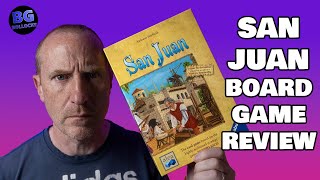
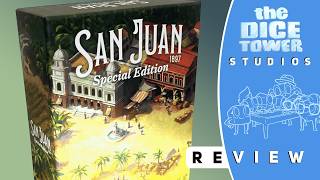









San Juan Deep Dive
What the Community Thinks About San Juan
San Juan has carved out a special place in modern board gaming as Andreas Seyfarth's elegant card game adaptation of the classic Puerto Rico. Reviewers consistently praise it as one of the finest examples of how to distill a complex economic game into something accessible without sacrificing strategic depth. The game has remained remarkably resilient on top 100 lists for over two decades, evidence of its enduring appeal to both casual and competitive gamers.
Core Mechanics That Define San Juan
Multi-Use Cards and Role Selection
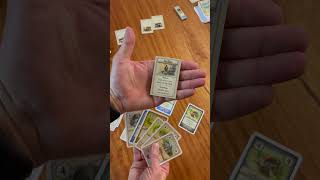
At the heart of San Juan lies one of board gaming's most ingenious innovations: cards that serve multiple purposes. Each card in your hand functions as either a building, currency, production resource, or good to trade. This elegant design forces meaningful decisions at every turn. The game revolves around role selection, where one player chooses an action for the main effect while all other players get a watered-down version. Producer lets you tuck cards behind production buildings to generate goods. Trader lets you exchange produced goods to draw cards. Builder lets you discard cards as payment to add buildings. Counselor lets you draw cards and choose one to keep. Prospector lets you draw a card. When you choose a role, you get the full power of that action, giving you a significant advantage that makes role selection genuinely impactful.
Engine Building Through Synergy
Cards built during the game augment all these actions through special abilities, allowing players to construct satisfying engines that generate both profits and points. The way these cards interact creates cascading benefits that reward forward planning. Players find themselves building toward specific strategies, whether focusing on maximizing production chains, collecting certain card combinations, or timing their trades perfectly as market prices fluctuate throughout the game.
The San Juan Experience
Light Yet Strategic Gameplay
Despite its simplicity in core rules, San Juan delivers genuine strategic tension. The game flows quickly, typically finishing in around 30 minutes, yet remains satisfying for experienced gamers. Players appreciate how accessible it is to teach newcomers while still offering the depth and decision-making that veteran gamers crave. It works remarkably well as both a gaming dessert after heavier titles and as a complete standalone experience.
Elegant Compression of a Classic
Reviewers consistently note that San Juan takes everything good from Puerto Rico and compresses it into something far more portable and faster to play. Unlike its predecessor, which demands several hours of engagement, San Juan delivers that Puerto Rico experience in a fraction of the time. The card-driven implementation removes components and setup overhead while preserving the economic heart of the original game. Players regularly find themselves enjoying the same kinds of meaningful choices and interactive gameplay that made Puerto Rico legendary, but with a level of accessibility that opens it to a broader audience.
What Makes San Juan Stand Out
Versatility Across Player Groups
The game's greatest strength lies in its ability to appeal across different player preferences and skill levels. Whether you enjoy optimizing engine production, engaging in player interaction, or pursuing economic victory, San Juan accommodates your style. It works as a family game, a bridge between casual and hobby gaming, and a legitimate choice for dedicated board gamers seeking an efficient experience. This versatility explains why it appears on so many different kinds of top 100 lists.
Staying Power and Accessibility
San Juan has demonstrated remarkable staying power since its 2004 release by Andreas Seyfarth, published by alea and Ravensburger, with recent reprints introducing it to new generations. The game's low barrier to entry means almost anyone can enjoy it after a brief explanation, yet the interactions between cards and the various paths to victory ensure that repeat plays feel fresh. Players find themselves discovering new strategies and combinations long after their first game, making it a perennial addition to gaming collections.
Potential Drawbacks
Luck in Card Distribution
The game does contain a good amount of luck in determining which cards become available and how they appear in the market. This randomness keeps everyone engaged throughout, preventing dominant players from running away with early advantages. However, players who prefer pure strategic control with minimal luck elements may occasionally feel frustrated by their card options, particularly in games where the market favors opponents' strategies.
Limited Complexity for Heavy Euro Enthusiasts
While San Juan offers genuine depth, players seeking the economic complexity of games like Power Grid or the intricate optimization of heavier titles may find it somewhat lean. Some devoted board gamers view it as a stepping stone rather than a destination game, a gateway title that teaches excellent design principles but doesn't demand mastery of intricate subsystems. Those accustomed to games with multiple interlocking economic systems might find San Juan's mechanisms streamlined almost to the point of simplicity, though this very quality is precisely what makes it so widely beloved.
If You Enjoy San Juan
Fans of San Juan should explore Puerto Rico, the strategic titan from which it draws inspiration, for a deeper economic experience. Race for the Galaxy shares its card-driven design and role selection but in a science fiction setting with additional complexity. Earth delivers that same engine-building satisfaction through a different mechanical lens. Those who love the quick-playing elegance might enjoy Skylands, which uses a similar follow mechanism, or Machi Koro for a different take on building and production. Splendor offers card-driven economic play at a similar weight, while San Petersburg provides alternative card economy mechanics from the same design tradition.
What Reviewers Are Saying
"This one you're kind of using cards to pay for other cards getting points in different ways, I mean getting crops and selling them and stuff you know everything you'd expect from the stellar game but it's the fact that it's all card driven, very easy to explain but still some a big kind of wide spectrum of different strategies you can go for."
— Chairman of the Board
"In San Juan you've got these multi-use cards so each card can be played either as a building which will give you some sort of ability or you can discard cards and use them as money to pay for buildings or you can tuck cards under production buildings and then they count as the resources."
— Adam in Wales
"San Juan is a light game with a good amount of luck to keep everyone interested and engaged. I've often enjoyed it as a dessert game."
— The Dice Tower