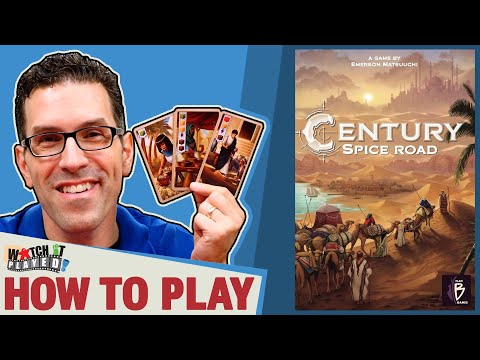
Century: Spice Road is the first in a series of games that explores the history of each century with spice-trading as the theme for the first installment. In Century: Spice Road, players are caravan leaders who travel the famed silk road to deliver spices to the far reaches of the continent for fame and glory. Each turn, players perform one of four actions:
Establish a trade route (by taking a market card)

Make a trade or harvest spices (by playing a card from hand)
Fulfill a demand (by meeting a victory point card's requirements and claiming it)
Rest (by taking back into your hand all of the cards you've played)
The last round is triggered once a player has claimed their fifth victory point card, then whoever has the most victory points wins.
Century: Spice Road - How To Play
- Caravan leaders who travel the famed Silk Road to deliver spices to the far reaches of the continent for fame and Glory
- takes place during a different point in history
- Splendor
Mechanics (from transcript analysis)
- engine building — this engine building game
Video topics + discussion points
Quotes (from this video)
- this top 10 list is based on the daily averages from boardgamegeek.com hottest game list over the past 30 days basically these are the games that people are looking at and talking about the most over on the internet's largest board game database website
- the quality of the single player experience keeping the quality of its solitire gaming as pristine and as high a priority as possible
- now will this game have been worth the wait well let's hope so
- the eighth most popular game in the BGG hotness this past month was the newest offering by designer Emerson matsuuchi Century spice road
- Arkham Horror the card game is what's known as a living card game or lcg
- a periodic point of contention with Arkham Horror the card game is that in order to have enough potential cards to accommodate multiple players at least two core sets of the games need to be bought
- in dice Forge players fight to gain Valor with the gods using an Armory of dice with removable faces
- I'm wondering will dice Forge suffer the same fate or does this dice game have more to offer in terms of its gameplay and Longevity than its predecessor did
- a bold statement one that leaves me wondering if these strides towards improving the game's functionality will really cause it to continue to LEAP froggit way to an even higher position in our top 10 next month
- first Martian aims to bring several Innovations to the board gaming scene by hoping to take app integration to the next level
- now that the game is starting to ship initial reports are that the game has been worth the wait
- for the past 4 months the number one spot on the list has belonged to one and only one game Gloom Haven
- even though Gloom Haven is technically the game in the number one spot we're going to take this opportunity to highlight a different game that's worth talking about
- it sounds like even though this is another game set in the Gloom Haven universe it is vastly different than its predecessor which is very neat and encouraging to see
References (from this video)
- Acquiring new merchants provides new abilities for future turns.
- Spice cards allow collection of spices.
- Upgrade cards allow for conversion of spices.
- Trade cards allow for flexible conversion of spices.
- Resting allows players to retrieve played cards.
- Claiming point cards is the main way to score.
- Exceeding caravan capacity requires returning excess cubes.
- Running out of spices in the bowls requires using replacements.
- spices and trade
- centuries past
Mechanics (from transcript analysis)
- action selection — On their turn, players choose one of four actions: acquire, play, rest, or claim a point card.
- card drafting — Players acquire merchant cards from a central display, with some being free and others having a cost based on their position.
- hand management — Players have a hand of merchant cards that they can play to perform actions, and can also use the 'rest' action to retrieve played cards back into their hand.
- Resource conversion — Players can upgrade existing spices into more valuable ones or trade sets of spices for others using specific merchant cards.
- set collection — Players collect spices (cubes) to meet the requirements on point cards to claim them for victory points.
Video topics + discussion points
Quotes (from this video)
- In centuries past, spices carried an air of mystery and allure.
- So join me at the table, and let's learn how to play.
- And that's the setup!
- But I would avoid using actual spices because that would just make a big mess.
- And that's everything you need to know to play Century: Spice Road.
References (from this video)
- Simple rules
- Nice components (Golem Edition)
- Good travel game
- Family enjoyed it
- spice trading
- Spice Road
Mechanics (from transcript analysis)
- Action Pool Building — Mentioned as a mechanic.
- contract fulfillment — Mentioned as a mechanic.
- engine building — Simple rules engine building.
- hand management — Upgrading resources to get better resources, hand gets the points.
- Resource management — Upgrading resources to get better resources.
Video topics + discussion points
Quotes (from this video)
- we are sharing our list what we would usually play and why coming up
- it is a very personal list because your dynamics are going to depend on your family's uh capacity to play games
- my parents played a lot back in the 80s less so since then
- looking for at least five players generally speaking
- project gaia first then no no there's no food chain magnet here your dad would be like what they there are no uh small text though or are they
- the crew is uh if the group plays up to five in a a very good i know your family is used to playing trick taking games i think
- colt express was a hit a few years ago um at our christmas place it's really fun plays up to six
- gravwell being a you know it's a it's a little bit more abs it's definitely much more abstract than cult express but it has the same um i mean it's not quite programming but it's simultaneous selection and enough things will happen that it's going to uh that you can't always plan for everything
- it's a good travel game as well indeed
- camel up is also a racing game but it's more so of betting than racing
- it's very clever racing game um because it takes the dice out of it
- it's the quacks of werdell burke
- this one's more on the thinking side of things of course if you uh it's it's it's one of the classic simple thinking games
- if you've never heard of any of these games you can still have fun with family monopoly it'll happen
- i only just realized that cludo was a pun on um on the old die rolling game ludo
- internet's always right so assume that exactly that is correct then
References (from this video)
- trade and resource management
- historical spice trade routes
- abstract/economy-driven
Mechanics (from transcript analysis)
- engine building — build a sequence of cards that improve future turns
- set collection — collect gem-like tokens to fulfill card requirements
Video topics + discussion points
Quotes (from this video)
References (from this video)
- Engaging hand-building decisions and engine-building potential
- Strong planning and interaction between cards as the game progresses
- Low downtime and fast pacing, even with more players
- Enjoyable planning and engine optimization
- Flawed incentivization mechanic that can stall the row and engine
- Runaway leader risk when the trade row stalls, leading to reduced interaction
- Limited variability; VP cards map predictably to spice values and there is little dynamic action from round to round
- Two-player variant can underperform due to early stall in card cycling
- spice trading
Mechanics (from transcript analysis)
- End-game trigger — The game ends when a player collects a certain number of VP cards (6 for 2–3 players, 5 for more players).
- hand-building / engine-building — Players build an engine by drafting and playing cards to generate and upgrade spices, progressing toward victory point cards.
- Resource accumulation — Playing cards yields spices into your caravan area; you can spend spices to gain others or to fulfill VP cards.
- spice management and conversion — Spices come in four types; some cards convert one spice into another, enabling engine growth.
- trade row and cycling — A row of trade cards is available; players can take top cards for free or pay spices to pull more advanced cards, with cards sliding down as taken.
- Turn structure — Each turn is a single action chosen from four options.
- upgrades — Upgrade cards allow increasing spice values or combining upgrades to improve actions.
- victory point cards and coins — Victory point cards at the top of the table grant points; gold coins (underneath VP cards) are worth 3 points each, silver coins are worth 1 point each.
Video topics + discussion points
Quotes (from this video)
- I love figuring out which card is going to be best for me based on the cards I already have in my hand as well as the slices I have in my area
- the surprisingly low amount of downtime in this game
- it's a largely multiplayer solitaire game
- I am quite good at this game
- it's a shadow of the game it could have been
- I cannot say that I love this game I do think that I recommend it
References (from this video)
- buttery smooth, fast play
- classic for a reason
- competition and market mastery
- medieval spice trade routes and card-driven economy
- classic euro-style with high momentum
- Wingspan (customization/flag-based play sessions)
Mechanics (from transcript analysis)
- set collection and card drafting — players craft pipelines of spices to gain points and momentum
Video topics + discussion points
Quotes (from this video)
- We funded and we exceeded even a few stretch goals.
- That's fraught with danger.
- The coolest name ever.
- the following mechanism is really neat.
References (from this video)
- Elegant, simple rules that are easy to teach
- Strong gateway engine-builder with depth on repeated plays
- Beautiful components and clear card imagery
- Less player interaction compared to more combative games
- Depth emerges with multiple playthroughs which may feel slower on first play
- spice cards and resource conversion
- Medieval spice trade world; compact engine-building environment
- functional, rule-driven
- Spect Ops
- Foundations of Rome
Mechanics (from transcript analysis)
- Card-driven resource management — Cards act as resources and actions that feed into point cards.
- engine building — Develop an engine that converts cards/cubes into points over the course of the game.
- engine-building — Develop an engine that converts cards/cubes into points over the course of the game.
- Resource management — Cards act as resources and actions that feed into point cards.
Video topics + discussion points
Quotes (from this video)
- Century spice road is at this point a pretty Legendary game
- it's super simple and it's railroad ink
- Patchwork is spectacular
- AO it's a fantastic modern classic
- Downforce is a fantastic racing game
- Men at Work is a phenomenal phenomenal dexterity game
- It's Love Letter
- King of Tokyo is a classic everybody loves it
- Ticket to Ride Europe is the one that I prefer
- Cascadia it is tremendous what a pick
References (from this video)
- Really simple to learn
- Really like it
- Easy to teach
- Trade route management
- Spice trading
- Trading themed
- Eastern Wonders
Mechanics (from transcript analysis)
- Card play mechanics — Play cards to collect resources
- Resource Trading — Trade resources for points
- Simple engine building — Build efficient card combinations
Video topics + discussion points
Quotes (from this video)
- Agricola is one of those games that you just got to have in your collection if you like euro style games
- Porta is one of my favorite underrated games
- Broom service I absolutely love food service one of the coolest mechanics in board games 100 percent recommend this game it is a hoot
- Barron Park is my favorite polyomino Tetris in a board game game
- Orleans is a top 5 game for me period just one of my favorite games to play ever
- Power grid this was the game that got me into board gaming y'all
- Seven wonders this is a modern-day classic
- Betrayal at house on the hill every game is different
- King of Tokyo one of those games that you have to have in your collection
- If you like board games one or percent recommend this game
References (from this video)
- Golem edition has great artwork
- Didn't enjoy during initial play
- Felt dry and procedural
- Bad card draw ruined experience
- Trading game
- Ancient trade routes
- Thematic
- Splendor
Mechanics (from transcript analysis)
- card drafting
- Resource Trading
Video topics + discussion points
Quotes (from this video)
- It wasn't just the hundred sort of best designed games this was the hundred games that I feel that I'm particularly sort of connected to
- The games that have a place in my heart really games that I've got a lot of nostalgia for
- It felt a bit like doing a roll and write game but without all of the sort of convenience
- I wish I still had castles of burgundy and notre dame
- The main thing that got in the way for me was all the iconography
- I do use board games as an escape from screens and technology
- I really like the production of cockroach poker
- I found it was a game where I could see the ending coming and then someone would just go and there we go we've got another 20 minutes now
- It feels like something other than a board game
- The decisions you make in the game are very very slight
- Right up my alley
- I do really like push your luck
- That's my favorite game
- Abyss is my second favorite game
- I love pekka pig
- I just think it's ugly
References (from this video)
- Clever mechanism creating variable card values
- Cards naturally become more attractive as they collect resources
- Engine building combined with resource economy
- Trading and commerce
- Medieval spice trade routes
- Engine building with trading
- No Thanks
Mechanics (from transcript analysis)
- Dynamic Card Value Through Accumulation — Cards increase in desirability as they accumulate resources from players passing on them, creating variable value based on position in card row
- Resource Accumulation on Cards — Attractive engine-building cards come out randomly, but players must spend resources left-to-right to reach them. When a card is taken, the player also receives all resources accumulated on it
Video topics + discussion points
Quotes (from this video)
- Balance, perfect balance, I think is kind of boring in games.
- I like games that have a card that might feel better than a different card either circumstantially or always.
- As long as you have a fair shot at getting that card over just a random draw, that's the key.
- Self-balancing mechanisms make sure that games remain balanced while you play.
- Games that use the players to selfbalance it, especially if there's a lot of direct interaction in the game.
- If you pull one lever up, something else is going to go down.
- There's a way that the game kind of gives you an interesting choice and a little way of catching up if you are falling behind.
References (from this video)
- Accessible, quick to teach
- Good depth for a light game
- Fits well in a family collection
- May feel repetitive for some players after many plays
- Card drafting and resource management.
- Abstract spice trade route across a stylized market.
- Abstract, streamlined for quick play.
- 7 Wonders
Mechanics (from transcript analysis)
- card drafting — Players draft cards to gain resources and victory points.
- hand management — Managing a hand of cards to optimize color production and chaining actions.
Video topics + discussion points
Quotes (from this video)
- these are essential to any collection
- gateway into the hobby
- we're a competitive family
- it's essential for our family collection
- the ultimate deck builder
- it's a party game you gotta have
- it's racing you know
- pickup and delivery, this is essential
References (from this video)
- Own the whole trilogy
- Good gateway game
- More depth than Splendor
- Love the spice collecting
- Collecting and trading spices
- Spice trading
- Economic trading
- Splendor
Mechanics (from transcript analysis)
- card drafting — Acquiring action cards
- Deck building — Building card engine
- hand management — Managing action cards
- set collection — Collecting spices for points
Video topics + discussion points
Quotes (from this video)
- It's so hard for us to come together to be cooperative
- If you don't have dessert you get hurt
- We wore out the cards we played it so much
- Multi-use card to the fifth degree
- Some games are nice to me some are not
- You can have both of them in your collection
References (from this video)
- Haven't played yet
- Economic simulation
- Trade routes
Mechanics (from transcript analysis)
Video topics + discussion points
Quotes (from this video)
- I used to call this a shelf of shame that was a pretty common thing to call it back in the day and I don't never really liked that term because I don't feel shame that I haven't got to these games
- this is mostly work like this is just a backload of things I probably should get to
- people will still be looking for it
- it doesn't matter if the game is like 20 years old people will still be looking for it
- I've painted this one and I spent a lot of time doing it
- there's no point putting them on the channel I think both of them have been out of print for like a decade
- one of the worst kickstarters by one of the worst studios in board gaming history
- Golden Bell Studios did everything wrong you could possibly think of
- purely toxic company run by incredibly terrible people
- it would be kind of a joke that I'd be able to do a three minute video of feudum
- this game has a tutorial video online that's like 40 minutes long
- The Rose explanation video feels like a parody but it's actually how the game is played
- nothing personally to me puts me off playing a game that then sitting down unboxing it and having a craft assignment
- stop making me spend hours assembling your damn games
- this is an uncontrollable mess right now
- I'm a full-time dad and I'm really doing this in the evenings
- I have a finite space and also it just puts pressure and stress on me having a whole bunch of crap there that I know I'm not going to get to
- I'm going to do a big cull
- I will be published by this company but that doesn't mean I'm going to be slavishly devoted to every single game they put out
- I am a sucker for cute animal games like I really am
References (from this video)
- simple yet deep resource conversion
- smooth progression curve
- can feel repetitive for some players
- Splendor
Mechanics (from transcript analysis)
- Resource conversion — trade and upgrade commodities along a linear path to obtain better resources and points
- Resource management — trade and upgrade commodities along a linear path to obtain better resources and points
Video topics + discussion points
Quotes (from this video)
- it's really satisfying because everybody's involved in every turn of the game
- i really like games where i get income throughout the game
- a puzzle is laid out by laying out a series of cards and then we race to fit those different dice into that different orientation shown on the puzzle