







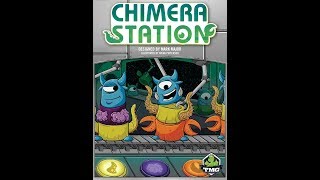
Chimera Station Deep Dive
What the Community Thinks About Chimera Station
Chimera Station occupies a peculiar position in the board gaming landscape: a game that earns passionate advocacy from those who have played it, yet remains largely overlooked by the broader community. Designer Mark Major created something that reviewers consistently describe as underrated, a title that deserves far more discussion than it receives. When Ryan Lopez, the co-designer of Scythe: Rise of Fenris, recommends a game, there is weight to that endorsement. Lopez's assessment is unequivocal: "I love it, I adore it," Lopez says of Chimera Station, going so far as to create a solo variant for the game simply to play it more often. Yet even this praise comes tinged with resignation. "Nobody cares," Lopez observes. "Nobody plays it." The game arrived just as Yokohama, another Tasty Minstrel production, was capturing the market's attention, and the timing proved catastrophic for Chimera Station's visibility.
What emerges from the community's perspective is not disagreement about the game's quality, but rather amazement that such a well-designed game has been consigned to obscurity. Those who have discovered Chimera Station recognize something genuinely special in how its mechanics and theme intertwine.
Core Mechanics That Define Chimera Station
Worker Customization Through Genetic Splicing
The signature innovation of Chimera Station is the ability to permanently modify your workers during play. Rather than replacing workers with stronger versions, players attach genetic components to their existing workforce: claws that enable displacement of opponent workers, leaves that generate food benefits, brains that award prestige points, and tentacles that provide additional resources. This is not a superficial cosmetic choice. Each attachment meaningfully changes what that worker can accomplish on the board. The splicing lab action becomes a crucial decision point. Players must weigh whether to use an action to enhance their workers or deploy them in their current state. Over the course of the game, a player's workforce becomes increasingly customized, reflecting the strategic choices they have made. This creates what Ryan Lopez identified as central to their own design philosophy: the satisfaction of building and upgrading assets that become progressively more powerful through your choices.
Worker Placement with Abundant Resource Generation
Chimera Station employs worker placement as its backbone, but reviewers consistently highlight how the game distributes resources with a generous hand. The module tiles on the reactor and the various action spaces generate constant opportunity for resource acquisition. Food, coins, prestige points, and genetic components flow freely enough that players rarely feel starved for options. This abundance shapes the emotional tenor of play. Rather than grinding through scarcity, players experience the pleasure of having multiple viable paths forward at any moment. Reviewers describe this as the game feeling generous, a quality that sustains engagement across multiple rounds. The resource economy supports experimentation. A player who commits their workers to building modules, gathering components, and feeding their growing army feels rewarded continuously rather than punished for poor resource management.
The Chimera Station Experience
Playful Transformation and Identity Building
There is something deeply satisfying about watching your worker pool evolve. You begin with a small unit of basic workers and through the course of play, you customize them into something uniquely yours. Some players build efficient specialists; others create generalist workers with multiple attachments. The game gives weight to these choices without forcing a single optimal path. This sense of gradual customization mirrors the experience of building something organically over time, like a military unit gaining experience and capability, or a team developing chemistry. The theme of a space station where factions compete to survive by modifying their workforce creates a narrative arc that many games fail to achieve. Players are not simply moving abstract tokens; they are commanding crews that become more formidable as the game progresses.
Abundance as a Core Feeling
Players consistently describe Chimera Station as a game where you are gathering resources, accumulating benefits, and building your engine throughout the game. There is rarely a moment where you feel helpless or resource-constrained. Instead, the challenge becomes prioritization. With so many viable options, the meaningful decisions emerge from opportunity cost rather than desperation. This creates a fundamentally optimistic play experience. You are not trying to survive; you are trying to optimize. Many modern board games lean into scarcity and tight resource management as sources of tension. Chimera Station offers an alternative: the satisfaction of abundance, the pleasure of having multiple good choices available and deciding which is best given your position.
What Makes Chimera Station Stand Out
A Truly Integrated Theme-Mechanic Connection
The genetic customization system is not a veneer over a standard worker placement skeleton. Reviewers recognize that the theming directly serves the mechanics. The idea that you are actually modifying your workers by attaching alien body parts is absurd on its face, yet it works. The slight whimsy of the theme does not undermine the strategic depth. Instead, it creates a memorable identity. You do not simply place your third worker; you place your worker with the tentacle attachment, the one that generates extra resources. This naming and personalization of workers based on their modifications keeps the game from feeling abstracted, even though the core systems are sound.
Strategic Depth Without Overwhelming Complexity
The two Stonemaier Games representatives discussing worker upgrade mechanics specifically cited Chimera Station as an exemplar of how to implement customizable units in a way that felt meaningful but not oppressive. The decision tree remains navigable even as options accumulate. Ryan Lopez, who has designed games and worked extensively on game development, noted that Chimera Station has flaws but argued that the solid 90 percent of the design is so strong that the remaining issues fade into the background. This is rare praise from someone who has grappled with the complexities of game design professionally. The game delivers on its promise without buckling under overcomplication.
Potential Drawbacks
Commercial Visibility Overshadowed by Contemporaries
Chimera Station arrived in a crowded marketplace and became eclipsed by releases from the same publisher and period. The game's Kickstarter campaign raised 88,000 dollars at a time when other Tasty Minstrel games like Yokohama were capturing hundreds of thousands. This commercial underperformance has concrete consequences: fewer players have encountered it, fewer stores stock it, and fewer content creators have spotlighted it. One reviewer acknowledged enjoying the game but noted frustration that it did not receive an expansion. The supply of available opponents and the secondary market presence both suffer when a game fails to achieve critical mass in player awareness.
Potential Theme-Preference Friction
The theming of customizable alien workers with attachable body parts reads as whimsical to some reviewers and off-putting to others. One reviewer described the core concept as "goofy," suggesting that the tonal approach divides players. Those drawn to serious, grounded themes may find the playfulness jarring. Players who embrace the weird science-fiction aesthetic of genetically modifying workers find it charming. This is not a flaw in the design itself, but rather a legitimate question of whether the theme speaks to an individual player's preferences. For some, the game's unique identity is its greatest asset. For others, the tonal disconnection between the earnest mechanics and the absurdist theming creates friction.
If You Enjoy Chimera Station
Players who love Chimera Station's worker customization mechanic will find similar satisfaction in the harvesters and crew upgrades present in Braided Skies, another Stonemaier game where customizing your workers throughout the game creates a persistent sense of growth and agency. Those who appreciate the abundant resource generation and the pleasure of building engines will connect with Orléans, a classic that shares Chimera Station's philosophy that players should have access to viable options without artificial scarcity. Players seeking another worker placement game with a unique twist should explore Scoville, which likewise transforms the genre by emphasizing player agency through unconventional mechanics. Finally, The Castles of Burgundy shares Chimera Station's elegant balance of strategic depth and accessibility, delivering meaningful decisions without overwhelming new players.
What Reviewers Are Saying
"Chimera Station by Mark Major from TNG. Awesome worker placement game, yeah, customizable workers. I love it. It doesn't get any discussion whatsoever. Came out right after Yokohama, which is like the biggest game, right. Yokohama is great, but people know that one. Oh, so it's so good. I love it, I adore. I actually made a solo variant for it because I liked it so much, just so I can play it more. It's flawed, but I just got on, nobody cares, nobody plays it."
— Ryan Lopez, The Mill
"The worker has a worker. The worker has a worker. This idea almost of like a Russian doll scenario where you put your main worker out and then a little worker jumps out and is able to do something. Um and so that evolved into this idea of um two types. One being the harvester that kind of helps you on your deploy and collect more of those tap stone resources and then the crew mate that when you bring them back on your recall turn can actually jump out of the ship and fill up one of those outfitting cards."
— Dan Germaine, Stonemaier Games
"This game has a lot of that positive uh resource I mean resource gathering everywhere you go. You're getting a lot of fun stuff to put onto your uh your player mat and then you're distributing it. Yeah, it's a game of abundance."
— Jamie Stegman, Stonemaier Games