/pic6937913.jpg)

/pic3720843.jpg)
/pic4885780.png)
/pic6937913.jpg)
/pic7419605.jpg)



















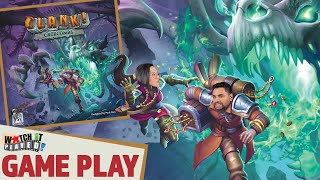















Clank!: Catacombs Deep Dive
What the Community Thinks About Clank!: Catacombs
Clank!: Catacombs has earned recognition as a standout entry in the Clank! franchise and the deck-building adventure genre. Multiple reviewers highlight its exploration mechanics, fast playtime, and the dynamic tension between pushing deeper into the dungeon and racing back to safety. The game consistently delivers memorable moments where tile flips dramatically alter the board state, and where a player's ambitious treasure hunt can end spectacularly in failure. It rewards clever play while embracing the chaos of dungeon crawling, making each playthrough feel distinct.
Core Mechanics That Define Clank!: Catacombs
Deck Building with Resource Management
At its heart, Clank!: Catacombs is a deck-building game where players start with identical starter decks and acquire cards from a shared market to strengthen their personal deck over time. Skill symbols allow players to purchase cards; swords enable monster combat and rewards; boots fuel movement through the dungeon. This three-resource system creates consistent decision points each turn. Players must decide whether to spend resources on acquiring powerful cards now or invest in immediate movement and exploration. The balance between deck investment and action spending drives the game's strategic depth, rewarding both tactical flexibility and long-term planning.
Tile-Based Dungeon Construction
Clank!: Catacombs sets itself apart through its modular, tile-driven board state. When players reach the edge of explored territory, they commit to a path, draw a new tile, and decide how to place and orient it. Tiles can rotate in any direction as long as one full edge aligns with an existing edge. Reviewers consistently praise this mechanic for creating genuine exploration tension; no two games follow the same layout. The tiles are mechanically dense, featuring rooms with locked treasures, artifact chambers, crystal caves that block further boot movement, and portals that teleport players across the dungeon. Every tile drawn presents new options and new risks, making the exploration phase feel alive and reactive rather than procedural.
The Clank!: Catacombs Experience
Exploration Driven by Reward and Risk
Community reviewers universally celebrate the exploration experience as one of the genre's finest. Moving deeper into the dungeon to find higher-value artifacts creates mounting tension. Players must choose between grabbing the first artifact they find and escaping quickly, or pushing further in hopes of discovering a better treasure. Rooms reward re-entry, dungeons sprawl in unexpected directions thanks to tile orientation choices, and locked features hide major payoffs behind lockpick expenditures. The sense of discovery is genuine. Reviewers note that tile reveals create organic "oh" moments where a newly drawn piece either opens new paths or cuts off planned routes. The game's fractured map means players cannot view the full dungeon at once, maintaining real uncertainty throughout play.
Frantic Endgame Race
Once the first player claims an artifact and escapes, the dungeon becomes far more dangerous. The dragon's rage accelerates, and players stuck deeper than the pink safety tiles receive zero points if knocked out. This creates a frantic race to the exit. Reviewers highlight how this dynamic transforms the game's mood. Early exploration plays as methodical puzzle-solving; the endgame becomes desperate scrambling. Players who ignored the escape route may suddenly find themselves in serious trouble, while players who escaped early instead enjoy pulling revenge through dragon attacks on rivals still inside. The shift from exploration to sprint keeps the experience varied and prevents any single playstyle from dominating.
What Makes Clank!: Catacombs Stand Out
Dynamic Map Over Static Board
Clank!: Catacombs diverges sharply from Clank! In Space and earlier Clank! editions by embracing a fully modular board. Previous versions featured a fixed game board, which reviewers note reduces surprise and replayability. With tiles drawn and placed each game, Catacombs ensures unpredictable dungeon layouts. A tile flip late in exploration can destroy a player's carefully planned path, or miraculously save another player's escape route. Reviewers consistently identify this mechanic as the game's signature innovation. One reviewer notes they could not return to playing the original Clank! after experiencing Catacombs' exploration feel, while Rolls in the Family calls the dynamic map "such an incredible benefit to be able to have this exploration feel."
Tile Placement Mastery and Skill Expression
Drawing a new tile is not a random resolve; it is a decision point. Players can orient the tile to benefit their current position or block opponents' paths. This rewards exploration and positional awareness. Reviewers appreciate how orientation choices create meaningful decisions beyond pure card play. A player who has carefully mapped the dungeon can position tiles to either extend their own escape route or force opponents into dead ends. Conversely, a player who has not been paying attention to the board state may inadvertently help others. This layer of spatial reasoning elevates the game above typical deck-builders and gives players genuine agency over exploration flow.
Potential Drawbacks
Tile-Drawing Luck and First-Mover Advantage
Tile draws introduce variance that can feel punishing or random. A player who commits to exploring a particular direction may find the drawn tile offers nothing of value, forcing a wasted turn or difficult path choice. Additionally, players who escape early and acquire high-value artifacts gain a significant scoring lead. Because artifacts diminish in value as the game progresses, first-mover advantage in artifact collection can feel decisive. Later-escaping players may find themselves unable to catch up despite solid card play and exploration decisions. This luck component trades some predictability for replayability, which reviewers appreciate overall, but it may frustrate players who prefer pure strategic control.
Health Meter Variability and Knockout Swings
Damage taken from monsters and dragon attacks can swing wildly based on cube draws. A player might navigate a dangerous area safely and face zero damage, while another player hitting the exact same room and monsters suffers heavy casualties. The dungeon bag mechanic randomizes damage distribution, and while this creates dramatic reversals and memorable stories, it also means that skill-based play sometimes bows to cube luck. Players knocked out before reaching a pink safety tile score zero points, which can feel exceptionally harsh. The variance adds excitement and replayability but creates moments where outcome feels detached from decision quality.
If You Enjoy Clank!: Catacombs
Players captivated by Clank!: Catacombs typically gravitate toward games combining deck-building with exploration and spatial puzzles. Carcassonne shares the tile-placement satisfaction and modular board feel, though it lacks combat and time pressure. Great Western Trail similarly requires pacing decisions and resource conversion, with a tempo element that reminds of Catacombs' race-to-escape structure. Arkham Horror: The Card Game offers thematic exploration and deck customization with higher complexity and campaign progression. For direct mechanical parallels, the original Clank! or Clank! In Space provide familiar action selection and deck building without the dynamic map innovation. Dune Imperium delivers competitive tension and worker placement with area control, appealing to players who loved the interactive endgame.
What Reviewers Are Saying
"The exploration in this game is honestly one of the most fun exploration feels in a board game I've played. Getting a tile and the tiles are just so cool."
— Rolls in the Family
"The tiles are so fun and interesting. There's so many times where we pull a tile and you're just like, oh, especially because you can orient it. It rewards you for exploring because you get to decide how do I want to orient this and what benefits me most."
— Rolls in the Family
"It gives me some good Carcassonne vibes in terms of how will this tile fit in. Having a dungeon that's different every time, that really does add to the replayability, and I find this one probably the most fun in the Clank series."
— The Dice Tower