







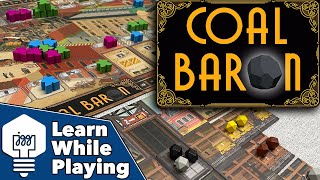
Coal Baron Deep Dive
What the Community Thinks About Coal Baron
Coal Baron, the 2013 Euro game by Kramer and Kiesling, has a reputation among reviewers as a simple game with more depth than its rulebook suggests. The strongest praise comes from players who use it as a go-to teaching game. Nick and Mike of The Brothers Murph say it is their favorite game to teach to strangers at conventions, and they note that almost every person they introduce it to has never played it before. Getting Games goes deeper, working through a full three player tutorial and focusing on the trade-offs between worker efficiency and speed.
Not every reviewer is convinced. The Broken Meeple played the original years ago and remembers it as a game that works but whose coal and iron mining theme never clicked. The Broken Meeple describes it as a product of its time, while acknowledging that fans of this style of game will want to look at the new edition. Watch It Played reported that CNC Publishing was bringing out a new edition with upgraded components and new art, launching on Kickstarter in January. The consensus is that the rules are easy to learn and the play is engaging, while the theme and the sheer number of tracking details are where skeptics push back.
Core Mechanics That Define Coal Baron
Worker Placement With Escalating Costs
Reviewers describe the worker placement in Coal Baron as an outbidding contest rather than a lockout. No space is ever blocked. If a space already holds workers, a newcomer can still use it, but must place one more worker than the previous occupant. The displaced workers move to a central canteen and can no longer act for the rest of that round. The Brothers Murph explain the practical effect: a player who put one worker on a space can be bumped by an opponent placing two, and the original player loses nothing except the spot, since the action has already been taken. Getting Games points out that in a three player game each player has only 15 workers per round, which makes this escalation a real budget decision. Late in a round, a single space can absorb double, triple, or even quadruple activations, and reviewers describe that moment as the point where workers start to run out quickly.
Action Points and the Mine Cage
The second system reviewers focus on is the mining action economy. Visiting a mining space grants a fixed pool of action points, and the cheaper spaces offer six while the richest offer ten. Each action can move the elevator cage along a shaft, load a coal token into the cage, or unload it onto an order card. The Board Gaming Doctor summarizes the budget simply: every step down the shaft costs a single action point, so a player must plan the route before committing workers. Getting Games adds that the cage holds only five tokens, which forces players to think about moving the cage ahead of time, and that cages can be used to telegraph future plans to opponents. Spending a large block of actions on one worker is often the efficient choice, but Getting Games notes that players sometimes accept less efficiency to deny a space to an opponent.
The Coal Baron Experience
A Tight Race for Space and Coal
The dominant feel in the transcripts is a quick, competitive race. Every turn asks whether to take the most efficient option or the one that keeps an opponent from getting it. Getting Games describes choosing to send two workers to a mining spot in the middle of the round, reasoning that waiting could hand the spot to an opponent and force that player to spend even more workers later. The tension rises when players check their order cards, because a carriage or truck delivery can be claimed first by whoever arrives at the delivery space in time. The result is a game where the timing of each action matters as much as the action itself.
Light, Social, and Easy to Teach
The second feeling is far more relaxed. The Brothers Murph describe Coal Baron as dumb simple in the best sense, and they treat it as a casual table game that anyone can pick up. Their repeated point is that a new player can understand the rules quickly and then make decisions that feel meaningful. The Board Gaming Doctor describes a similar ease, noting that the rules came together without much effort and the game felt straightforward to play. For reviewers who value approachable games, the experience is one of fun discovery rather than a demanding strategy exercise.
What Makes Coal Baron Stand Out
Escalating Majority Scoring Across Three Rounds
Reviewers consistently praise the way scoring grows through the game. Getting Games explains that every scoring event is based on majorities, with the leader taking the larger reward and the runner-up taking the smaller one. The first round scores coal types, the second adds delivery methods, and the third scores empty Minecarts. The Brothers Murph highlight the design consequence: scoring in the first era also scores again in the second and third, so early investments can pay off repeatedly. That structure rewards players who plan which colors and delivery types they will need later in the game.
Simple Rules Hiding Layered Decisions
Both The Brothers Murph and Getting Games stress that individual rules are simple while their combinations are rich. Getting Games highlights the mine balance rule, which subtracts two points for every tile of difference between illuminated and non-illuminated tiles at game end. That rule turns a simple color-matching turn into a question about future flexibility. Grabbing only the tiles needed for current orders can leave a player too lopsided to recover, so the balance penalty pushes players to think beyond the next scoring event.
Potential Drawbacks
A Dated Theme and Presentation
The most frequent criticism is thematic. The Broken Meeple found the mining setting uninspiring and says the theme made it hard to care about the game, even while not disliking the mechanics, and also notes that the game feels like a product of its time, which may matter to players who expect modern art direction and components. The second edition is expected to address the presentation, but reviewers who are not already fans of the subject matter may find the older look and theme less compelling than the systems underneath.
Worker Pressure and Luck of the Draw
Getting Games identifies two pressure points. The first is worker scarcity, since each player has a limited number of workers per round and the escalating costs make late-round spaces expensive to contest. The second is the randomness of the Minecart tiles, which are drawn from a shuffled stack. In the tutorial, the reviewer hopes for double gray Minecarts and instead receives singles, which changes the plan. Players who dislike variance in tile availability may find that the game punishes unlucky reveals more than it rewards clever planning.
If You Enjoy Coal Baron
Players who enjoy Coal Baron's escalating worker placement will find a similar satisfaction in Caverna, the Uwe Rosenberg farming and mining game. Both games reward careful planning of which spaces to occupy and when, and both ask players to balance immediate action against longer-term engine building. Coal Baron is the lighter and faster of the two, so it works well as a teaching game, while Caverna offers a deeper and more substantial version of the same worker placement puzzle for players who want more to manage.
What Reviewers Are Saying
"Each individual rule is super simple. But what you can do on your turn is super super simple, but it just comes together in this really fun package."
— The Brothers Murph
"I also like the idea of getting those eight movements for a single worker instead of waiting and potentially having our opponents go on to those spots and forcing us to spend more of these workers. So I think expediency is better than efficiency at this moment."
— Getting Games
"It's one game that I didn't have to work too hard to understand as I learned it straight from Board Game Arena. So it's got that going for itself."
— The Board Gaming Doctor