



Cookie Champion Deep Dive
What the Community Thinks About Cookie Champion
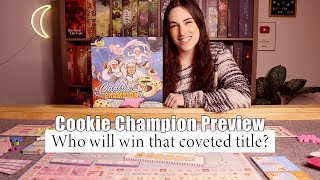
Reviewers who have covered Cookie Champion describe it as a baking competition on a Food Network style set, built on a Euro framework. Janna of The Board Game Garden opened a sponsored preview by comparing the premise to television cooking contests, with bakers gathering ingredients, producing recipes, and presenting finished cookies to judges. The Getting Games tutorial walked through a full three player game, while a later vlog from the same channel introduced the game alongside other upcoming releases. The consensus is cautiously enthusiastic. Reviewers like the blend of area majority, resource management, hand management, and drafting, and they expect a demanding but rewarding table experience. Both sources were built on prototype or pre-release material, and the tutorial host warned that art and components could change in the final edition. Publisher Eagle Griffin Games sponsored the Board Game Garden preview, and the vlogger linked the designers to their earlier game Roco, which signaled to them that the design pedigree was worth watching.
Core Mechanics That Define Cookie Champion
Resource Management
Resource management drives nearly every decision in Cookie Champion. Ingredient tiles sit in a market row, and their price depends on how many tiles remain in that row. Getting Games explained that taking a tile early costs more than waiting, and a tile can become free once it is the last one left. The same logic applies to the flour, sugar, and butter tracks on each player board. The Board Game Garden walked through the flour track as an example: the first step costs nothing, two steps cost two coins, three cost five, and four cost nine. Reviewers stressed that goods must be rationed across the recipes a player is chasing, the presentations they hope to make, and the staff they want to hire. Getting Games also noted that many elements become cheaper as other players take them during the same round, which turns each purchase into a question of timing as much as cost.
Area Majority
The judges‘ tables are the main scoring engine. Five presentation tables carry different point values, and the leading player on each table receives the largest reward while the second place player receives a smaller one. The Board Game Garden noted that the central table pays six points to first place and three to second in a standard game, while a two player game awards only first place. Getting Games described the tie breaking rule, which favors the cookies closest to a green token on each table. That rule means a player who sits at the back of a table is at a disadvantage in close contests. Reviewers saw the majority system as a reason to spread presence across several tables rather than committing everything to one spot.
The Cookie Champion Experience
A Crowded Bake-Off Tension
Reviewers describe a table where everyone is competing for the same recipes, ingredient tiles, and staff at once. Getting Games pointed out that the market is shared, so a player who takes the perfect ingredient may leave a rival with a free one. The feeling is one of constant pressure, where an efficient turn can still be undercut by the next player. Janna of The Board Game Garden called the game a slightly heavier, busy type of design, which signals that the tension comes from a lot of moving parts rather than from a single race.
Satisfying Staff Chains
The second feeling reviewers mention is the reward of building a chain of bonuses. Each staff card has a main action and a bonus action, and players can line up combinations that compound across the round. Getting Games highlighted a staff pairing that earns money for each presentation at a table, and the host called it a really good combo that opponents should try to block. Reviewers enjoy the moment when a sequence of small actions suddenly pays off, especially when a single staff card rewards a plan that has been developing for several turns.
What Makes Cookie Champion Stand Out
The Euro Blend Inside a Cooking Theme
Janna of The Board Game Garden praised the mix of mechanisms as the main reason for interest. Area majority, resource management, hand management, and open drafting appear together, and the preview framed them as a welcome change from the real-time cooking games the channel usually covers. The cooking theme gives the Euro structure a clear identity, which many reviewers find more memorable than an abstract set of tracks.
The Sell or Present Choice
Every finished cookie forces a choice. A player can sell it for five coins per prestige point, which provides liquidity, or present it to a judges‘ table for points that may grow through majorities and bonuses. Getting Games explained that selling gives up points in exchange for money, and reviewers consider this trade-off one of the most interesting decisions in the game. Staff drafting from baking trays also received attention, since the tutorial host argued that choosing which staff to hire is central to the strategy.
Potential Drawbacks
Density and Rules Overhead
Janna of The Board Game Garden described Cookie Champion as a game with a lot going on, and said that the preview would skip smaller rules to focus on the overall shape of play. Getting Games covered many overlapping systems, including staff, presentation tables, objectives, bonus tiles, and income from decorations, which means new players need time to absorb how these pieces connect. Reviewers who prefer lighter Euros may find the setup and rules reference demanding.
Teaching Friction and Pre-Release Uncertainty
The Getting Games tutorial recommended skipping the baking tray draft for a first play, which suggests that the full drafting system adds friction when teaching new players. The same tutorial warned that the prototype art and components might differ in the final version, and the preview by The Board Game Garden was tied to a crowdfunding campaign. Potential buyers should expect the published rules and components to be the final judge of these concerns.
If You Enjoy Cookie Champion
Players who enjoy Cookie Champion‘s blend of area majority and hand management, and who want a cooking theme that is more than decoration, will find this design appealing. Janna of The Board Game Garden contrasted Cookie Champion with Kitchen Rush and Coffee Rush, which the channel described as real-time cooking games. Players who want the kitchen theme with a turn-based pace and a Euro scoring structure will likely find Cookie Champion more deliberate, while players who enjoy quick simultaneous chaos may prefer Kitchen Rush or Coffee Rush for a faster, more frantic evening.
What Reviewers Are Saying
"so this one including some area majority as well as some Resource Management as well as some hand management and open Drafting and stuff like that having those Euro style mechanisms gets me pretty excited for this one"
— The Board Game Garden
"and for many of these elements the price goes down as more people take them within the round"
— Getting Games
"I like Roco quite a lot I think Eagle Griffin also makes very good-looking games so I think this appears to be a good combo"
— Getting Games