


Crash & Grab Deep Dive
What the Community Thinks About Crash & Grab
Reviewers agree on the basic identity of Crash & Grab, the programmed-movement game from Pull the Pin Games: it is a light, loud race where collisions are the point. Brains On Games describes it as "a lot of silly chaotic nonsense," and Ryan and Bethany Board Game Reviews call it "silly fun controlled chaos" that rewards players who know what they are signing up for. Both channels found the game quick, funny, and easy to enjoy without overstaying its welcome.
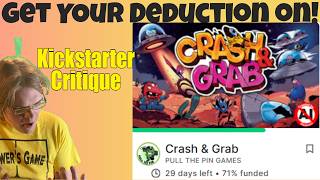
The reviewers differ mainly on depth. Brains On Games is the most skeptical voice, arguing that the game is "not a super strategic game where you're going to be thinking in depth about your turn." Ryan and Bethany are more enthusiastic about the strategic texture that comes from power-ups and from choosing when to chase a crew member. Bower's Game Corner approaches the game from a different angle entirely. Its review is a Kickstarter critique that grades the campaign page rather than the tabletop experience, and it lands on a B minus, mostly because the presentation fails to sell the game's range of modes and pledge options. Both Brains On Games and Ryan and Bethany played a preview copy, so reviewers note that rules and components could still change before release.
Core Mechanics That Define Crash & Grab
Hidden Movement
Movement in Crash & Grab is programmed in secret. Brains On Games explains that each player holds three movement cards that "secretly determine how far they're going to move and in what direction," and some of those cards carry a bonus. One card carries a green token that lets a ship move a second time if the player spends it, while a flexible card allows a move of up to five spaces. Ryan and Bethany frame the choice as a trade-off: a controlled two or three card that comes with special abilities and tokens, or a zero to five card that offers flexibility but no bonuses. Once everyone has committed, the moves resolve in an order that the rotation die may change, so a player cannot be sure where a rival's ship will be when their own move finally happens. Brains On Games also noted that a player can redirect at the end of a turn, which it called "actually well played." Designers Clayton Skaki and Brian Hink, as Ryan and Bethany introduce them, built the system for Pull the Pin Games.
Modular Board
The play area is assembled from tiles, and Brains On Games describes them as "oriented at random" at setup. The map grows with the player count, and Ryan and Bethany explain that Pull the Pin Games added inserts to reach the three and four player layouts and more pieces again for five and six players. Crew members and power-ups are also laid out in changing positions. Whenever one is collected, a replacement appears in a random location, so the board gradually refills and never looks the same twice. Ryan and Bethany say the design scales well enough that the four player game "feels like the main mode," with the extra turn-order tokens given to the fifth and sixth players to restore some control. Bower's Game Corner similarly called the setup "a really interesting modular system."
The Crash & Grab Experience
Silly, Controlled Chaos
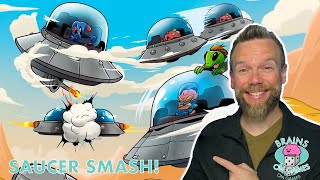
The most consistent feeling reviewers describe is good-natured chaos. Ryan and Bethany compare the game to "space bumper cars," and they note that its arena feel is similar to the battle mode of Mario Kart. A collision is not a mishap: when a ship crashes another, the crasher can take one of the victim's collected crew members or an upgrade cube, so bumping rivals is a central plan. Brains On Games admits the game was "utter chaos" during its playtests, with tractor beams pulling lost crew members toward ships and collisions sending UFOs across the board. The artwork reinforces the tone, with octopus-like aliens for the green player and three-eyed creatures for the red player, and the reviewer found that "we had a lot of laughs playing this game."
Guessing Under Uncertainty
Because turn order is decided by a die that is rolled only after movement is chosen, players spend the round predicting one another. Brains On Games says that everyone was "hanging on that roll" once their move was locked in, since the result determined whether a planned move would succeed. The reviewer also described a layer of social deduction: players must judge whether a rival will chase the crew member in the middle of the table, grab an upgrade cube with a three-space move, or collect a boost. Ryan and Bethany reinforce the point by noting that the rotation die keeps whoever is fifth or sixth in flux, so no one feels permanently targeted.
What Makes Crash & Grab Stand Out
Upgrade Cards That Reshape Every Ship
Ryan and Bethany single out the power-ups as the reason the game works: "the powerups make this game so much more interesting." Players collect energy, draw two upgrade cards, keep one, and place the other on the bottom of the deck. The chosen card gives a permanent ability, such as bonus effects when crashing, when gathering crew, or when moving, which lets each ship develop differently. Ryan and Bethany say they "love that you have these kind of customizable ways to make your ship behave differently than everyone else's ship." Brains On Games also praised the rotation die and the upgrade economy, while noting that a card that awards an upgrade cube and a boost on respawn was "a fantastic ability to have."
A Color-Steal Rule That Protects Your Plan
Ryan and Bethany highlight a rule that stops rivals from taking a player's own crew members. Players can steal any opponent's crew, but a ship that gathers its own color makes those crew members unstealable. Ryan and Bethany argue that this gives the game a reliable route to victory: "there's a pathway to victory if you want to take that," and players can build something without it being torn down. The rule still leaves room for aggression, since a player can also ignore their own color and crash everyone to take their crew instead.
Potential Drawbacks
Upgrades Can Crowd Out Other Movement
The most repeated criticism is that the upgrade cards are too strong for the rest of the movement options to compete. Brains On Games observed that the three movement card, which generates an upgrade cube, was chosen almost every time, because "the abilities were so strong" that players wanted every upgrade they could buy. The reviewer acknowledged that other sources of upgrade cubes can change this, but still found that the game rarely showed the other cards in action. Combined with the chaotic turn order, this makes the game feel more reactive than planned, which is exactly why Brains On Games described it as "not a super strategic game."
A Campaign Page That Undersells the Game
Bower's Game Corner spent much of its review on the Kickstarter presentation and argued that the page hides the game's strongest selling points. The main image leads with generic artwork rather than the components, the six game modes are not highlighted until late in the page, and the player count, play time, and age range are buried. The reviewer also found the pledge structure hard to follow. The entry edition starts around $29, the mid tier adds an expansion-like bundle, and the big box with deluxe components reaches the high $70s, and the reviewer felt the page did not explain why the larger jump was worth it. Bower's Game Corner did conclude that the game is "legitimately" a one to six player design and that it deserved support.
If You Enjoy Crash & Grab
Players who enjoy the bumper-car energy of Crash & Grab should look at Mario Kart's battle mode, which Ryan and Bethany cite as the closest analogy. Both reward collecting power-ups and then using them to knock opponents off course, and both are at their best when the table is loud and the outcomes are unpredictable.
Players who want a demolition-derby feel with a ship that can come apart under pressure should consider Galaxy Trucker. Bower's Game Corner made the comparison because both games share that sense of a vehicle breaking apart when the chaos hits. Good Cop Bad Cop is another natural pick, since Bower's Game Corner notes that the team behind Crash & Grab also made that social deduction game, and players who enjoy reading their rivals will find a similar pleasure in both. Finally, Bower's Game Corner points to the bomber mode in the larger box as a Bomber Man-style game, a good pick for players who want the same explosive, trap-the-rival energy in a separate mode.
What Reviewers Are Saying
"I loved this rotation die. I really thought it was fun and again extra chaotic to not know whether you're going to go second or third, and everybody was sort of hanging on that role once they'd chosen their move, cuz that was going to dictate whether their turn maybe was going to be successful or not."
— Brains On Games
"I actually really like that people can't steal your color when you're going out on the board. And I like that for two reasons. One, if you want, you can just focus on your color, so that when you're building up to something, people can't tear down what you've been building up."
— Ryan and Bethany Board Game Reviews
"If you let me know, hey, this is a demolition derby style game, it's going to come in a small enough box where I'm looking at a decent price, let me know that from the outside. Let me know the size of that box. Let me know a price. Let me know more."
— Bower's Game Corner