






Cult of the Lamb Deep Dive
What the Community Thinks About Cult of the Lamb
Cult of the Lamb board game has struck reviewers as an ambitious and layered adaptation of the popular video game. The consensus centers on respect for how thoroughly the designers captured the video game's core loop: risky dungeon runs alternating with base-building strategy. Reviewers consistently praise the component quality and the sheer scope of what Paper Fort Games attempted to pack into the box. However, several note that this is unquestionably a game designed for experienced board gamers, not casual players dipping into the hobby from the video game alone. The price point is high, but most who have seen the components and played through a round believe it is justified by the depth of content.
Core Mechanics That Define Cult of the Lamb
Crusade Phase: Roguelike Dungeon Exploration and Combat
The crusade phase is where Cult of the Lamb translates the video game's roguelike essence into board game form. Players navigate through a network of rooms, moving up through increasingly difficult levels toward bishops and bosses. Movement is handled via simultaneous hidden card selection, creating a semi-cooperative tension: players fight monsters together and want the enemies defeated, but whoever deals the most damage claims the most points. This structure allows for both collaboration and subtle competition: you might choose to let a rival take the brunt of retaliation damage if you trust you can handle the consequences. The escalating difficulty is genuine; each round introduces a new level with its own deck of bosses and minions, ramping up the challenge significantly. Combat relies on dice rolling and card play, with a shop system allowing players to spend resources between encounters to upgrade weapons or heal.
Cult Phase: Worker Placement and Base Development
After each crusade ends, players transition to the cult management phase, where the game pivots entirely to worker placement. Here, followers and the prophet (your main character) are placed on action spaces to gather resources, recruit new followers, construct buildings, and claim doctrines that provide ongoing benefits. Unlike the crusade's action-packed combat, the cult phase is a deliberate economic puzzle. You must decide which followers to level up, which buildings to prioritize, and how to allocate your limited faith and food resources. There is genuine tension in managing follower populations: you can eliminate rivals' followers by spending faith, but your own cult must be fed at the start of each phase or they sicken and die. The goal is to use the cult phase to ramp up your power (better weapons, more followers, stronger doctrines) so you can survive the escalating crusade difficulty that awaits in the next round.
The Cult of the Lamb Experience
Ambitious World-Building Through Layers of Complexity
Reviewers consistently describe Cult of the Lamb as "a lot of game" in both weight and scope. This is not a quick, breezy experience. The game asks players to hold multiple systems in their heads simultaneously: dice rolling, card play, worker placement, resource management, and escalating boss patterns. Yet this complexity serves a purpose. The layering creates a genuine sense of progression and consequence. Decisions made in the cult phase have tangible impact on crusade performance. Early-game runs feel chaotic and risky; by level four, either you have built sufficient power through careful cult management, or you find yourself overwhelmed. Reviewers who embraced the complexity noted that the two-phase rhythm creates natural pacing: the action-focused crusade contrasts with the thoughtful, turn-order-based cult phase, keeping the play experience dynamic across a multi-round campaign.
Dark Whimsy and Theme That Deepens Through Play
The board game captures the dark whimsy of its video game source. There are moments of genuine humor (the game includes cult management details like poop and sickness mechanics) layered alongside serious strategic decisions about sacrifice and resource allocation. Reviewers noted that thematically, the game delivers on the promise of running a cult. You are literally managing followers, deciding which ones to level up, which ones to sacrifice for faith, and which doctrines to impose on your flock. The weapons your prophet wields have names tied to playstyles, and doctrines reflect genuine doctrinal choices. The game does not shy away from the darker themes of the video game, but it threads them with enough abstraction that the tone remains playful rather than graphic. By the final rounds, when followers are dying from sickness, buildings are crumbling, and you are mounting a desperate crusade against an increasingly powerful bishop, the theming and mechanics align to create genuine narrative tension.
What Makes Cult of the Lamb Stand Out
Faithful Mechanical Translation of Video Game Systems
Adapting video games to board games is notoriously risky. Designers must decide how much to simplify and what to preserve. Paper Fort Games made the ambitious choice to preserve depth. The roguelike loop (run, fail, return, upgrade, run again) translates directly to the crusade and cult phases. The escalating difficulty is real, not flavor text. Unlike some video game adaptations that devolve into heavy bookkeeping that obscures the core fun, Cult of the Lamb uses its mechanical complexity to reinforce the video game experience. You genuinely feel resource-constrained in the cult phase, which makes shop visits in the crusade phase meaningful. Reviewers who worried about video game adaptations becoming bloated exercises in busywork were pleasantly surprised that the systems, while numerous, serve the core gameplay loop rather than padding it.
High Component Quality and Clear Production Vision
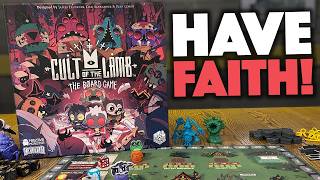
Reviewers praised the physical quality and presentation. The components are substantial and well-designed, with nice touches like follower meeples that gain halos when leveled up. The Kickstarter campaign video was particularly effective at demonstrating the game in action, which helped convert skeptics. One reviewer who came in with no interest in Cult of the Lamb reported being sold entirely by seeing the components in context. The production quality signals that Paper Fort Games understands what fans of both the video game and board games expect. This is not a licensed cash-in with cardboard cutouts; it is a thoughtfully produced game that respects its source material.
Potential Drawbacks
High Complexity and Playtime May Limit Audience
The game's ambition is also its potential weakness. This is not an entry point to modern board gaming. Reviewers were clear that it demands experienced board gamers who are comfortable with simultaneous mechanics, hidden information, dice rolling, worker placement, and multiple economies all operating in parallel. The crusade phase in particular can feel chaotic on first play, and the cult phase requires forward-thinking and system mastery to optimize. Some reviewers expressed concern that fans of the video game expecting a lighter, faster experience might be overwhelmed by the bookkeeping and decision paralysis. One reviewer noted that video game adaptations risk showing players "all the math the video game does for you," and while Cult of the Lamb manages this better than many, it is still a complex board game first and a video game adaptation second.
Price Point and Component Overload on Campaign Page
The Kickstarter pricing is steep: the standard version costs around $100, with deluxe options reaching $160+. While reviewers who saw the components in action felt the price was justified, the campaign page presentation initially works against the game. Stretch goals are presented as a chaotic list, and the main image does not effectively communicate the sheer amount of content. One reviewer felt that clearer visual organization of the campaign page, consolidating stretch goals and showing pledge tiers more prominently, would have helped sell the value proposition faster. For backers on a budget, the entry price can feel prohibitive, even though the per-unit cost spread across the components is reasonable for a game of this scale.
If You Enjoy Cult of the Lamb
Cult of the Lamb is designed for board gamers who love roguelike experiences, dungeon crawls, and games where building up your power matters mechanically. If you enjoyed Frostpunk or Lands of Evershade (other heavy, thematically rich games with escalating challenge), you will likely find Cult of the Lamb compelling. The game is built for players who want their board game to demand thought across multiple rounds and who are willing to sit down for a campaign-style experience where early mistakes inform later strategic decisions. Fans of the video game should approach with eyes open: this is a board game that happens to adapt Cult of the Lamb, not a board game that plays like the video game itself. However, if you are someone who appreciates sophisticated worker placement, enjoys dice-driven combat, and wants a game where every decision ripples across multiple game phases, this is worth serious consideration.
What Reviewers Are Saying
"There is a lot of gameplay in this. It seems like complex and like not video game not not like oh for video gamers who might dabble in board games. No, it looks like a game for board gamers."
— The Dice Tower
"Yeah, you're managing a cult. It's kind of feels like town management, if you will, like a town simulation, but you're managing your cult. And this is done with worker placement. So, it completely shifts from a game mechanic standpoint."
— Man vs Meeple
"Do I want it? Yes. That video was fantastic. You spotlighted what you needed to spotlight. I came into this having no interest of Cult of the Lamb at all, and now I want to play the game, and also play the video game. So, kudos to them, Massive Monster. I'm excited to see what they do in the future."
— Bower's Game Corner