/pic7476829.jpg)
“Ruin has come to our family.” In this adaptation of Red Hook’s Darkest Dungeon video game, you strive to cleanse a manor and its surroundings of all manner of evil: hordes of the undead, foul beasts and eldritch abominations. And, finally, either at death’s door or at your wit’s end, you will have to uproot evil itself from the darkest dungeon.
Darkest Dungeon is a fully cooperative dungeon crawl game in which players take on the role of adventurers. Although brave and determined, adventurers are only human! They are prone to the madness and pain the twisted dwellers of the dungeons will inflict upon them. Death can occur, but is not the worst fate: heroes can be driven mad and beyond help!
The game is played in campaigns of 11 missions. To reach the Darkest Dungeon itself, players will undertake 3 missions per threat level and vanquish the boss. Then, they will be strong enough and face the horrors of the Darkest Dungeon! They may emerge victorious, if they dispatch the source of evil that plagues the land.
For each hero, select 3 skills out of 7 before heading into your mission (and level the heroes up to gain access to more skills). In each room, pick the most suitable stance to best resolve the conflict! Then, on each turn, a player chooses two of the available actions of moving, interacting with the environment, changing their stance or using a skill (if eligible for their current stance). Triumph over encounters, resist rampant madness and emerge victorious before throwing yourself into another battle. Between missions, spend your time in the hamlet, visiting various buildings to find relief from the physical and mental trauma you’ve just endured. Restore the hamlet to its former glory and it will reward you and help you to fulfill the ultimate goal.

- Turn-based RPG
- Dungeon
Mechanics (from transcript analysis)
- Tactical combat — It's tactical intense actually.
- Turn-based RPG — Darkest Dungeon is a turn-based RPG where you have to get out of well a dark dungeon.
Video topics + discussion points
Quotes (from this video)
- Every end has a beginning is the tagline it's also a statement so vague that it doesn't really say anything does it while still remaining technically correct like everything happens for a reason or matthew i don't want to marry you but it's definitely a prequel
- my love for kinicia games has me looking at this thinking maybe i am the one maybe i can take the code back to the source and free everyone from the matrix if you will
- I made that out to be 8 billion 468 million 125 thousand 50 possibilities but still that's a lot of possibilities you do have to concede that point
- and all i want is to be a promo in viticulture jamie snakemeyer and a couple bottles of wine would be nice
- my guess is that the kickstarter will be launched around the same time as the darkest dungeon sequel is released in december but either way i'm hoping this lures some more video gamers into our own dungeon the dungeon of board games which now that i say that out loud isn't as alluring as i'd hoped
- it's all very technical but the result is a vote that reflects their community rather than just the opinions of one person
- if you do want the opinion of just one person then play the crew it's the best game ever
- I love carcassonne and my brother is some kind of carcassonne wizard who I hate so if you're like me then this book might be the thing to give you the edge that you need
- not the australian german baseband though that wouldn't be the end of the world propane nightmares anyone what a banger
- Oh no he's not dead sorry I admit that made him look like it no he's sorry he's just retiring my bad sorry
References (from this video)

- Had fun with it for like a minute
- Too tedious
- Not as fun as I want it to be
- The most important thing wasn't your characters, it was making the town
Mechanics (from transcript analysis)
Video topics + discussion points
Quotes (from this video)
- it was a little too long 12 hands was too many I would have preferred playing the 500 instead of a thousand
- this system was had its cool things it had some cool things but it also had just some garbage ideas
- it's just like who came about these rules it's just like these aren't streamlined these are garbage they are horrible
- the Marvel superheroes game was like the Marvel Universe
- spacehulk spacehulk spacehulk space Hulk I knew it was Warhammer I just didn't know
- it's the one where you uh you're playing as a disease trying to kill everybody take over the world it's like an AA control game
- I think it's in my top 25 or 50 games of all time
- the game just chef's kiss
- Shadows of Brimstone game and it's just like yeah doing nothing
- Brimstone is our money maker they they'll milk the dead
- it's sort of a Rog likee and I think it doesn't get enough credit
- like you're doing the same thing just longer and more tedious and more like that's that's bad
- the deluxe version of it um had a basically kind of a foil cover like as the person's casting a spell and so there's this kind of rainbow effect foil cover of like the magic that's coming up
- it was it was insane yes crazy what people go foil covers bring to the end
- the Cliffhanger game with a more compact box size streamline rule book and over a decade's worth of Polish and AATA worked in this is the ultimate edition of the classic Cliffhanger Adventure game
- the cards were tiny
- Shadows of Brimstone game and it's just like
- we couldn't get any traction we couldn't get anybody to notice the game even existed anywhere
- it was like it sold it we sold out day and a half just because it had a foil had a foil rainbow cover
- I hate those things yeah I pick every box sleeve off of every game I've ever got
- we would rather be cheated out of money than refuse a customer service request from somebody who honestly needed it
- the owner said why isn't that guy allowed in the store and they told him why and he's like it's a free country he can say whatever he wants
- I was like Rich if like quite literally Rich you should just tell people that I will be there and that will get more people to come in and and sell stuff and I and give me the table for free
- I don't make anything so what's the point of
- I don't have to pay $5 just so sit at a [ __ ] table now
- we're not coming here anymore you come to my house for board game night that's it
- well how about you buy it and when you're done with it bring it back to me and I'll give you the money back minus five bucks
References (from this video)
- Ambitious, complicated, and fun.
- Excitement about the miniatures.
- Intricate and complex, 'managey'.
- Overly complex rules and hierarchy systems.
- Too much to play due to management.
- Hasn't hit the table in years.
- Ambition, complication, fun in a dark setting
- Dark, decrepit caves
- The Darkest Dungeon (video game)
Mechanics (from transcript analysis)
- Stat Management — Players would love to run all the stats themselves for enemies and characters.
Video topics + discussion points
Quotes (from this video)
- There's some games that just don't seem like they fit on the table. Sometimes, literally.
- The digital space, the game doing that for you just makes the experience better in my opinion.
- This is a good example of where becoming a board game can go drastically wrong.
- The math and the scoring algorithm at the end of the game was complex enough we didn't want to learn how to do it.
- So, I think this and and most versions of Risk should be digital.
- Half the game is spent doing management of the systems that you're trying to explore through.
- The experience of play is taken down a notch due to the degree of management necessary, which is a theme we see across the board in many areas.
References (from this video)
- ambitious dark fantasy theme and presentation
- potential for tense, cinematic combat moments
- extortionate and opaque production practices (shipping, etc.)
- overly fiddly with many tokens and decks
- required upgrades and poor rule clarity
- grim and punishing, stress-driven adventures
- gothic dungeon crawling with Lovecraftian overtones
- campaign-based with heavy stacking of decks and tokens
- Slay the Spire
- War of the Ring
- Slay the Spire (board game adaptation)
Mechanics (from transcript analysis)
- complex upkeep and admin — Town or Hamlet mechanics add layers of administration between dungeon dives.
- multi-deck management — Hero decks, monster decks, room decks all require constant shuffling and tracking.
- token-driven status — Stress tokens, damage tokens, and status tokens drive game state and risk.
Video topics + discussion points
Quotes (from this video)
- IP doesn't fix bad design flaws.
- When players are actively rewriting your core mechanics before they'll play the game again, that's a massive red flag about the underlying design philosophy.
- The treasure deck, which is completely random.
- You're fighting the RNG of the deck more than you're fighting the actual monsters.
- Semi-cooperative is basically code word for we made players sabotage and betray each other constantly.
- This moment the game broke for me.
- For $1.5 million and that hype, mediocre is a massive letdown.
- They claimed 600% shipping increases due to COVID in Ukraine war. Refused to absorb those costs or offer refunds.
References (from this video)
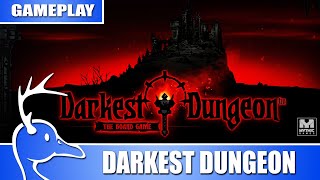
- Faithful translation of the video game feel into a board game with strong party dynamics
- Innovative hybrid combat that blends positioning, stances, and initiative
- Strong thematic presentation with minis and room design
- High complexity and upkeep that may deter casual players
- Token management and space requirements can feel fiddly and bulky
- dark fantasy, doom, perseverance of a party under stress
- fantasy dungeon/cave exploration with a hamlet hub and cursed-infested depths
- grim, atmospheric, narrative-driven with procedural exploration
- Darkest Dungeon (video game)
Mechanics (from transcript analysis)
- Curio Rooms and XP/ Treasure — Curio rooms spawn battles and provide XP and treasure opportunities; outcomes affect the party path.
- Hamlet vs Dungeon Phases — Two-phase flow: a hub area for healing/upgrading and a dungeon exploration/combat track.
- Hero/Monster Stance System — Heroes have stance choices (Aggressive/Defensive) affecting which abilities are available; monsters likewise have stance-driven effects.
- initiative deck — Combat order is determined by a shuffled initiative deck, influencing timing and responses.
- Monster Special Rules — Monsters use unique abilities and positioning effects, including debuffs and stacking tokens.
- Resource and Stress Tracking — Characters manage resources (torches, food, coins) and accumulate stress, bleed, blight, and other tokens.
- Scouting and Corridor Exploration — Exploration involves scouting to reveal rooms, with consequences for traps, curio rooms, and loot.
Video topics + discussion points
Quotes (from this video)
- This is not a lightweight dungeon crawler.
- This is an aggressively more complex game.
- It's deeper than I anticipated.
- It's a hybrid that translates video game complexity into a tabletop experience.
References (from this video)
- Combat depth and excitement during battles
- Enemy AI design and activation variety
- Boss fights with distinct mechanics
- Hero turn design with stance-based decisions
- Punishing difficulty and despair-heavy theme without strong narrative payoff
- Slow resolution of dice-based effects
- Campaign balance issues and anemic character progression between levels
- Randomness can undermine planning and lead to frustrating decks
- Despair, risk, survival, and the psychological toll of adventuring
- Fallen, perilous dungeon explorations in a grim fantasy setting, spanning a campaign from hamlet to dungeon
- grim, roguelike, consequence-driven with a death spiral of afflictions
Mechanics (from transcript analysis)
- Boss Battler — Boss encounters with unique effects and escalating threats.
- boss_fights — Boss encounters with unique effects and escalating threats.
- Campaign — Progression between dungeons with hamlet events and leveling up between campaigns.
- campaign_structure — Progression between dungeons with hamlet events and leveling up between campaigns.
- Dice Rolling — Rolling negative black dice to determine character afflictions and setbacks.
- dice_resolution — Rolling negative black dice to determine character afflictions and setbacks.
- enemy_activation_and_positions — Enemies activate according to stance order with varied actions and AI behavior.
- hero_turns_and_stances — Hero abilities are influenced by stances and targeting priorities during combat.
- randomness_and_risk — Decks and random rooms can produce extreme outcomes; swinginess in difficulty.
- Resource Management — Provisions and funds manage damage, stress, disease, and healing between dungeon crawls.
- resource_management — Provisions and funds manage damage, stress, disease, and healing between dungeon crawls.
- Risk Management — Decks and random rooms can produce extreme outcomes; swinginess in difficulty.
Video topics + discussion points
Quotes (from this video)
- the combat is where the game shines
- the enemy Ai and how they enemy activate all a slam dunk for me
- the bosses are cool too
- turning around to the heroes and that's also a pro for me
- it's a bit of a mixed bag overall
References (from this video)
- Deep thematic flavor and tension
- High replayability through campaigns and variants
- Steep learning curve
- Punishing outcomes can be frustrating
- peril, dread, and risk management during expeditions
- Darkest Dungeon-inspired gothic dungeon crawl set in a grim universe
- procedural narrative with persistent consequences across sessions
- Gloomhaven
- Descent: Legends of the Dark
Mechanics (from transcript analysis)
- campaign persistence — Between sessions, character injuries and decisions carry over.
- cooperative exploration — Players explore a shared dungeon, revealing rooms and events.
- Deck Building — Players craft or draw action cards that influence combat and exploration.
- Deck-building actions — Players craft or draw action cards that influence combat and exploration.
- Hero risk management — Characters accumulate stress, afflictions, and damage that affect decisions.
- Resource and torchlight management — Careful stewardship of supplies and light level to progress.
- Resource Management — Careful stewardship of supplies and light level to progress.
- Risk Management — Characters accumulate stress, afflictions, and damage that affect decisions.
Video topics + discussion points
Quotes (from this video)
- they're all ones
- check out that darkest dungeon campaign
- Mythic Games is a sponsor of Things Get Dicey
- let me see if i can go back to sleep
- should check out the latest kickstarter