






Darwin's Journey: Oceania Deep Dive
What the Community Thinks About Darwin's Journey: Oceania
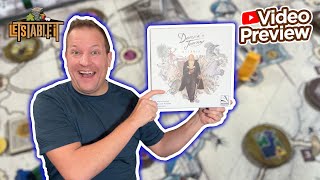
Darwin's Journey: Oceania has earned strong enthusiasm from reviewers who recognize it as exactly what Darwin's Journey players have been asking for: a substantial expansion that freshens the base game without burying it under new complexity. Reviewers consistently praise the expansion for adding genuine variability and meaningful new decisions while staying true to the game's exploration-and-collection core. Let's Table It, a dedicated Darwin's Journey enthusiast who plays the base game daily on Board Game Arena, calls it a game-changer that "will slap you in the face again" with renewed gameplay. Man vs Meeple frames it as "a traditional good old-fashioned expansion for a medium heavyweight Euro," while Totally Tabled highlights it as one of 2026's most anticipated solo expansions for seasoned players. The community sees this as an expansion that respects the original design while charting genuinely new territory.
Core Mechanics That Define Darwin's Journey: Oceania
Hazard Track
The hazard track is Oceania's defining innovation. Players encounter hazards whenever they are the first to discover a specimen on the board or when they move their boat or explorer past a hazard token. Each encounter moves them up the track, which maxes out at five. Critically, the player furthest along the hazard track receives a consequence tile at the end of each round, giving them a one-time reward that creates a genuine risk-versus-reward tension. This means deliberately accumulating hazards can be strategic if you can capitalize on the bonus, but the real cost comes through end-of-round consequence tiles that force forfeit requirements based on your hazard position. If you cannot forfeit the required items, you lose victory points. Players also have ways to mitigate hazards by gaining antidotes, adding a layer of tactical resource management. As Totally Tabled notes, this mechanic creates "a risk versus reward dynamic," turning hazard accumulation into a real decision rather than a pure punishment.
Worker Placement with New Locations
Thundergryph Games expanded the classic worker placement system that defined Darwin's Journey by adding new locations across the main board that unlock as players advance. The post office and university unlock when a player's boat passes certain banners, granting access to new correspondence and academy actions respectively. Two village campsites offer dynamic modularity, each featuring different tiles that change how you can spend resources and gain bonuses during setup. These new spaces don't overcrowd the board because they unlock progressively, and they spread out player incentives so that the fiercely contested Academy action from the base game no longer dominates everyone's strategy. Reviewers note that while this increases options, the game flows remarkably smoothly thanks to limited worker supplies and thoughtful action space design. Let's Table It observes that the Blue Navigation action becomes "even more important in this expansion as you need to get to the post office and the university to unlock those benefits."
The Darwin's Journey: Oceania Experience
The Tension Between Exploration and Caution
Darwin's Journey has always been about carefully managing your resources while pushing toward discovery. Oceania deepens this tension by making every specimen you discover carry a potential hazard cost. First-mover advantage becomes more complex: yes, you get the specimen, but you also advance on the hazard track, which triggers consequences you may not be able to afford. The expansion turns exploration into calculated risk-taking rather than simple competition for resources. Reviewers describe a more thoughtful, strategic pacing, where players must weigh whether claiming a specimen today is worth the end-of-round penalties it might trigger.
Engine-Building Through Incremental Unlocks
Much like the base game, Oceania rewards long-term planning and strategic specialization. The new personal objective tiles offer paths to scoring that don't exist in the base game, and unlocking the university or post office gives permanent access to new actions. The expansion's player boards have been reimagined with "distinct bonuses," meaning your strategy path from turn one shapes your entire engine. Reviewers who love engine-building find the new board layout particularly satisfying because almost every action feeds back into your scoring somehow, as noted by Going Analog when discussing similar games: "there's so many different ways to score, and there's so many different ways to make certain scoring aspects even more valuable." This creates a deeply interlocking puzzle where your early decisions define your late-game options.
What Makes Darwin's Journey: Oceania Stand Out
Four New Islands and Complete Thematic Refresh
The expansion introduces an entirely new Pacific Island map with 16 unique specimens, each tied to Oceania's distinct fauna and flora. This is not a cosmetic upgrade. The map is reimagined with four islands instead of the base game's layout, meaning the geography itself forces different exploration patterns and player positioning. The spatial shift means you cannot simply replay base-game strategies on a new board. Reviewers consistently highlight that the specimens are new, the locations are new, and the movement patterns are fundamentally different. Man vs Meeple emphasizes that "there's all new modules, there are also some nice sort of improvements to how things work in terms of tracking the different species," including colored tokens instead of clear ones, making the board more legible during longer games. For Darwin's Journey veterans, this new map represents exactly what they asked for: fresh ground to explore with mechanically meaningful changes rather than mere reskinning.
Modular Complexity You Control
Oceania is designed so that the expansion's mechanical innovations feel optional without losing their impact. Jessica from Gaming with Edo and Jessica notes that "there's a lot of content there and a lot of modules to kind of mix and match and try out," meaning experienced players can dial in exactly which new elements they want to engage with. The village campsite tiles change from game to game, the consequence tiles are randomized, and the hazard track itself becomes a variable difficulty layer. Totally Tabled describes the hazard mechanic as "entirely optional and specifically geared towards hardcore Darwin's Journey fans," yet even players who prioritize the base game enjoy having it available. This design philosophy means the expansion scales elegantly from gentle introduction to deep strategic play.
Potential Drawbacks
Loss of Familiar Base Game Strategies
The expansion removes some beloved optimizations from the base game. Specifically, certain Academy-related discounts and worker co-location bonuses that many players relied on no longer exist. Let's Table It explains: "those two abilities to unlock are no longer available which means more expensive seals throughout the game because you're not going to be able to get the discount." This forces players to build new engines and abandon strategies they may have perfected in dozens of base-game plays. While reviewers frame this as a refreshing reset, players deeply invested in specific Darwin's Journey strategies may initially feel disoriented. The silver lining is that the new locations and personal objectives provide alternative paths to the same outcomes, but it requires relearning the game's economy.
Increased Learning Curve Despite Familiar Mechanics
While the core worker placement system remains intact, the expanded board, new consequence tiles, and hazard track logic add cognitive load that reviewers acknowledge without criticism. The new player boards have more slots with specialized effects, and end-of-round penalties require tracking across multiple players simultaneously. Man vs Meeple notes that the expansion adds "not necessarily in complexity on this one but it just in variability," yet that variability itself demands more scenario planning. Totally Tabled observes the hazard track's mechanics are "entirely optional," which may lead newer players to feel uncertain about whether they should engage with it. For solo players especially, managing hazards, consequences, and the expanded action economy simultaneously can feel overwhelming until the system clicks. This is not a criticism of the design but an honest acknowledgment that mastering Oceania requires more upfront work than a simpler expansion would demand.
If You Enjoy Darwin's Journey: Oceania
The comparison games mentioned by reviewers all share Oceania's DNA: medium-to-heavy Euro games with deep resource management and meaningful interaction through shared boards. Everdell and The Great Library both feature worker placement and engine-building rewards, much like Darwin's Journey, though they occupy lighter weight brackets. Terraforming Mars, frequently invoked in discussions of gameplay engine depth, similarly rewards long-term planning and strategic card synergy. If you are drawn to games where early decisions compound into late-game engines, and where the board state shifts dramatically based on player positioning, you will find yourself at home with Oceania. The expansion also appeals to players who love spatial puzzles; the four-island layout creates authentic navigation challenges distinct from the base game's geography. For solo players seeking modularity and difficulty scaling, reviewers confirm Oceania delivers on both fronts without requiring campaign tracking or legacy elements.
What Reviewers Are Saying
If you play this expansion like you do when you play the base game then it will slap you in the face again because you will try to limit your hazards or you need to gain more antidotes to help lower your hazard marker at times.
— Let's Table It
There's a lot of content there and a lot of modules to kind of mix and match and try out so there's going to be some sort of very in-depth experience as I go on this journey with Darwin.
— Gaming with Edo & Jessica
"I do think this feels like a traditional good old-fashioned expansion for a medium heavyweight Euro that you'd expect for sure, and new player boards, new, new dual layered player boards too, so for you know also some bling."
— Man vs Meeple