






Dice Forge Deep Dive
What the Community Thinks About Dice Forge
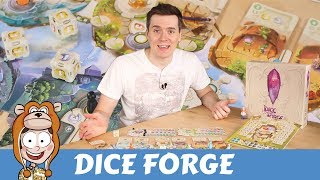
Across the channels that have covered it, Dice Forge draws a consistent reaction: the dice-crafting hook is the thing everyone wants to talk about. Actualol frames it as a deck-building game with the deck swapped out for a pair of customizable dice, and calls the result immediately appealing, comparing the joy of snapping new faces onto the dice to the satisfaction of building up a hand in Dominion or Clank. Adam in Wales - Board Game Design lands in a similar place from a different angle, describing Dice Forge as a strange but genuinely innovative game, one of the first to make the dice-swapping idea work as a real strategy game rather than a gimmick.
Where the channels diverge is on how much the luck of the roll should worry a player. Actualol treats the swinginess as part of the appeal, arguing that the uncertainty of whether an expensive upgraded face will ever come up is what makes each roll tense and satisfying. Adam in Wales - Board Game Design is more guarded, calling the game quite luck-based and predicting that the swinginess of it, along with the fiddliness of popping dice faces on and off, will turn some players off even while enjoying it themselves. On Rolls in the Family, one of the hosts had only just tried Dice Forge for the first time and came away enthusiastic, describing the play session as a lot of fun and comparing the feeling of the shared, simultaneous rolling to Space Base, a game the hosts already knew well.
Core Mechanics That Define Dice Forge
Building and Upgrading Your Dice
Every player starts with two dice and an inventory for tracking gold, points, and other resources. On a turn, all players roll their two dice at the same time and add whatever they generate to their own inventories, a detail both Actualol and Rolls in the Family single out because it keeps everyone engaged rather than waiting through other players' turns. Gold earned from rolls can be spent to remove one of a die's existing faces and snap on a new, more powerful one, so the dice themselves change and improve as the game goes on. Adam in Wales - Board Game Design notes that the tradeoff is real: a face added to a die is not guaranteed to ever come up, so a player can sink resources into an upgrade that never pays off, while a cheap face might show up every turn instead.
The Card Market and Resource Spending
Beyond upgrading dice, players spend the resources they roll on cards pulled from a shared display, which grant abilities and victory points, or on other die faces and track extensions. Adam in Wales - Board Game Design describes the purchase of a card as placing a pawn on its space in the display, and if another player's pawn is already sitting there, that player gets their pawn back along with an immediate reward of rerolling their two dice. Rolls in the Family describes a related piece of the board as functioning almost like a worker-placement space, where players move markers to different locations to reach the cards they want, occasionally blocking each other in the process. Actualol adds that a full resource track forces choices too, since gold beyond a player's capacity is wasted unless it is converted through a card or spent on extending the track.
The Dice Forge Experience
Everyone Rolling at Once
Because every player rolls on every turn rather than just their own, Dice Forge plays with a rhythm closer to a shared push-your-luck moment than a traditional turn-based deck builder. Actualol calls this out directly, noting that everyone rolling together and comparing results keeps the table involved throughout, and that the game never drags as a result. Rolls in the Family echoes this, with one host describing the constant rolling and immediate excitement of a good result as a lot of fun, and drawing the comparison to how every player stays invested on every turn in Space Base.
Short, Tense Rounds
Reviewers agree the game moves quickly once it gets going. Actualol describes Dice Forge as going by in a flash, with the dice only just starting to feel powerful when the game suddenly ends, leaving a sense that there was never quite enough time to use everything a player built. Adam in Wales - Board Game Design similarly points to a fairly short overall time frame, while stressing that within that short window there are real, nagging decisions to wrangle over, like whether to spend scarce shards now or hold them for a better purchase later.
What Makes Dice Forge Stand Out
A Genuinely New Twist on a Familiar Structure
Both Actualol and Adam in Wales - Board Game Design frame Dice Forge as something new built on a familiar skeleton. Actualol pitches it directly as a deck-building game with dice standing in for cards, and says the switch brings more joy than plain deck building managed for them. Adam in Wales - Board Game Design goes further, arguing that while other games had experimented with snapping new pieces onto dice before, Dice Forge is the first to turn the idea into an interesting strategy game rather than a novelty, and expresses hope that strong sales will lead to expansions that develop the system further.
Production Values and Table Presence
The physical quality of the game comes up unprompted in more than one review. Actualol praises the artwork as glowing with color and polish, the dice as chunky and showing no wear, and even the market board's recessed slots for storing spare faces as a thoughtful touch, adding that the included insert was clearly made with care. Adam in Wales - Board Game Design goes as far as calling the insert the best they have ever seen, and points out that the game is very affordable for what ends up in the box.
Potential Drawbacks
Luck Can Overrule Planning
The randomness that makes rolling exciting is also the game's most repeated criticism. Actualol is upfront that there is more luck in Dice Forge than in a typical deck-building card game, since a face a player paid heavily to add to their die is never guaranteed to actually come up. Adam in Wales - Board Game Design agrees the game leans luck-based rather than purely strategic, and warns that the swinginess of results, combined with the fiddliness of clicking dice faces on and off and occasionally losing a piece, will be enough to turn some players away even if others enjoy that same unpredictability.
Limited Content Out of the Box
With only two sets of cards included, Actualol suggests the base game can start to feel a little same-y over repeated plays and is ripe for an expansion to mix things up. Adam in Wales - Board Game Design shares that hope, framing Dice Forge as a strong starting point for a system that could get considerably more interesting once expansions arrive, which implies the base box alone may leave players wanting more variety than it currently offers.
If You Enjoy Dice Forge
Actualol frames Dice Forge as what a deck-building game like Dominion or Clank could feel like if dice replaced the deck, and looks forward to future games that blend dice crafting into bigger systems the way those games handle cards. On Rolls in the Family, the comparison lands on Space Base, with a host noting that the shared, simultaneous rolling and the sense that every player stays invested on every turn reminded them of that game directly.
What Reviewers Are Saying
"I've been pleasantly surprised by Dice Forge. The dice crafting system is simple, effective, and brings me more joy than plain deck building ever did. I'm always looking for games that I can use to show non-gamers how far board games have come, and this is a brilliant showpiece."
— Actualol
"I enjoy dice rolling. I love the aesthetic of the game and love the tactile nature of clipping the pieces onto the side, and there are clever luck mitigation aspects in it. The insert in the game is the best insert I've ever seen, and the game is very affordable for what you get in the box."
— Adam in Wales - Board Game Design
"It was so much fun, a really enjoyable experience. It reminded me a little bit of Space Base, a game that both of us enjoy."
— Rolls in the Family