






Drop Drive Deep Dive
What the Community Thinks About Drop Drive
Drop Drive has captured the imagination of board gamers across multiple reviewer channels, praised consistently as a refreshing, tactile experience that blends spatial strategy with deliberate chaos. Reviewers across casual and enthusiast communities describe the game as "an absolute blast" and note its ability to appeal to both families seeking accessible fun and players craving strategic depth. The consensus centers on the game's unique mechanical innovation and the satisfaction of its core dexterity system, which reviewers frame as the heart of the experience.
Core Mechanics That Define Drop Drive
The Procedurally Generated Universe Through Dropping
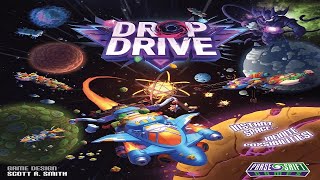
At Drop Drive's heart lies its signature Big Bang mechanic, where players gather all components and drop them onto a central sun, scattering asteroids, planets, and pirates across the play area to create a galaxy that has never existed before. Reviewers emphasize how this mechanic ensures no two games feel identical. One reviewer describes it as "recreating the Big Bang," noting the theatrical appeal of the moment when components rain down and settle into their random positions. The sun itself serves as both a thematic centerpiece and a practical boundary that shapes where resources land and how movement flows. This procedural generation directly addresses a common design challenge: how to maintain exploration feel and discovery in a tabletop game where the board state is typically known to all players.
Ship Upgrades and Personalized Exploration Strategies
Each player's spaceship evolves through the game via the explore deck, which yields passengers, specimens, and upgrades that physically attach to their ship cards. Reviewers highlight the joy of this expansion mechanic, noting how your vessel transforms from a simple starting configuration into something uniquely yours. One reviewer observed their ship becoming "the venomous Majestic expansive Queen," illustrating the naming convention that grows with each upgrade. These ship modifications directly affect gameplay: a gas extractor gives bonus credits for selling white asteroids; a flick drive allows you to teleport your ship rather than drop it; passenger-bonus cards reward you for delivering specific NPCs to their destination planets. The asymmetry created by different starting ships, captain abilities, and acquired upgrades means players follow divergent paths to victory, reducing the "everyone's doing the same thing" fatigue that can plague shorter games.
The Drop Drive Experience
A Tactile, Fast-Paced Gameplay Loop
Reviewers consistently praise Drop Drive as a highly tactile game where you are "actually playing with the pieces," not just moving tokens on a printed board. Each turn, you move your ship using a nav tool, a physical line that extends from your ship to show your movement range, which can vary in length and wiggle depending on your upgrades. When you want to quickly teleport to a distant part of the galaxy, you spend fuel to drop your ship from above the board and attempt to land it near targets you want to reach. This dexterity element creates moments of genuine tension and excitement: will your fuel canister drop where you intended? Will your ship land close enough to gather that salvage? Reviewers note the game flows quickly, typically completing in 45 minutes to an hour, making it ideal as either a main event or a palette cleanser between heavier games. One reviewer explicitly framed it as "a beer and pretzels game," acknowledging its social, low-stress character despite the strategic choices.
Emergent Chaos and Cooperative Potential
The game supports both competitive and collaborative interaction through a clean encounter mechanic. When ships meet, players can choose hailing frequencies (mutual cooperation to each grab nearby cargo) or armed conflict (a die roll determining whose ship takes damage and loses cargo). Anomalies introduce wild cards: space mines that players can flick at each other, wormholes that instantly teleport ships, Dyson spheres that grant permanent fuel upgrades. Reviewers highlight how the anomaly system adds unpredictability and keeps the game from feeling like a pure optimization puzzle. One reviewer observed that despite the presence of pirates and combat, "you're not losing pieces permanently" and the game leans toward a race to acquire and sell resources rather than direct elimination. This lightness of consequence, combined with the option to pursue peaceful trade, makes Drop Drive welcoming to families and casual groups while still offering enough tactical depth for experienced players to engage with optimal routes and resource timing.
What Makes Drop Drive Stand Out
Sandbox Design That Respects Player Creativity
Drop Drive explicitly markets itself as a sandbox game, and reviewers appreciate how the rulebook acknowledges this philosophy. The core game is brief, but the box includes multiple expansions (described as "mini micro-expansions") that add edge worlds, wormholes, space mines, and alternate planets. Reviewers note that you can mix and match these modularly, or play a longer extended game by increasing the number of market tokens required to end the game. One reviewer noted the freedom you have to "really make a bigger bigger planet" by adding walls to expand the play area if desired, adjusting the exploration feel. This design philosophy means Drop Drive can serve as a filler game for experienced groups or a richer experience for those seeking more table time, all from a single box.
Asymmetrical Setup and Replayability
Reviewers emphasize the asymmetry that emerges before the game even begins. Each player selects a captain with a special ability (extra specimen slot, bonus credits for passengers, or extra movement flexibility), then draws two half-ships that form their starting vessel. The captain abilities stack with the ship configuration, ensuring that no two starting positions are identical. Combined with the randomized component drop, the random asteroid deliveries players encounter, and the explore deck draws, reviewers suggest you could play the same player count configuration many times without experiencing identical gameplay. One reviewer remarked on how the mix of strategic planning (where to position for planets) and chaotic execution (dexterity of drops and navigating anomalies) creates moments that feel simultaneously tactical and improvised.
Potential Drawbacks
Holographic Component Storage and Setup Friction
Several reviewers noted that while the holographic sleeves holding certain mini-expansion tokens are visually striking, they create awkward storage. One reviewer stated the packaging "feels a little weird" when you have many tokens and upgrades to organize between plays. Setup and teardown involve managing tokens, asteroids, and the various deck piles, though reviewers acknowledged this is not egregious compared to other modular games. For groups prioritizing quick table reset, this may be a minor friction point.
Anomaly Rule Clarity and Extended Play Fatigue
Reviewers occasionally referenced the need to consult rules for specific anomalies, particularly custom rules for anomalies like the faint signal. The rules are textual rather than graphically clear in places, and some anomalies reference custom rules modules that players may not have unlocked yet. Additionally, while the fast base game is praised, reviewers indicated that if you play the extended version with all modular additions, the game can feel repetitive once you've learned the core loop, since you're repeating the same "move ship, deliver cargo, visit planet" cycle for longer. One reviewer explicitly suggested the base game shines as a quick filler and that adding expansions is a way to extend engagement rather than fundamentally change the experience.
If You Enjoy Drop Drive
If Drop Drive has captured your interest, consider exploring Dungeon Drop, the fantasy predecessor that pioneered the dropping mechanic with dungeon delving and monster combat. Reviewers note that Drop Drive takes the "chaotic fun" of Dungeon Drop to the next level with more strategic depth, ship personalization, and a clearer theme, though both games share the tactile dexterity core that makes them memorable. Rattle Battle Grab the Loot offers an alternative dexterity experience with similar flicking and rolling mechanics in a pirate setting, though reviewers indicate Drop Drive's sandbox philosophy and modular expansion system give it more long-term flexibility. Both comparisons are framed by reviewers as different expressions of the same mechanical DNA rather than direct replacements.
What Reviewers Are Saying
"taking the chaotic fun of Dungeon Drop which came before this to the next level this pickup and deliver game in space is an absolute blast"
—Watch It Played
"the coolest thing to me is the nav tools and using them to move around the board but also using it for your drop drive to get inside of a new area of space so that you can explore it"
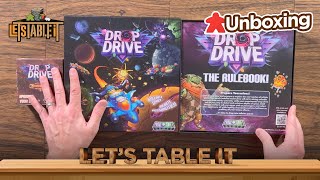
—Let's Table It
"Today, we invite you to join us in a journey across a galaxy haphazardly scattered with asteroids, resources, and random encounters as we play Drop Drive, designed by Scott R. Smith and published by Phase Shift Games, who helped sponsor this video. We'll gather our crew and prepare to explore the vast reaches of infinite space in this lightweight sandbox game for two to four players that plays in 45 minutes to an hour. There's planets to visit, pirates to fight, and an entire randomized universe to explore as we discover why one good turn of Drop Drive deserves enough."
—Game Night Picks - Pair Of Dice Paradise