







Electropolis Deep Dive
What the Community Thinks About Electropolis
Electropolis, the 2019 city-building game from Homo Sapiens Lab, earns a generally favorable response from the reviewers who have covered it. The praise centers on its tile puzzle and its tight decision-making, while the criticism tends to focus on how punishing its pollution system can feel and on the plainness of its visual design. Board Gaming Ramblings is one of the most enthusiastic voices. One of its hosts describes the game as one of their favorite city-building titles, and both hosts placed Electropolis on their underrated lists. When the channel later revisited its 2019 favorites, it kept the game on the list as a lighter title that still offers a lot of depth.
The BoardGameGeek podcast panelists were also positive. One called the game a great puzzle that they really enjoyed, and noted that it is pretty basic to look at compared with more visually striking titles. Alex of Might I Suggest A Game placed Electropolis at number ten on their list of the best board games by Asian designers, praising its pairing of a tricky tile placement puzzle with clean artwork. Watch Review describes the game as a balancing act between generating electricity and keeping public support high.
Core Mechanics That Define Electropolis
Tile Drafting Through Turn-Order Bidding
The defining decision in Electropolis is how many tiles to take. Watch Review explains that all of the tiles are arranged in a circle, and that each player bids for the number of tiles they want in turn order. The more tiles a player wants, the later they act, and the fewer they want, the earlier they choose. BoardGameGeek describes this as betting on how many tiles you will draft, and Board Gaming Ramblings highlights the trade-off directly: an early pick gives you the pieces you need, while a late pick means choosing from whatever the earlier players left behind. Reviewers agree that the weaker tiles are where the pressure lies, since a player who ends up stuck with unwanted buildings can see a turn-order gamble go badly.
Card-Gated Tile Placement and Adjacency
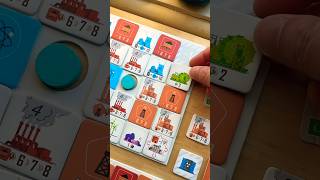
Placement is where reviewers see the puzzle come together. Tiles have to be built next to one another, and the development cards a player drafts determine which region of the city board they can build in. Watch Review notes that these cards also carry the special abilities and resources that make a turn worthwhile. Board Gaming Ramblings adds that the card played in a given round decides the sector available for building, so a tile drafted for one area can become useless once the round points elsewhere. A player who drafts third may find that the neighbors they planned around were already taken by earlier players. BoardGameGeek points out that the city hall tile helps a player win approval from the public, which adds another layer to every placement decision.
The Electropolis Experience
A Solitary Puzzle Built on Your Own City
Much of the feel of Electropolis comes from building your own city and optimizing it in private. Board Gaming Ramblings describes the play as a lot of puzzling, with the rules staying simple while the choices stay demanding. Reviewers repeatedly return to the satisfaction of arranging tiles so that everything fits, and to the frustration when a planned adjacency falls apart because the cards in hand point to a different sector. The result is a tableau puzzle that feels personal even though players are drawing from the same shared supply.
Interactive Pressure in the Shared Tile Market
Interaction arrives through the draft. Because every player competes for the same tiles, the choice of what to take often depends on what others might leave behind. Board Gaming Ramblings describes the dilemma of whether to take the exact tile a player wants or simply take more tiles and accept the risk of weaker options. Turn order shifts with each bid, so the pressure to act early or late changes from round to round. Reviewers describe this constant reshaping of the available market as a dynamic counterpart to the solo puzzle of the city itself.
What Makes Electropolis Stand Out
A Tight Puzzle That Fits Into a Short Session
Board Gaming Ramblings praises how much game Electropolis delivers in a modest amount of time, describing the rules as very simple and the playtime as not especially long, yet the decisions carry real weight. The channel summarizes the design as low complexity with high depth, and says that players get a lot of play in a short session. That combination is why Board Gaming Ramblings holds Electropolis up as a model of how much weight a simple ruleset can carry.
Thematic Energy Decisions
Reviewers also single out how closely the game's choices mirror real-world energy planning. Players choose among coal, gas, nuclear, and green energy, and each choice carries consequences for the city. Alex of Might I Suggest A Game says the design includes many thematic elements that feel like the decisions a real city would face. Alex reports losing a game to a partner who stacked nuclear and green energy, a lesson about how the system rewards balance. Watch Review frames the same tension as the core of the experience, where the most electricity is only worth having if public support and pollution stay in check.
Potential Drawbacks
A Punishing Pollution Balance
The pollution and approval system draws the most criticism. BoardGameGeek explains that players must secure approval from the public for the pollution they generate, and that overpolluting without enough approval costs a large number of points at once. Board Gaming Ramblings notes that it is difficult to pursue your goals without taking some damage along the way, because the drafting and placement constraints push you toward compromises. Board Gaming Ramblings also points out that the draw of tiles can produce negative pieces late in the game, which can turn a lucky late pick into a liability. Players who are new to the system may find this balance harsh before they learn how to avoid it.
Plain Visual Presentation
Opinions on the art are more mixed. The BoardGameGeek panelist found the game pretty basic to look at, and argued that Asian games often give no visual hint of how they play, in contrast to the cozy or dark art common in Western releases. Alex, by contrast, praised the clean artwork as part of what makes the game appealing. Readers who prioritize striking illustration may find the presentation underwhelming, while those who value clarity may appreciate the readable tiles and boards.
If You Enjoy Electropolis
Players who appreciate Electropolis's energy-production choices and its tile-placement depth may want to explore Power Grid, which also asks players to balance power plant investment against a shared resource market. Those drawn to the city-building puzzle and the satisfaction of optimizing a personal tableau may find Ark Nova a rewarding next step, since it similarly rewards careful planning of how each piece fits into your own build. Both titles share the feeling of a tight, decision-heavy engine that rewards foresight, the same quality reviewers describe in Electropolis.
What Reviewers Are Saying
"It's super tight. It's pretty difficult to do the things you're trying to do without doing a lot of bad stuff on the way because you're drafting tiles, but the more tiles you decide to take, the later you will be in the drafting."
— Board Gaming Ramblings
"Electropolis pairs a tricky tile placement puzzle with some really clean artwork but my favorite part about it is that it has a lot of thematic elements that really feel like they mirror the decisions you'd have to make in a real city."
— Alex, Might I Suggest A Game
"I really like it. I have to go and hunt copy down because it's such a good game. It's a great puzzle and I really enjoy it."
— BoardGameGeek