




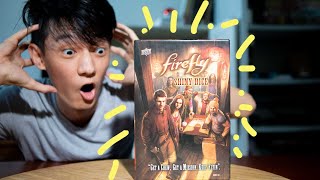

Firefly: Shiny Dice Deep Dive
What the Community Thinks About Firefly: Shiny Dice
Firefly: Shiny Dice divides reviewers sharply. One seasoned board game critic calls it the worst published game they have ever played, awarding it a 1 out of 10 after struggling through multiple sessions. Yet casual gaming communities see it differently. Reviewers at Gen Con described it as an accessible "coffee shop game" that teaches quickly and moves fast, praising its easy-to-learn appeal for players unfamiliar with modern board games. The disconnect is real: this same game feels like tedious solo play to one audience and like casual fun to another. What explains the gap is less about the game's theme than about what happens when push-your-luck mechanics meet a rulebook that confuses rather than clarifies.
Core Mechanics That Define Firefly: Shiny Dice
Push Your Luck
The core tension of Firefly: Shiny Dice revolves around a single question each turn: do you bank your points and stay safe, or do you push for more and risk losing everything? After rolling your dice and organizing them into crew and cargo, you draw a mission and decide whether to complete it. If you defeat all five foes arrayed against your ship, you survive the round and score points. But here is where luck comes in. You can choose to go again, rolling the same dice (minus the ones knocked out by foes) and risking your accumulated points on another round of combat. The more rounds you push, the fewer dice you have to work with, narrowing your odds of survival. Do you pull out after round one and pocket your gains, or do you press your luck and chase the higher payouts waiting in round two or three?
Dice Rolling
Every action in Firefly: Shiny Dice flows from rolling 15 dice and reading their results. Seven represent your crew (each with a unique Firefly character and special ability), three are passengers, and five are bad guys. Rolling generates all the information you work with. Your crew faces three nemeses from the show: Niska, who kills; Saffron, who captures crew and passengers; and Badger, who hoards your supplies. Resolving each round means checking whether your dice match up to defeat the foes before they knock out your crew or steal your cargo. The dice mechanic is straightforward to execute but dense to track; with 15 dice bearing multiple symbols, the moment between rolling and organizing can feel more like busywork than drama.
The Firefly: Shiny Dice Experience
Casual and Approachable
Board to Death TV demonstrated the game at Gen Con to mixed crowds and found that newcomers embraced it immediately. The game teaches in five to ten minutes, and once the core loop clicks, play flows. It is the kind of game you can teach over coffee, enjoy in a half hour, and move on. That accessibility is a genuine strength. Players do not need years of hobby board game experience to understand what they are doing or why. The theme of captaining a ship and pursuing missions creates an immediate narrative hook, even if you are just rolling dice and comparing symbols.
Isolated and Tedious
Yet for players expecting meaningful interaction or decision-making, Firefly: Shiny Dice becomes a study in loneliness. One critic noted that the game is "solitaire to the utmost extreme." Players do not affect each other except through a single mechanism: rolling four of a kind causes an opponent to lose points. Everyone else simply waits while the active player spends several minutes organizing 15 dice, consulting the rulebook to parse mission jargon, and determining what can be defeated. The downtime is substantial relative to game length, and since there is nothing to plan or react to while waiting, the waiting simply drags. Combined with a mission system that often feels random and punitive, the experience can shift from fun to exhausting.
What Makes Firefly: Shiny Dice Stand Out
Premium Components and Thoughtful Presentation
Open the box and the game feels like a polished product. The dice are multicolored with clear engravings and roll beautifully across the included rubber play mats, which have raised sections to organize crew, passengers, and bad guys. The player screens include quick reference guides and hide point cards from opponents. Everything fits back into the box with care. These are the kind of component touches associated with games two or three times the price. It is worth noting that only two play mats are included for a game intended for up to five players, a cost-cutting choice that reviewers found frustrating. Still, what is there is well-made.
Thematic Crew Abilities Grounded in Character
The game includes crew members from the Firefly series, each with an ability that echoes their role in the show. Mal can target Saffron, in a callback to their antagonistic history. Jayne can destroy an entire foe at extra cost, fitting his role as the fighter. Zoe is versatile and can handle multiple threats. This attention to character consistency is one of the few places where the Firefly license elevates the experience beyond a generic dice game. Reviewers who knew the show appreciated the flavor, and it gave the abstract roll-and-resolve loop a narrative anchor, even if that anchor was thin.
Potential Drawbacks
A Rulebook That Obscures Rather Than Clarifies
Learning Firefly: Shiny Dice from the included rulebook is described as consistently unclear. The rulebook lacks diagrams for setup or the turn sequence, offers no visual aid for how combat plays out, and does not define the jargon it uses. Missions reference terms like "Sabotage," "Bushwhacked," and "Gorram," none of which are explained on the player aids, forcing frequent trips back to the rulebook. For a game sold as easy to learn, this is a significant friction point, and reviewers noted that a designer-provided tutorial is almost mandatory to start playing at all.
A Weak Push-Your-Luck Economy
A push-your-luck game needs to make you want to push: you should face a real choice, not a foregone conclusion. Reviewers found that Firefly: Shiny Dice struggles here. Facing five foes each round, and losing dice to pay crew abilities and absorb hits, players are often left with too few dice to meaningfully continue by round two. The randomness of mission cards compounds this; some missions feel thematically inconsistent or lean too heavily on luck rather than decision-making, and the inflexibility of what counts as a win can make pushing your luck feel like a losing proposition rather than a thrilling risk.
If You Enjoy Firefly: Shiny Dice
The most direct comparison from reviewers is Deep Sea Adventure, where you push deeper into the ocean for better treasure but risk drowning. Incan Gold offers a similar dynamic: stay in the expedition and collect rewards, or pull out and secure your gains while other players chase more. Both games layer player interaction on top of push-your-luck tension, forcing you to read your opponents and second-guess their next move. If you are drawn to the simplicity of Firefly: Shiny Dice but want the player interaction it lacks, those two games deliver a similar risk-reward loop with the social element baked in.
What Reviewers Are Saying
"This right here is the worst published game I've ever played. Looks half decent, right? Firefly shiny dice, get a crew, get a mission, keep flying. But we will learn that this is a dice rolling pusher luck game without much pusher luck."
— Shelfside
"This is your coffee shop game. You're hanging out with friends, real easy to learn, and you just get done with the game. And if you have five hundred friends you can do the one game and just pass the dice around. It just takes forever to get around five hundred people."
— Board to Death TV
"I'm so bored. This was featured on the very first video on our channel, an unboxing. And then when we actually got to read the rulebook we're like, wait, I don't think we should review this. Fast forward to now, I have finally finished my first actual game of firefly shiny dice, multiplayer and single player, and I was pretty much just bored the whole way through."
— Shelfside