






Forgotten Depths Deep Dive
What the Community Thinks About Forgotten Depths
Forgotten Depths has earned a devoted following among tabletop RPG and dungeon crawler enthusiasts, particularly from the Dungeon Dive channel, which has covered the game extensively across multiple reviews and top-10 lists. The community consensus is clear: this is a standout game that brings genuine novelty to a well-trodden genre. Reviewers consistently describe it as one of the best dungeon crawls ever made, with praise extending far beyond simple mechanical competence. What sets Forgotten Depths apart is how reviewers feel while playing it, not just what they do. The game creates a sense of wonder and exploration that few dungeon crawlers achieve. Players describe a "dream-like" or "Otherworldly feel" that permeates every aspect of the experience, from the moment you open the box to the final confrontation in the depths.
Core Mechanics That Define Forgotten Depths
Tile Placement
The tile placement system in Forgotten Depths transforms exploration into a puzzle-like experience rather than a sequence of random encounters. Players lay down tiles to build the dungeon map, but the challenge is finding where to place each tile so that the edges connect properly. This is not routine; it is dynamic. You can spend 10 or 12 cards building out the floor before you are forced to encounter anything, and when you do need to encounter something, it is your choice what to interact with and in what order. Blocking elements like monsters, doors, and features force decisions about sequencing. The genius lies in this blend of randomness and player agency. As you lay tiles, you are also searching for specific node shapes that unlock special discovery locations granting extra rewards and lore. These shapes grow more complex and harder to find as you progress deeper into the dungeon, creating a natural difficulty curve through environmental storytelling rather than stat inflation.
Combat
Combat in Forgotten Depths plays from a small, symmetric deck of cards held by each player and the enemy. Heroes commit to their attacks first, revealing two cards from their hand. The enemy then plays cards, and the resolution follows a strict hierarchy: blocks (matching numbers), enemy hits (enemy higher), and hero hits (hero higher). What makes this system compelling is the constant push and pull of damage. When you play a higher-value card, you deal more damage but take counter-damage equal to the difference. Overcommitting to a powerful attack leaves you vulnerable. This creates meaningful tension in every exchange, and every character has special abilities tied to their block triggers, adding another layer of player choice. The combat keeps excitement high without relying on dice rolls, giving players real tactical decisions while maintaining narrative tension.
The Forgotten Depths Experience
Exploration and Discovery
The overwhelming sense of exploration defines Forgotten Depths. This is a game fundamentally about mapping an unknown world, about discovering its secrets, and about piecing together its history. Reviewers consistently highlight how the exploration mechanics reinforce this thematic core. As you build the dungeon tile by tile, you are not moving from encounter to encounter; you are revealing a landscape. The discovery cards represent real moments of wonder, those instants when you stumble upon something legendary. Each ecology (dungeon level) tells a story through its encounters and points of interest without forcing you to sit and read lengthy flavor text. The art on every card contributes to this atmosphere of finding something strange and wondrous in a dying world.
Otherworldly Atmosphere
Marian Churchland's art creates a soft, muted visual language that sets Forgotten Depths apart from the bombastic, grimdark aesthetics that dominate dungeon crawlers. The illustrations employ watercolor techniques with clean lines, evoking a French comic book sensibility. Creatures are rendered with an unsettling beauty: walking tables with six legs, emaciated demons, dog-sized bronze scorpions. This is a world that mixes science fiction and fantasy, a setting that feels dying and alien all at once. The art does not assault the senses; it invites exploration. Combined with how the game unfolds through player action rather than narrative exposition, this creates an atmosphere where every moment of play feels like you are discovering something in a real, tangible world.
What Makes Forgotten Depths Stand Out
Unique Treasure System
Each character has their own custom treasure deck containing gear and items specifically tailored to that hero. When you discover a treasure chest, you choose which character draws from their deck. This ensures every treasure is relevant and useful, eliminating the frustration of finding a sword when you are playing a wizard. It also makes treasure placement a genuine strategic decision in multiplayer games. The treasure system extends to character progression. As you level up, each character can learn unique abilities from their own ability deck, and weapons can be upgraded by replacing combat cards with treasure-based variants. This layered system of personal progression means each character builds differently, feels different to play, and rewards players who invest in their heroes across multiple runs.
Thematic Expansions
The three expansions released for Forgotten Depths demonstrate design integrity. The Camp Dialogue expansion is pure narrative, offering conversation cards between character pairs that fire when resting at campfires. The Vault of Yar adds both story (history lore cards) and a sub-dungeon to explore. The Ever Chamber introduces a new biome that connects to all three main dungeons, letting players create custom routes through the world. Reviewers highlight how these expansions feel organic extensions of the design rather than mechanical bolts-on. They offer optional depth; you can play the game countless times with just the base experience or layer in additional complexity and narrative. This modularity respects both players who want stripped-down dungeon diving and those hungry for world-building and story.
Potential Drawbacks
Availability and Cost
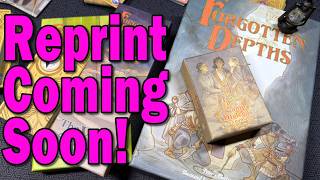
Forgotten Depths was out of print for a period, making copies difficult and expensive to find on the secondary market. Reviewers mention this with genuine frustration, as a great game sitting behind a paywall serves no one. The good news is that the game has been picked up by a new publisher, with a second edition delivering a significantly smaller box (roughly the size of Legends Untold or Rogue Dungeon) and a redesigned rulebook that halves the size of the original. The new edition addresses production complaints while keeping the game intact, but the reprint underscores how availability affected the game's reach in the community.
Rules Learning Curve
While not excessively complex, Forgotten Depths has enough moving parts that it is not a pick-up-and-play game. The tile placement, node discovery system, experience spending, and combat mechanics form an interconnected web. Reviewers note that the rewritten rulebook for the second edition improves readability significantly, but new players should expect to invest time in learning the game. The good news is that once learned, the game flows smoothly. The mechanics are intuitive enough that players internalize them quickly, and the rulebook is now compact enough to reference easily at the table.
If You Enjoy Forgotten Depths
Fans of Forgotten Depths often compare it to games like Dark Souls, Diablo, Legends Untold, and Rogue Dungeon. The comparison to Dark Souls is particularly apt: like FromSoftware's games, Forgotten Depths creates a sense of discovery through environmental storytelling. You explore, find secrets, gain power, and move deeper into a hostile world with the constant hum of potential danger. The tile placement puzzle aspect draws fans of spatial puzzle games, while the deck-building and character progression appeal to players who love optimizing their builds. If you loved the exploration in Legends Untold, the combat polish of Rogue Dungeon, or the world-building of Stars of Acarios, Forgotten Depths offers a synthesis of what makes each of these games compelling, filtered through a unique lens that makes it feel entirely its own thing.
What Reviewers Are Saying
"Forgotten Depths is different. It's a game with novelty that shines as bright as the sun and it's all the better and more interesting for it."
— Dungeon Dive Daniel
"Everything about forgotten depths is novel. The exploration is novel, the combat, the story, the way the expansions work. It's one of the most novel games that I'm aware of, and all of that novelty works together to create a super interesting and engaging game."
— Dungeon Dive Daniel
"I love just about everything about playing the game and the way it looks and the way I feel while I am playing it."
— Dungeon Dive Daniel